The thesis in one line
Leading approaches in quantum gravity over the past decade have argued that spacetime is not a primitive stage but an emergent construct woven from quantum entanglement. A current, active thread in that program proposes that the observed dark energy — the nearly constant energy density accelerating cosmic expansion — may be the macroscopic imprint of residual entanglement energy in a large-scale entanglement network.
Where the idea comes from
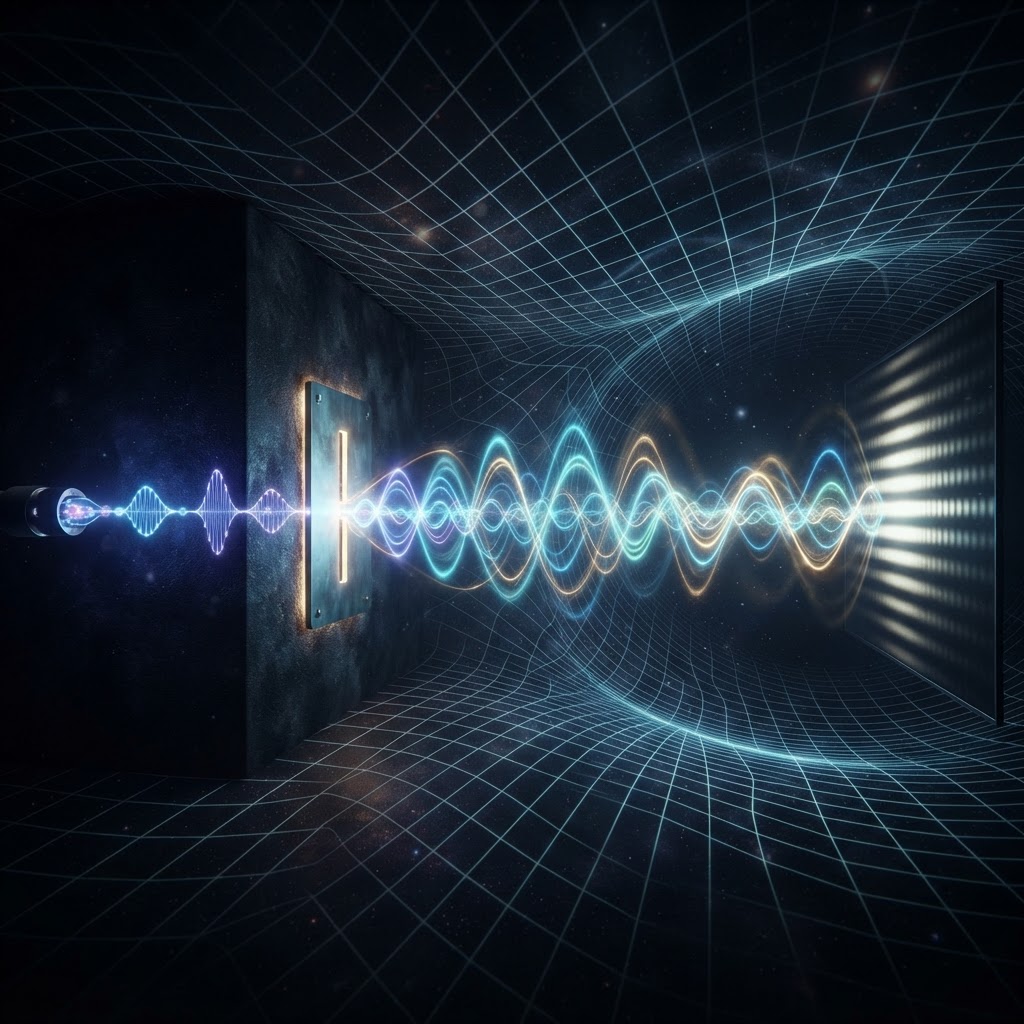
The conceptual scaffold begins with several converging insights. Entanglement entropy appears to encode geometric data in holographic models (think AdS/CFT and the Ryu–Takayanagi relation), and people from Van Raamsdonk to Maldacena & Susskind have argued that classical spacetime connectivity follows from patterns of entanglement. Jacobson and others have shown that Einstein’s equations can be derived from thermodynamic or entanglement-equilibrium conditions. Taken together, these results suggest that when quantum degrees of freedom are organized into a network, their entanglement both builds geometry and contributes a coarse-grained energy density — potentially the dark energy we measure.
How it would work in practice
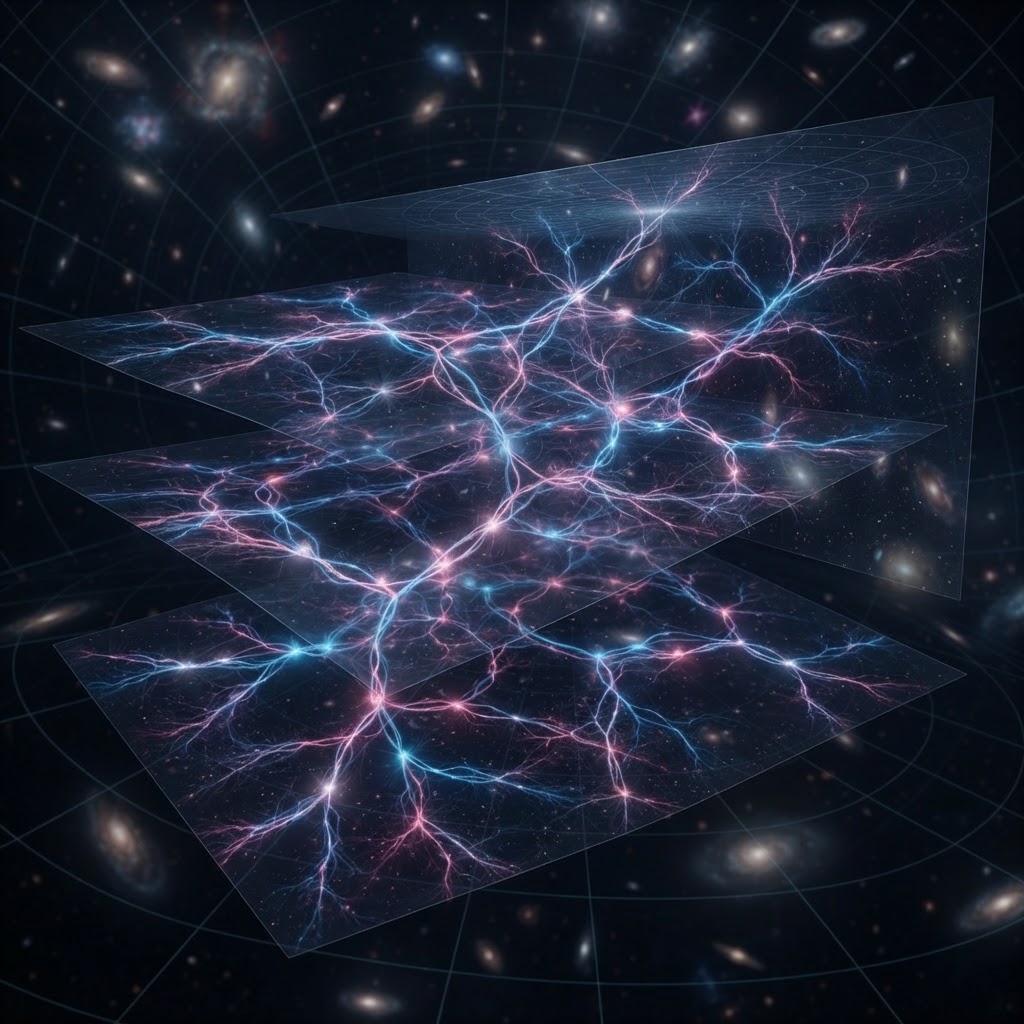
Envision the universe as a large quantum graph: nodes are local quantum subsystems, links encode entanglement. Local changes in entanglement shift the effective geometry; global, irreducible entanglement across cosmological horizons produces a uniform, vacuumlike energy density. Unlike particle-based vacuum-energy calculations that run into enormous UV divergences, the entanglement-network picture attempts to locate the cosmological-constant problem in the quantum-information structure of spacetime — the way entanglement is distributed and regulated by a putative quantum-gravity cutoff.
Why this is timely
Recent years have seen stronger technical control over entanglement measures in relativistic and holographic settings, and more explicit derivations showing how gravitational dynamics can be read from entanglement equilibrium. This has enabled modelers to propose concrete mechanisms by which a small, positive cosmological constant can emerge as a statistical property of entanglement networks rather than as a fine-tuned parameter of a field theory.
What would validate or falsify it
- Observational tests: if dark energy is entanglement-driven, small deviations from a perfect cosmological constant (time dependence of w, scale-dependent signatures in large-scale structure) may appear at percent or sub-percent level — within reach of DESI, Euclid and future CMB surveys.
- Theoretical requirements: a concrete microphysical model must explain how entanglement is regularized to give the observed tiny energy density, and how the same mechanism reproduces Einstein gravity at large scales.
Challenges and the road ahead
The principal hurdle is quantitative: converting qualitative, information-theoretic statements into a controlled calculation that yields the observed value of dark energy without new fine-tuning. There are also deep conceptual knots — defining entanglement in cosmological (de Sitter) settings, regulating UV divergences in a background-independent way, and connecting microscopic network dynamics to standard cosmological perturbation theory. Still, the proposal reframes the cosmological-constant problem into the language of quantum information, which opens new tools and potentially new observables.
In short: treating dark energy as an emergent, statistical property of an entanglement network is not yet a finished theory, but it is maturing into a falsifiable research program that bridges quantum information, holography, and precision cosmology.