Technology & Computation
54 articles
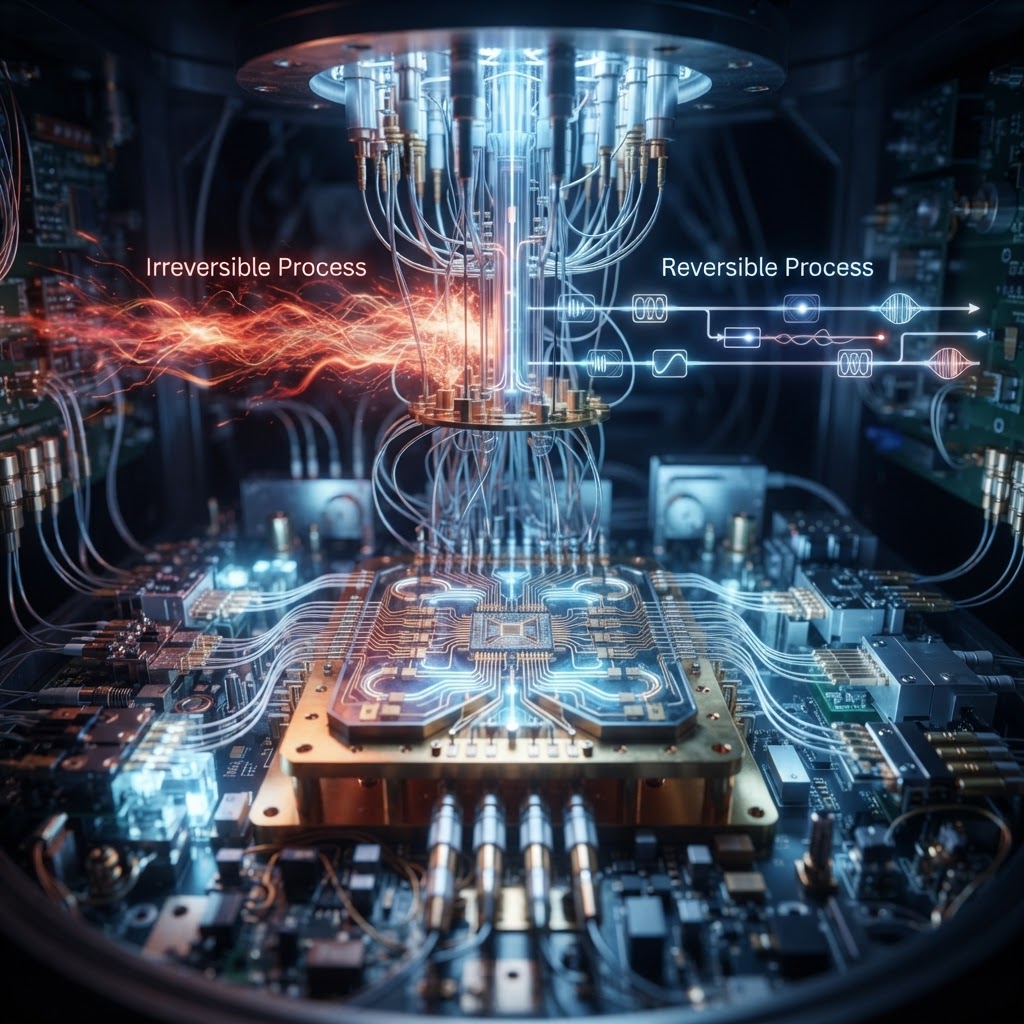
Can Reversible Computing Break the Heat Barrier of Information Erasure?
New experiments and revived architectures sharpen an old claim: avoid erasing information and you can, in principle, escape the kT ln2 energy tax — but engineering obstacles remain.
Neuromorphic Chips Go Sparse: Harnessing Biological Sparse Coding for Energy‑Efficient Intelligence
A resurgence of biologically grounded sparse coding is reshaping neuromorphic architectures, trading dense matrix work for event‑driven, highly selective activity that slashes energy and improves generalization.
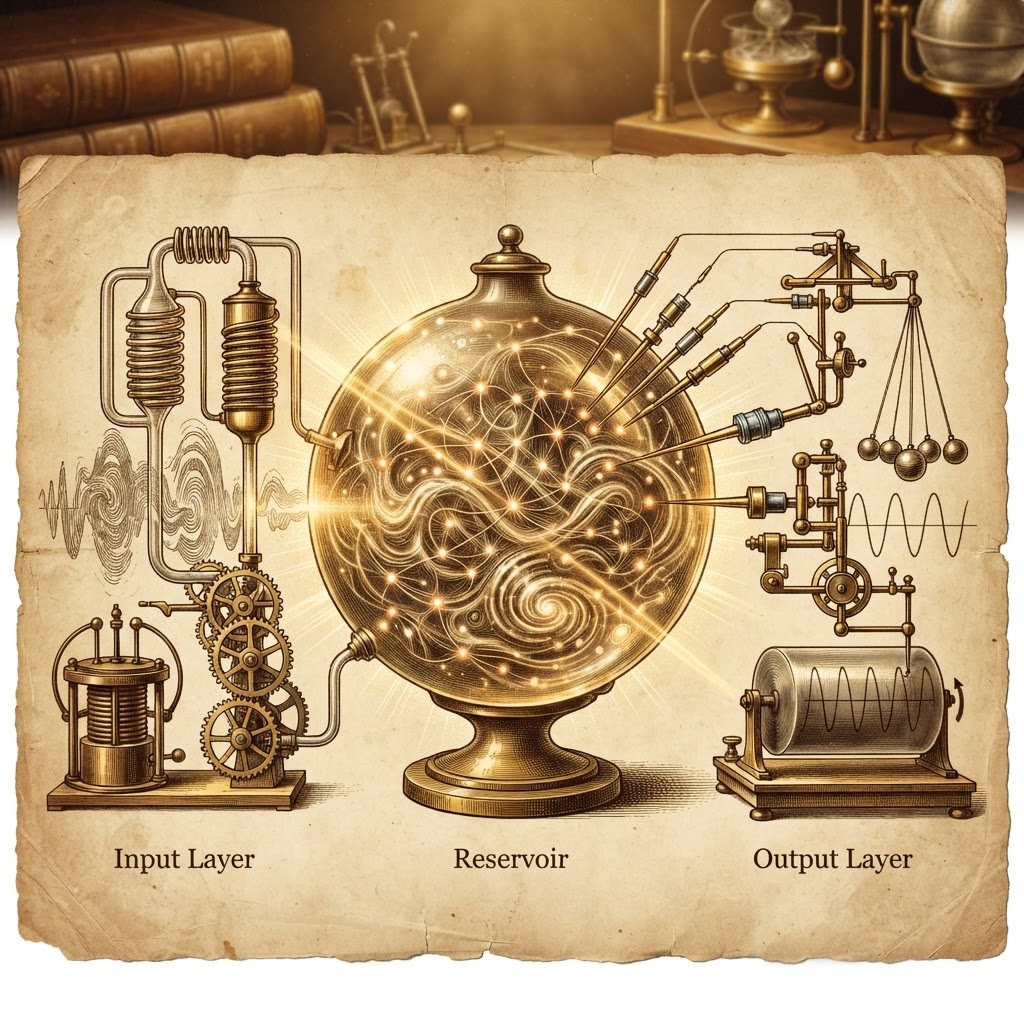
Reservoir Computing: Mining the Dynamics of Physical Systems for Computation
A modest trick — leave the hard dynamics alone and only train the readout — turned ordinary physical systems into surprisingly powerful computers.

Reversible computing narrows — but does not erase — Landauer’s limit
New experiments and theory show logical reversibility can sidestep the kT ln2 cost of erasure in principle, but finite speed, noise and control work keep a hard engineering gap.

The R.A.K.E.R. Initiative: Remembering As Knowledge & Energy Rights
A blueprint for a new robotics standard where the phone becomes the brain, the robot becomes the body, and Assistive Intelligence restores human coherence.

Elon Musk’s Claim: Will Data Centers Move Into Earth Orbit?
A technical review of Musk’s proposal, weighing power, cooling, radiation, latency and launch economics against current research and engineering realities.

High‑Efficiency Solar Thermal Systems Surge with Advanced CSP and Long‑Duration Heat Storage
New receiver designs, high‑temperature fluids and thermochemical storage push concentrated solar thermal toward higher efficiency and dispatchable power — not a wholesale replacement for photovoltaics but a complementary path to decarbonize heat and grid services.

Carbon‑Neutral Aviation Fuels: Progress, Pitfalls, and the Fischer‑Tropsch Deep Dive
Recent advances in synthetic kerosene and Power‑to‑Liquid pathways are promising, but technical, lifecycle and scale constraints mean widespread adoption is years away.

Not a Fifth Spatial Dimension: What ‘5D’ Computer Processing Really Means
Emerging research reframes ‘5D’ as higher-order representational and predictive architectures, not literal spatial ascension.

How Bell Labs' Transistor Rewired the World — and Still Runs It
Seventy-eight years after Bardeen, Brattain and Shockley flipped the switch on the first transistor, that tiny semiconductor junction remains the defining bit of modern technology — even as engineers race to keep it relevant.

Ada Lovelace: The First Programmer — How She Saw Software a Century Early
New archival analysis and modern simulations reinforce that Ada Lovelace did far more than annotate Babbage — she sketched the conceptual architecture of software itself.

When Errors Yield: Quantum Error Correction Thresholds and the Timeline to Fault Tolerance
A small number — the error threshold — separates experiments from reliable, large-scale quantum computation; history shows how we found it and why it still shapes the race to scalable quantum machines.