Introduction
In 1994 Leonard Adleman walked into a laboratory and turned a classical computer science problem into a chemistry experiment. He used short strands of DNA to solve a seven-city instance of the Hamiltonian path problem, demonstrating that chemistry could explore many candidate solutions in parallel. That elegant, counterintuitive experiment launched a field: DNA computing. Today the idea—using molecules to encode and explore combinatorial search spaces—has matured into a multidisciplinary effort combining computer science, molecular biology, and nanotechnology. It remains as intellectually provocative now as when it first appeared.
Origins and key figures
Leonard Adleman is the obvious starting point. His 1994 paper showed how DNA’s natural tendency to form complementary pairs could be harnessed to represent and then filter candidate paths through a graph. The experiment used mixing, amplification and biochemical selection steps to eliminate incorrect paths and recover a correct one. Adleman’s result was not a practical route to beating silicon at chess, but it was a proof of principle: chemical systems can carry out computation.
Richard J. Lipton followed quickly, proposing how DNA might address NP-complete problems more generally, such as SAT. Niles Seeman’s work in the 1980s and 1990s laid the foundation by showing how DNA could be made into predictable nanoscale structures. Erik Winfree crystallized the theory: algorithmic self-assembly, strand displacement cascades, and the relationship between computation, kinetics and thermodynamics in molecular systems. Paul Rothemund’s DNA origami and Qian & Winfree’s strand-displacement circuits later provided the toolbox for programmable molecular algorithms.
Why this felt revolutionary
Classical computation is serialized at the level of transistors, even when massively parallel systems are used. DNA computation introduced a different metaphor: massively parallel chemical exploration. A single test tube can contain 10^14 to 10^18 molecules—trillions upon trillions of candidate solutions—allowing an embodied search of combinatorial spaces that would be infeasible to enumerate on conventional hardware.
Equally significant was the shift in thinking about resources. Where a silicon engineer budgets clock cycles and memory, a molecular programmer budgets reagent concentrations, hybridization energies, and time. The computation happens as much in space (molecular mixtures) and time (reaction kinetics) as it does in logical steps.
How DNA approaches combinatorial optimization
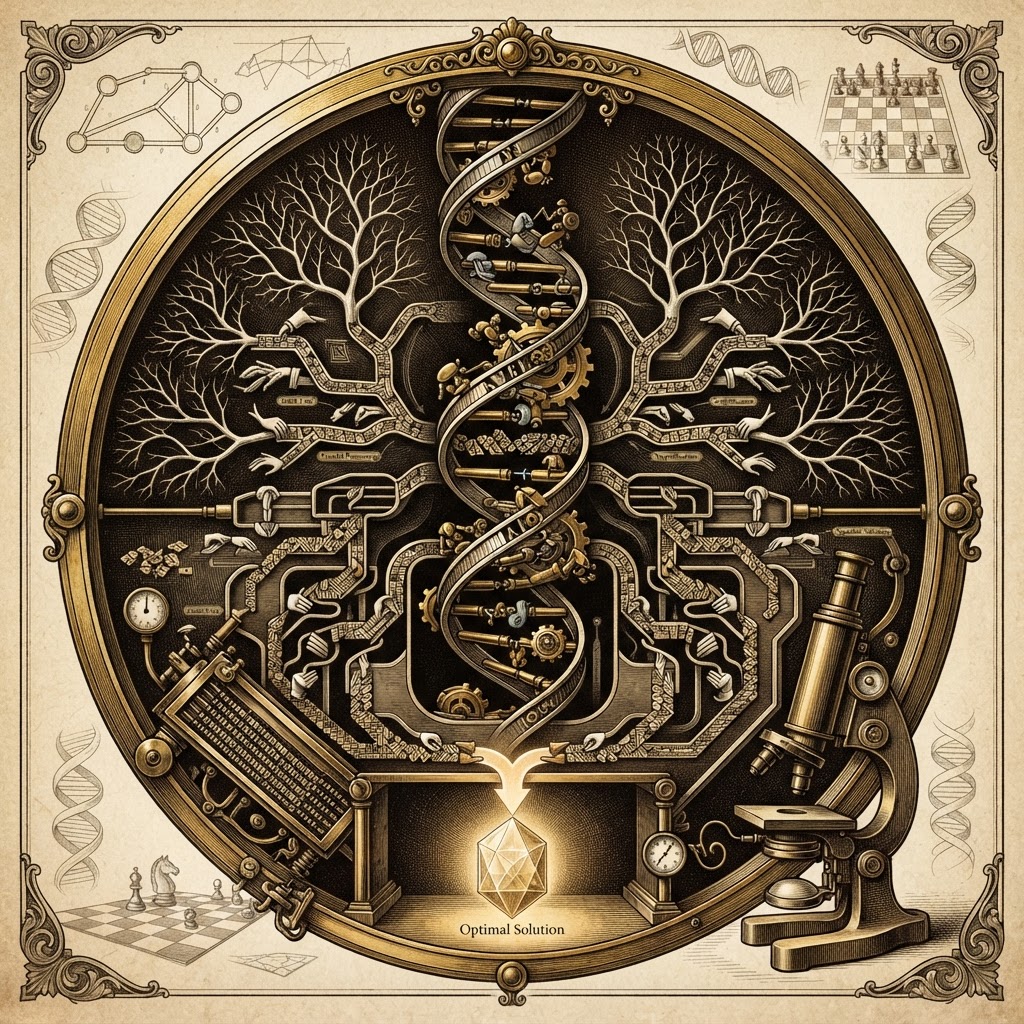
At a high level, DNA computing for optimization maps problem instances to libraries of DNA strands where each strand—or assembly of strands—represents a candidate solution. Through biochemical operations (mixing, temperature cycling, enzymatic reactions, strand displacement), researchers amplify desirable products and remove or suppress incorrect ones. Readout is typically by gel electrophoresis, fluorescence or sequencing.
- Encoding: Items of the solution (vertices, boolean variables, assignments) become oligonucleotide sequences.
- Generation: Combinatorial libraries are synthesized or assembled to represent every candidate.
- Selection: Chemical operations preferentially enrich valid solutions (for example, paths that visit each vertex once).
- Readout: Surviving strands are identified, often by sequencing.
Achievements and limits
Early demonstrations were dazzling but small: solving toy instances of Hamiltonian path, SAT, subset-sum and other NP problems. Later advances produced defined molecular circuits and modular strand-displacement systems that can implement logical and arithmetic operations more reliably. DNA origami and enzyme-free reaction networks have shown impressive control over stoichiometry and kinetics.
Yet practical limitations persist. Error rates from imperfect hybridization and competing reactions grow with problem size. The “massive parallelism” advantage collides with bottlenecks in synthesis (writing inputs), purification, and sequencing (reading outputs). Resource usage can scale exponentially with problem size: you may need more molecules than are physically reasonable. Thermodynamics and kinetics impose time and yield constraints that are hard to engineer away.
Why it matters today
DNA computing reframes our understanding of computation by emphasizing energy, matter, and stochasticity as computational resources. The field has seeded practical technologies: DNA-based sensors, molecular circuits for diagnostics, and hybrid approaches where classical heuristics narrow the search and biochemical systems explore local optima. The marriage of DNA data storage with algorithmic wet labs has also inspired automated labs that can iterate molecular computations rapidly.
Beyond applications, the intellectual payoff is large: molecular computing forces computer scientists to wrestle with real physical constraints and gives chemists algorithmic languages to program reactions. It has informed new thinking about neuromorphic chemical networks and about how living systems compute.
Open questions
The central unresolved question is crisp: can molecular computing—alone or in hybrid architectures—outperform classical methods on real-world, large-scale combinatorial optimization problems in a way that is economically and energetically favorable? Progress will depend on better error correction, scalable read/write technologies, and clever algorithmic mappings that avoid exponential resource blowup.
Conclusion
DNA computing is not a replacement for silicon but an expansion of the computational palette. It is a human-scale reminder that computation is a physical process. The field that began with Adleman’s elegant tubes has grown into a rich dialogue between disciplines, and it continues to push the boundary of what it means to compute in a world of molecules.