Introduction: a shift in how we think about computing
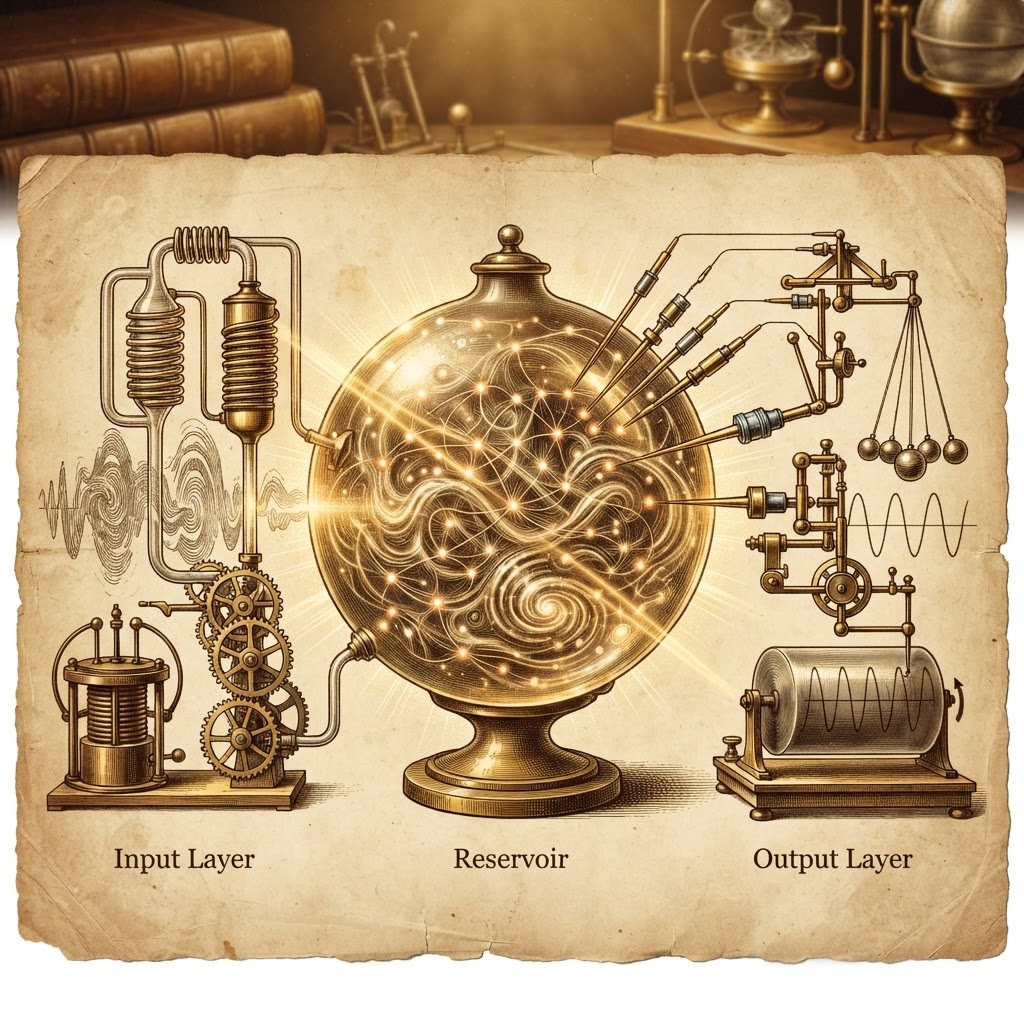
At the turn of the 21st century a simple but radical idea quietly reshaped how researchers thought about temporal computation. Instead of painstakingly training every connection in a recurrent neural network, what if one could exploit the rich, natural dynamics of a fixed—possibly physical—system as a high-dimensional feature generator, and only train a simple linear readout? That approach, now known as reservoir computing, opened a path to fast, low-cost, and hardware-friendly computing architectures that blur the border between algorithm and material.
Roots and early champions
The story has clear pioneers. In 2001 Herbert Jaeger formalized the Echo State Network (ESN), showing that a randomly connected recurrent network, when driven by an input, can create a fading memory of recent inputs useful for prediction if the reservoir satisfies the “echo state” property. A closely related line of work, led by Wolfgang Maass and collaborators (notably Henry Markram and Thomas Natschläger), introduced the Liquid State Machine (LSM) in 2002. Maass framed a powerful theoretical claim: transient responses of a recurrent neuronal network could be read out to perform arbitrary time-dependent computations, making the network a liquid that transforms input streams into separable dynamical patterns.
Why was this revolutionary? Recurrent neural networks were notoriously difficult to train — backpropagation through time struggled with long-range dependencies and vanishing gradients. Reservoir computing sidestepped that bottleneck. The hard, nonlinear dynamics were left intact; only a linear projector learned to map the dynamic state to the desired output. That small change made temporal learning far more tractable and suggested that computation could be delegated to dynamics rather than carefully tuned weights.
Theory: why dynamics compute
Two concepts underpin reservoir computing: fading memory and separation. Fading memory ensures the reservoir’s state reflects recent inputs more than distant past, while separation means different input histories produce distinct states that a simple readout can distinguish. Maass and others proved that reservoirs with these properties can approximate a wide class of time-invariant filters — a kind of universality for temporal tasks.
Subsequent theoretical work quantified the information-processing capacity of dynamical systems and related it to parameters such as nonlinearity, memory depth, and noise. Those results helped explain why certain reservoirs perform well on forecasting, speech recognition, and control tasks: the reservoir both stores temporal context and performs nonlinear expansions that make linearly inseparable relationships accessible to a linear output.
From silicon to light and steel: physical reservoirs
One of the most enduring contributions of reservoir computing has been to inspire computation in physical media. If an abstract recurrent network can be a reservoir, so can an optical cavity, a bucket of water, a memristor array, or a network of spintronic oscillators. Groups led by M. C. Soriano, Laurent Larger, Daniel Brunner, and Ingo Fischer demonstrated photonic reservoirs that operate at gigahertz or faster timescales; others showed that delay-based electronic systems, mechanical oscillators, and nanoscale magnetic devices can all implement reservoirs.
Physical reservoir computing matters because it leverages the material substrate’s intrinsic dynamics instead of fighting them. That can yield orders-of-magnitude speedups and energy efficiencies for certain tasks, enabling ultrafast signal processing, low-power edge intelligence, and sensors that compute where they sense.
The human and scientific context
Reservoir computing sits at the intersection of neuroscience, dynamical systems theory, and engineering. Maass’s background in theoretical neurobiology, Jaeger’s systems perspective, and the later contributions of experimentalists who built photonic and electronic devices created a cross-disciplinary ecosystem. The concept also resonates with older ideas — von Neumann’s analogue computing and the brain’s putative tendency to exploit dynamics — reframing them in a pragmatic, implementable form.
Why it still matters
Today reservoir computing informs work in neuromorphic hardware, ultrafast photonic processors for telecommunications, and compact machine-learning modules for battery-powered devices. It also reframes a philosophical question: what counts as a computer? If a laser cavity or a mechanical network can be harnessed as a solver for a time-dependent problem, computation becomes a property of interaction between input and medium rather than of gate counts and instruction sets.
Open questions and the road ahead
The field is vibrant but unresolved. We still lack a practical, general theory that tells engineers how to design or select a physical reservoir to match a desired task budget. Robustness, programmability, and scaling to more complex cognitive tasks remain challenging. Nonetheless, reservoir computing has already shifted both thinking and practice: it proved that the computational power of physical dynamical systems is not merely metaphorical but a usable engineering resource.
In short: by trusting dynamics and training only the readout, reservoir computing revealed computation hidden in motion — and set the stage for devices that compute at the speed, scale, and efficiency of the world they inhabit.