Revisiting Landauer’s limit
More than sixty years after Rolf Landauer linked logical irreversibility to a minimum thermodynamic cost, the conversation has shifted from philosophical bounds to engineering possibilities. Landauer’s result — that erasing one bit of information requires at least k_B T ln 2 of energy dissipated as heat — is no longer a theoretical curiosity. Experimental tests have repeatedly confirmed the bound at microscopic scales, and a new wave of work asks whether the bound can be sidestepped by making computation logically reversible.
What reversible computing promises
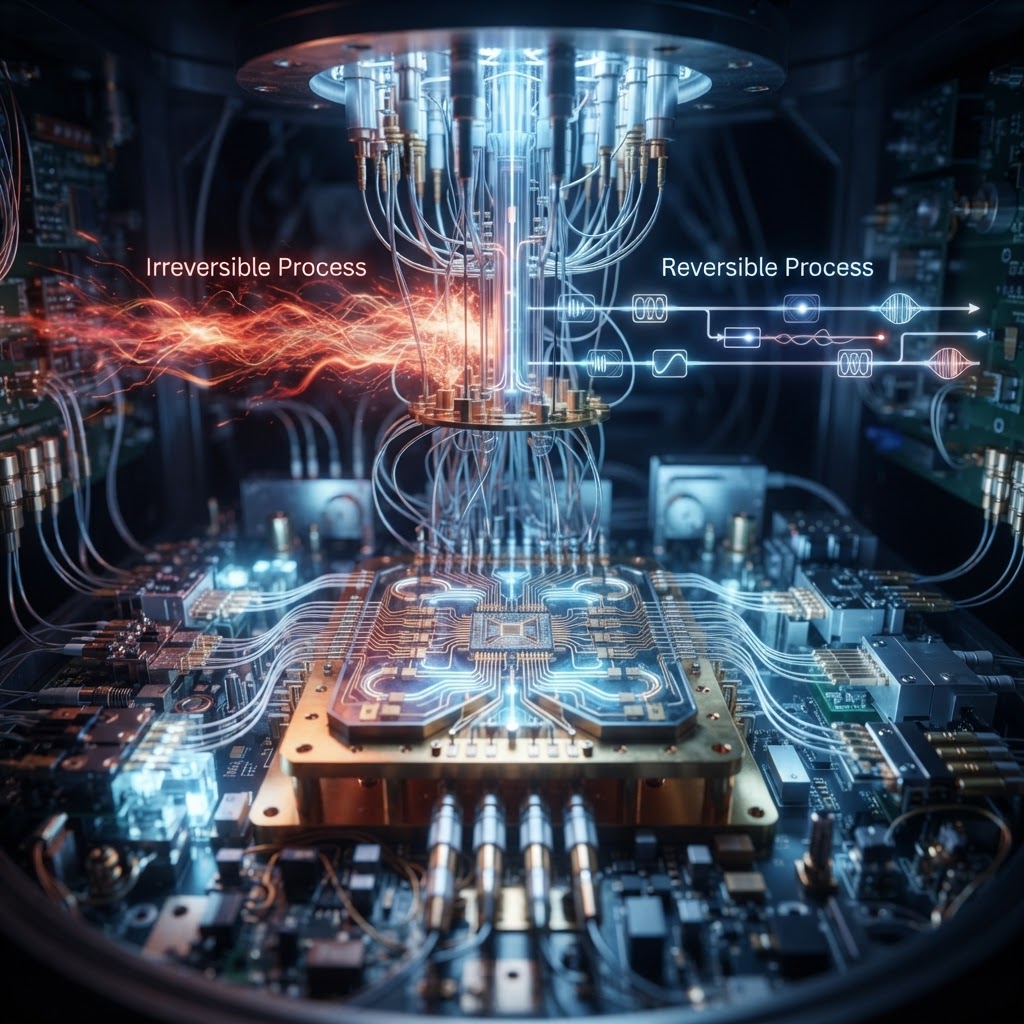
Reversible computing is the class of computational processes that avoid logically irreversible operations (like erasure) and therefore, in principle, avoid the associated minimal heat cost. If every computational step can be reversed, no net increase in entropy is required to perform the operation, and the kT ln2 tax need not be paid. The idea is simple on paper: replace many-to-one maps (which erase information) with one-to-one maps and track auxiliary information so the original inputs can be recovered.
From principle to practice: experiments and prototypes
Experimental demonstrations of Landauer’s principle in colloidal particles and single-electron systems have established that the bound is real and relevant at mesoscopic scales. Those experiments also show another important truth: reaching the bound requires extreme care — very slow, well-controlled operations and minimal coupling to uncontrolled degrees of freedom. Practical demonstrations of reversible logic have been narrower in scope but suggest feasibility in specific hardware: adiabatic CMOS circuits, superconducting adiabatic logic families, and certain mechanical or nanomagnetic gate proposals can implement nearly-lossless forward and backward transitions under slow, low-noise conditions.
The tradeoffs that matter
- Speed versus dissipation. Approaching thermodynamic reversibility requires operations to be performed quasi-statically. That implies slower clocking or staged, energy-recycling architectures — costly in latency-sensitive systems.
- Overhead for reversibility. Avoiding erasure typically demands extra bits (ancillae) and bookkeeping, which increases device count and control complexity. The energy spent managing, moving, and eventually resetting those ancillae can swamp the savings unless handled carefully.
- Error correction and noise. Real devices suffer from errors. Maintaining reversibility in the presence of noise may require active error correction, which can itself be dissipative.
- System-level costs. Control electronics, clocking, and refrigeration (for superconducting platforms) introduce energy expenditures that are often overlooked when quoting per-gate thermodynamic costs.
Why this matters now
Modern computing is moving into regimes where energy per operation is increasingly important. Data centers, pervasive sensing, and large-scale AI workloads drive demand for efficiency gains that cannot be met by scaling alone. Reversible computing provides a principled pathway to lower fundamental dissipation, and renewed interest from both academic groups and niche industry players reflects that urgency.
Where the debate stands
The central practical question is no longer “Is Landauer true?” but rather “Can reversible architectures deliver a net energy benefit once real-world overheads are included?” The answer remains unresolved: at small scales and in special-purpose settings, reversible techniques can reduce dissipation; at large system scales, engineering and speed constraints still tip the balance toward conventional irreversible architectures.
Expectation: The coming years will see hybrid strategies — selective reversible kernels where energy matters most, combined with conventional logic elsewhere — rather than a wholesale reversal of how we compute.