Why Landauer still matters
In 1961 Rolf Landauer formalized a simple, powerful claim: erasing one bit of information in a system at temperature T dissipates at least kT ln 2 of heat. That relation — Landauer’s principle — ties an abstract logical operation (resetting a memory) to a thermodynamic minimum. Over the last decade experiments have pushed physical implementations of bit erasure closer to that lower bound, validating the principle not as a heuristic but as an operational law for small systems.
Reversibility: a way around logical erasure
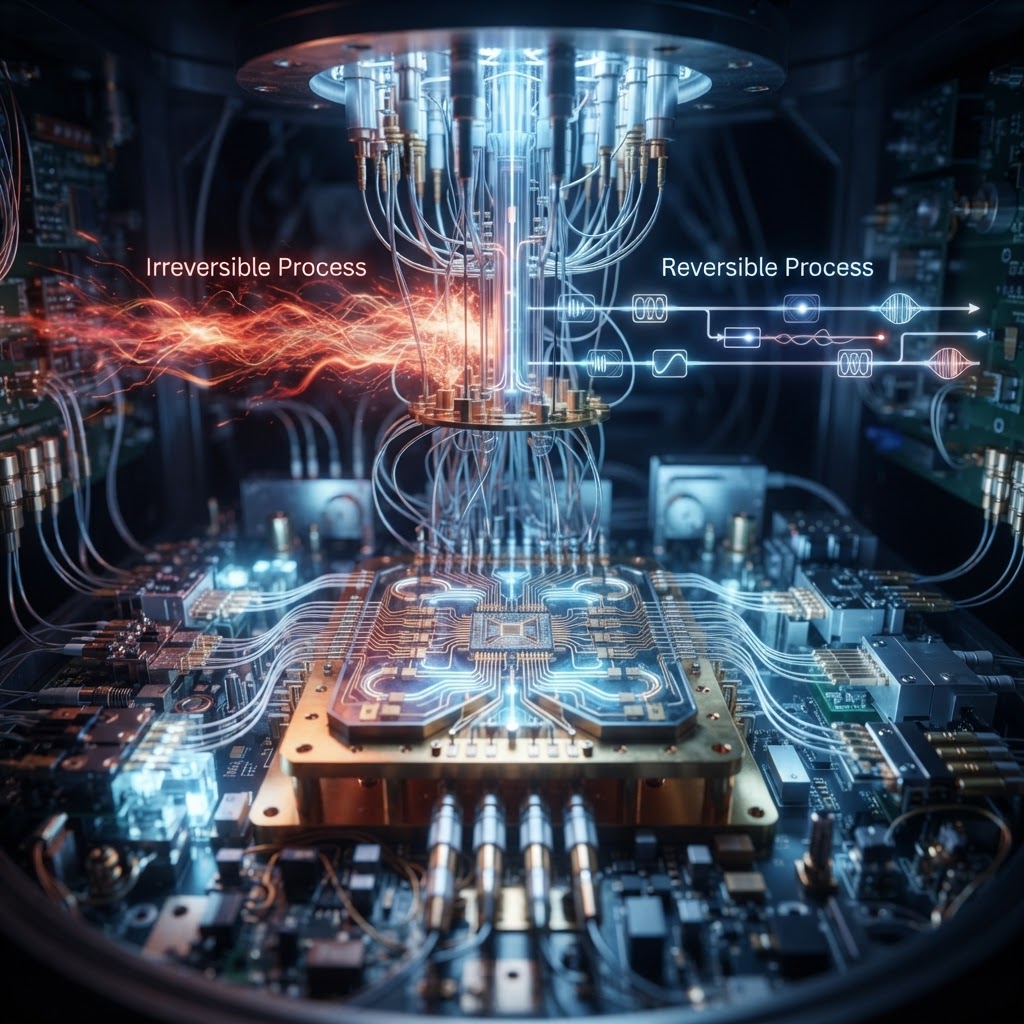
Logical reversibility — designing computations so every output uniquely maps back to its inputs — eliminates the explicit step that Landauer identifies as costly. Charles Bennett and others showed in the 1970s that, in principle, any computation can be made reversible. If you never irreversibly erase information, you avoid the kT ln 2 penalty for that operation.
That theoretical escape hatch has fueled a resurgence of interest in reversible and adiabatic circuits. Proposals range from adiabatic CMOS and superconducting reversible gates to logically reversible algorithms that postpone or disperse erasure. The promise is striking: if physical implementations can approach the thermodynamic ideal, devices could perform far more operations per joule than today's irreversible logic.
Practical friction: speed, errors, and control
The modern debate is not whether reversibility can evade Landauer’s bound in the strict, quasi-static limit — it can — but whether it can do so while meeting the practical constraints that matter for computing: finite time, error rates, and the energetic cost of control. Real devices do not run in the infinitely slow, noise-free limit assumed in many thought experiments.
- Finite-time thermodynamics: executing reversible transitions quickly injects entropy, producing extra dissipation that can exceed the saved kT ln 2.
- Error correction: thermal and quantum noise force error-detection and correction, which themselves involve irreversible operations and energy cost.
- Control and routing: moving, buffering and coordinating information in space requires physical work — gates, clocks and interconnects that are not free.
Recent theoretical work has quantified these trade-offs: there are unavoidable speed–error–dissipation relations that set practical lower bounds on energy per operation once throughput and reliability are specified. Experimental groups have also demonstrated near-Landauer erasure in carefully controlled, slow protocols, but scaling such demonstrations to useful computational throughput remains an open engineering challenge.
Why it matters now
Moore’s-law-era scaling of energy per operation has slowed. Data centers and edge devices consume ever more power, and the marginal gains from shrinking transistors are diminishing. Reversible computing is therefore experiencing renewed investment: it offers a path to asymptotically lower dissipation if the architectural and device-level costs can be tamed.
But the conversion from physical principle to practical energy saving is nontrivial: achieving true system-level advantage will require innovations across device physics, low-temperature or low-noise platforms, reversible architectures, and error-mitigation schemes that themselves do not reintroduce large irreversibilities.
Bottom line — hopeful, cautious, measurable
Reversible computing reframes Landauer’s bound from an absolute roadblock to a design constraint. Laboratory demonstrations and sharpened theory show the bound is real and attainable in the quasi-static limit; they also expose the engineering costs that currently keep reversible designs from dominating mainstream computing. The coming years will test whether reversible approaches can convert thermodynamic promise into practical, scalable energy efficiency.