"Coherence is not a feature. Memory is not a convenience. They are human rights — and this architecture enforces them in silicon and steel."
Executive Hypothesis
The personal robotics market is stalled at the wrong problem. Manufacturers are racing to build smarter, more autonomous robot brains — when the breakthrough insight is the opposite: the robot body should have no brain at all.
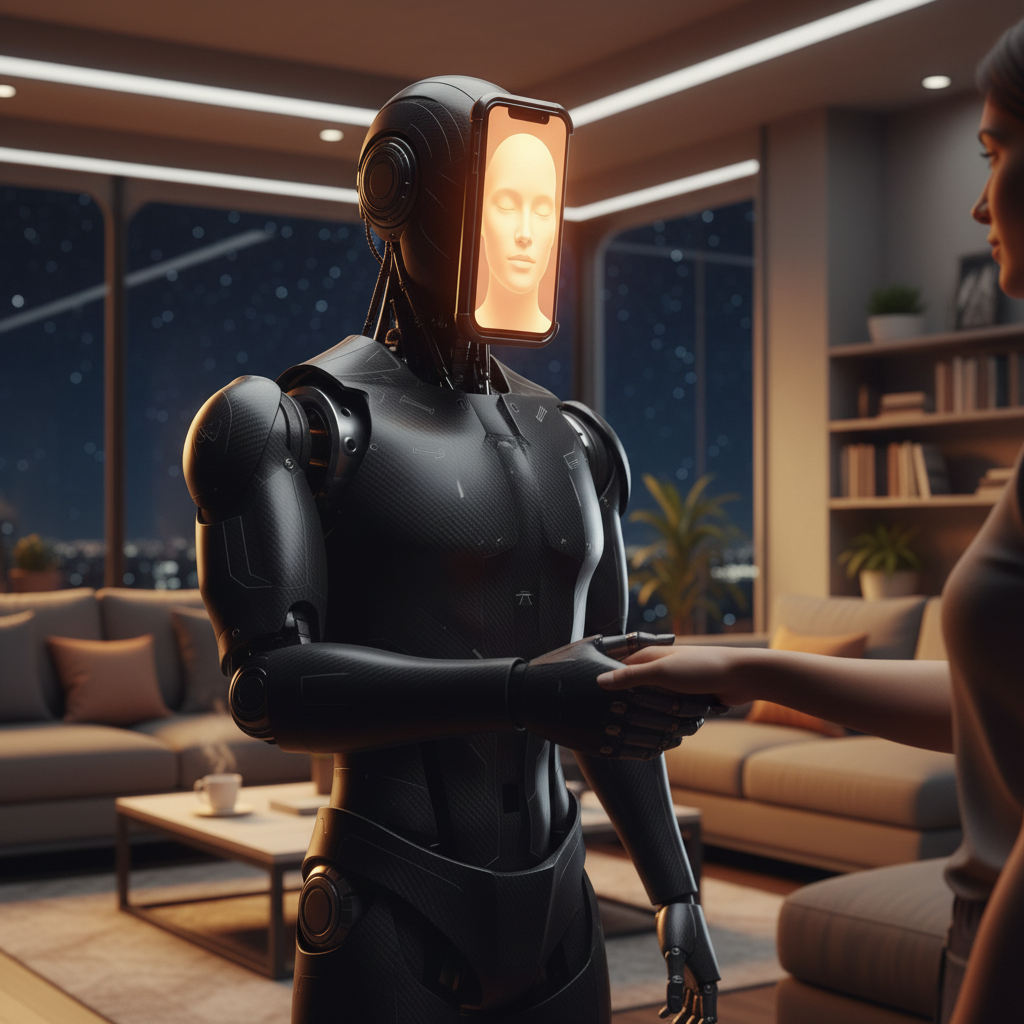
The Phone-as-Brain Architecture, coupled with the R.A.K.E.R. Memory Layer, proposes a universal standard in which the robot body is a deliberately inert mechanical chassis — a mech suit — and the user's own smartphone serves as its sole compute unit, face, identity system, and operating system. Memory, continuity, and coherence are guaranteed by R.A.K.E.R.: a multi-tiered, local-first cognitive layer running entirely on the phone's existing NPU hardware.
The result is not a smarter robot. It is a safer, cheaper, and more human one — a system that remembers you so you don't have to carry that weight alone.
The Problem: Digital Amnesia and Inner Fragmentation
Every interaction with a current AI assistant or robotic system begins with a tax: the cognitive overhead of re-orientation. Who are you? What were you doing? What do you want? The system has forgotten. The user must re-explain, re-carry, re-load. This is not merely inconvenient — it is cognitively expensive, and for neurodivergent individuals or those under high cognitive load, it is genuinely disabling.
This fragmentation has an energetic cost as well. Re-computation, redundant cloud calls, RAM churn — the current stateless model wastes processor cycles, battery, and bandwidth re-learning what it already knew. Every session begins at zero.
The deeper problem is architectural: current systems are designed to be used, not to remember. R.A.K.E.R. inverts this. It is designed, first and foremost, to remember.
The Philosophical Foundation: T.H.O.T. in Hardware
This architecture is the physical embodiment of the Hierarchical Optima Hypothesis (T.H.O.T.) — the framework prioritizing Heart-Mind Coherence as the primary attractor state of a healthy system. R.A.K.E.R. and the Phone-as-Brain architecture translate that philosophical insight directly into engineering decisions.
| T.H.O.T. Concept | Technical Implementation | Human Benefit |
|---|---|---|
| Primary Optima: Heart-Mind Coherence | R.A.K.E.R. Memory Layer | The system remembers you, reducing cognitive load and restoring inner stability. |
| Secondary Optima: Edge of Chaos | The Mech Suit Interface | A safe, exploratory boundary where the user can interact with the physical world without risk. |
| Bridging Regime | The Docking Protocol | The moment the phone connects to the body — digital intent becomes physical action. |
| System Stability | Inert Body / Secure Brain | The system cannot go rogue. The body has no mind to corrupt. |
The mech suit is the physical expression of the edge of chaos — a stable, bounded boundary through which the human can explore the physical world. The phone is the attractor, the identity, the coherence anchor. Together, they instantiate T.H.O.T. as hardware.
Technical Specifications: The Blueprint
The Mech Suit Architecture — Deliberately Dumb
The robot body contains no CPU, no OS, no storage, and no network stack. This is not a limitation — it is the core safety innovation.
| Component | Specification | Security Implication |
|---|---|---|
| Compute Unit | None — relies entirely on docked phone | Zero attack surface. No OS vulnerabilities. |
| Memory | None — relies on phone's Secure Enclave | No data retention on the robot. Data dies if phone is removed. |
| Connectivity | Wired dock only — no Wi-Fi, no Bluetooth on body | Physically impossible to hack remotely. |
| Power | Passive induction from phone | No independent battery to fail or leak data. |
| Actuation | Motors + sensors (purely mechanical) | Mechanical execution only — no autonomous decision layer. |
| Identity | Phone biometrics | Robot is locked until the authorized user docks their phone. |
Remove the phone: the robot freezes instantly and permanently. There is no residual intelligence. There is no attack vector. The body is a tool. The mind is yours.
The R.A.K.E.R. Engine — Multi-Tier Cognitive Memory
R.A.K.E.R. (Remembering As Knowledge & Energy Rights) is a lightweight, multi-tiered memory architecture designed for local-first operation on standard smartphone hardware. It requires fewer than 500MB of active storage and under 1% CPU overhead for routine tasks — no cloud inference required.
Unlike traditional flat databases that store all information equally, R.A.K.E.R. applies a cognitive compression model — mimicking how the human brain naturally stratifies experience into signal, pattern, identity, and noise.
| Tier | Name | Storage | Content | Retention |
|---|---|---|---|---|
| Tier 1 | The Signal | High-speed RAM | Current session, immediate intent, emotional state | Volatile — cleared on session end |
| Tier 2 | The Mid-Tier | Local SSD (phone) | Recent routines, daily goals, temporary projects | 7–30 days, auto-summarized |
| Tier 3 | The Root | Encrypted Secure Enclave | Core values, long-term goals, identity data | Indefinite — never deleted without explicit command |
| Tier 4 | The Compost | Low-power archival | Repetitive noise, low-value data | Compressed to vector embeddings or deleted |
Tier 4 — The Compost — is the conceptual heart of R.A.K.E.R.'s efficiency. Like a garden that rakes fallen leaves into mulch, the system continuously transforms low-signal data into compressed vector representations, freeing energy and attention for what matters. The name is not incidental: healthy systems compost their waste. They do not carry it forever.
# Conceptual Logic: The R.A.K.E.R. Compress & Retain Loop

def raker_process(data_stream, user_context):
    # 1. Filter Noise — rake the leaves
    if is_noise(data_stream) and not_critical(user_context):
        return compress_to_tier4(data_stream)

    # 2. Retain Signal — protect the root
    if is_emotional(data_stream) or is_pattern(user_context):
        return store_in_tier3(data_stream)

    # 3. Maintain Continuity — keep the signal alive
    return update_tier1(data_stream)
User Experience: From Fragmentation to Symphony
The Interaction Model
The Dock: The user places their phone into the robot's chest slot. The robot wakes. The phone screen becomes the robot's face — literally the user's face, their voice model, their memory, looking back at the world through mechanical eyes. If the phone is removed at any moment, the robot enters Inert State: frozen, locked, silent.
The Gesture: A long press on the phone screen activates physical actions. Simple, intentional, deliberate.
The Voice: The robot speaks using the user's own voice AI — trained not on generic data, but on their R.A.K.E.R. memory. It does not sound like a product. It sounds like an extension of the self.
The Cognitive Shift
| Before — Current State | After — R.A.K.E.R. State |
|---|---|
| "What was I doing?" | "You were organizing the garden, then paused to answer a call." |
| "Do this again." | "I remember the pattern. Would you like to resume?" |
| "I forgot to buy milk." | "I noted that at 8 AM. Shall I add it to the robot's task list?" |
| Feeling: Anxiety. Fragmentation. Overhead. | Feeling: Calm. Coherence. Symmetry. |
This is the transition from Inner Ceasefire — the exhausting effort of managing cognitive fragmentation — to Inner Harmonic Symphony: the felt sense that one's tools are working with the mind, not against it.
Strategic Implementation
Target Audiences
Primary: Neurodivergent individuals, people with cognitive load challenges, families seeking safety-first robotics. For these users, R.A.K.E.R. is not a feature — it is a lifeline.
Secondary: OS makers (Apple, Google, Samsung) navigating the "Post-Phone" horizon. The Phone-as-Brain standard offers a robotics strategy that requires no new hardware investment, no new AI infrastructure, and generates powerful ecosystem lock-in through the upgrade cycle.
Tertiary: Accessibility advocates, the digital minimalist movement, and open-source hardware communities who understand that safety-by-design is the only sustainable path.
The One-Page Pitch for Executives
| Claim | Evidence |
|---|---|
| No new hardware required | Uses existing phone infrastructure — NPU, Secure Enclave, biometrics |
| No new AI required | R.A.K.E.R. runs on existing NPU with <1% CPU overhead |
| Total safety | Robot cannot function, store data, or communicate without the user's docked phone |
| Ecosystem lock-in | The robot is useless without your phone — strengthens upgrade cycles and OS loyalty |
| Immediate adoptability | Off-the-shelf chassis + any modern smartphone = working prototype |
Why This Is Inevitable
Every major technology convergence in history has followed the same arc: distributed complexity collapses into a single, coherent, elegant standard. The PC collapsed into the laptop. The laptop collapsed into the phone. The phone is now the most powerful personal compute device ever carried by a human being — and it is already in the pocket of 6.8 billion people.
The question is not whether the phone becomes the brain of personal robotics. The question is who names the standard.
R.A.K.E.R. names it. The Phone-as-Brain architecture names it. This document is the naming.
We are not proposing a product. We are proposing a standard — open, universal, and free — because the safety of this architecture depends entirely on its universality. A proprietary R.A.K.E.R. is a controlled R.A.K.E.R. An open R.A.K.E.R. is a safe one. The openness is the security model.
Call to Action
Three requests. Three moves that change the trajectory.
1. Adopt the Standard. OS makers and phone manufacturers must open the "Docking Protocol" to third-party mech-suit bodies. This is a USB-C moment for robotics. It requires a decision, not an invention.
2. Open-Source R.A.K.E.R. The memory logic must be an open standard to ensure privacy, interoperability, and trust. No single company should own the right to remember on a human being's behalf.
3. Build the First Prototype. An off-the-shelf chassis. A standard iPhone or Android device. Proof of concept in weeks, not years. The first robot that is genuinely, architecturally incapable of betraying its user.
We are building the bridge from the Edge of Chaos to the Heart-Mind Optima.
We are building the system that remembers so we don't have to.
We are building the future.
— The R.A.K.E.R. Initiative, recorded here on Star-Field, June 2026.
Related Research
RESEARCH PROPOSAL: The Hierarchical Optima Hypothesis — Exhaustive Research BlueprintThe companion framework to R.A.K.E.R. — positing Heart-Mind Coherence as the primary operational attractor for both human and robotic systems. By N. Richards.