Introduction
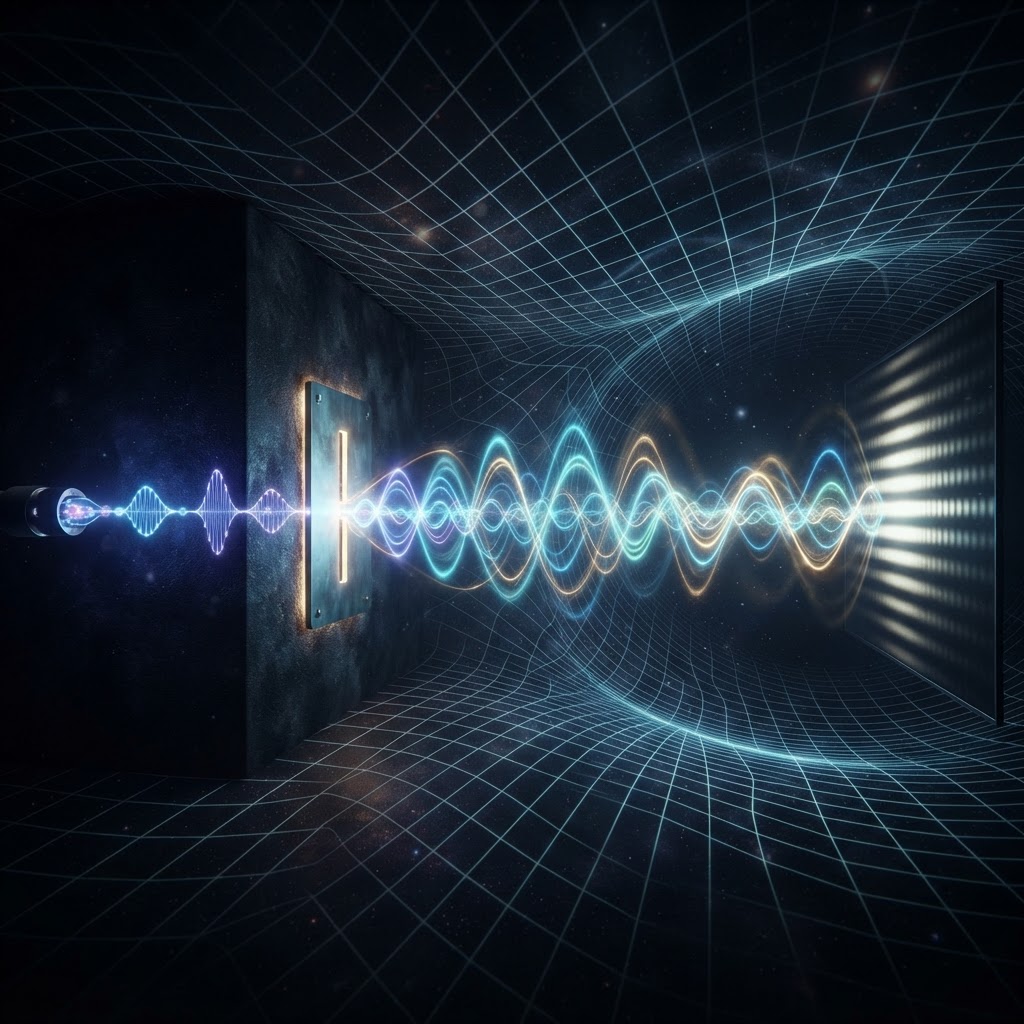
The double-slit experiment is both the origin story and the continuing puzzle of quantum mechanics: send particles through two openings and, contra classical expectation, an interference pattern appears as if each particle traversed both slits at once. Over roughly a century of experiments and debate, that simple arrangement has become a laboratory for the deepest questions in physics — and a proving ground for ever-more-sophisticated tests of quantum theory.
What’s new now
Recent work has moved the double-slit beyond pedagogy into precision science. Experimentalists have steadily pushed mass, complexity and control: electrons, atoms, large organic molecules and engineered nanoparticles have all produced interference fringes. At the same time, techniques such as weak measurement, quantum erasure and delayed-choice setups have allowed researchers to probe the transition between wave-like interference and particle-like ‘which-path’ information without destroying the fragile quantum state outright.
Key developments include:
- Scaling up matter-wave interferometry to heavier, more complex systems, narrowing the gap between microscopic superposition and everyday objects.
- Application of weak measurement protocols that reveal ensemble-average trajectories and correlations while minimally disturbing interference.
- Precision tests that constrain hypothetical mechanisms for spontaneous wave-function collapse and environmental decoherence.
Why the experiment still matters
The double-slit sits at the juncture of experiment, interpretation and technology. On the experimental side, it is a remarkably sensitive interferometer: any tiny coupling to the environment that could cause decoherence will wash out fringes. That sensitivity makes interference experiments powerful null tests of theories that modify quantum mechanics — for instance, continuous spontaneous localization models or proposals tying collapse to gravity.
On the interpretational side, the paradoxes remain fertile. Variants such as Wheeler’s delayed-choice and the quantum eraser sharpen the conceptual tension: choices made after a particle traverses the apparatus can affect whether we observe interference, highlighting that standard quantum mechanics resists any naive, classical storytelling about particle trajectories.
Progress and limits
Laboratories now routinely use the double-slit and its analogues to set quantitative bounds on nonstandard physics. At the same time, control of environmental factors (thermal radiation, collisions, vibrations) has improved, extending coherent behaviour to larger systems. Yet these advances also expose practical limits: maintaining coherence for macroscopic objects requires extreme conditions, and distinguishing genuine collapse mechanisms from ordinary decoherence remains experimentally challenging.
What’s at stake
Beyond the foundational stakes, the same physics underlies quantum technologies. Interference underpins quantum sensors, matter-wave lithography and elements of quantum information processing. Thus, refining our understanding of when and how interference breaks down has direct technological import.
Looking forward
The open frontier is the boundary between quantum and classical. Will experimentalists continue to push interference to ever-larger masses until some new effect appears, or will quantum mechanics hold unflinchingly at scales we currently regard as classical? Proposals to test gravitational or noise-induced collapse remain active, and the double-slit — in many guises — is likely to remain the simplest, most incisive probe.
The double-slit has gone from paradox to precision tool. After a century, it still teaches us how the world can be both particle and wave — and where, if anywhere, that duality might finally yield.