The patient who changed the question
When neurosurgeons removed large swaths of the medial temporal lobe from Henry Molaison (known for decades as patient H.M.) in 1953, their aim was to cure severe epilepsy. What followed was an outcome no one expected: H.M. could not form new episodic memories. He could hold a conversation, learn a motor skill, and retrieve decades-old facts, yet every day he awoke to a world that, in a fundamental way, had just happened.
What was discovered (and what was underappreciated)
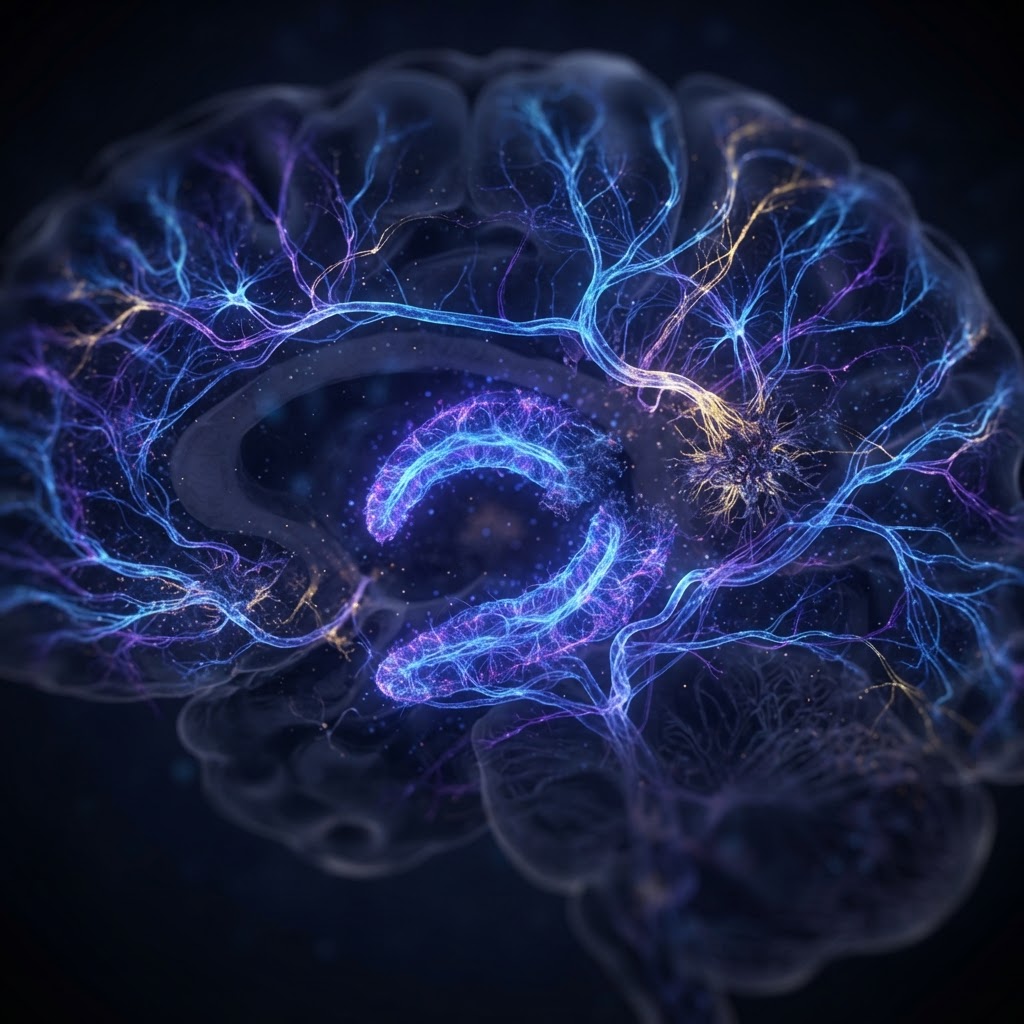
Scoville and Milner’s 1957 report established the hippocampus and adjacent medial temporal structures as essential for forming new declarative memories. That lesson is textbook now, but it missed subtler, crucial truths that were harder to see without patient H.M.
- Memory is multi-system. H.M.’s intact procedural learning (he improved at mirror-tracing tasks despite no recollection of practicing) forced researchers to separate declarative memory (facts, events) from implicit systems (skills, habits).
- The hippocampus is about relational and temporal organization, not static storage. H.M.’s remote memories could survive, implying that long-term storage resides across distributed neocortical circuits. The hippocampus appears to bind disparate elements of an experience—where, when, who—into an index that can later recruit the distributed fragments.
- Memory and imagination share a neural substrate. Later work showed that patients with hippocampal damage struggle not only to remember past episodes but to imagine coherent future scenarios. This reveals a role for the hippocampus in simulating sequences of events — a generative process, not a passive archive.
Why H.M. still surprises us
Two features make H.M.’s legacy persist. First, his syndrome clarified that memory consolidation is a process: over time, memories become less hippocampus-dependent as they are reorganized across cortex. Second, H.M. exposed the hippocampus as a temporal binder — critical for order, context, and relational links. These functions explain why H.M. could learn a motor routine (procedural), recall semantic facts learned long before surgery (distributed cortical traces), yet be unable to piece together the events of yesterday.
Practical and ethical echoes
H.M. enabled decades of animal experiments, human fMRI studies, and computational models that now target replay, pattern separation/completion, and indexing theory. But his case also posed an ethical mirror: neuroscience’s enormous gains have sometimes come at the expense of vulnerable patients whose lives became object lessons. Contemporary research standards owe H.M. and his family a debt.
What remains unresolved
H.M. clarified where to look but not exactly how the hippocampus communicates with cortex to stitch—and later release—memories. Do replay events during sleep transfer a memory trace wholesale, or do they sculpt cortical representations gradually? How are temporal sequences encoded so we can place experiences in order? Those mechanistic gaps are the true legacy: H.M. pointed science toward questions we are still mapping, with new tools but familiar mysteries.
H.M. did not just lose memory; he revealed memory’s architecture. The hippocampus is less a vault and more a timekeeper and an index—an organ for linking moments into narratives. That realization, still underexplored in public imagination, remains one of neuroscience’s most profound and human lessons.