A Theory With a Long Shadow
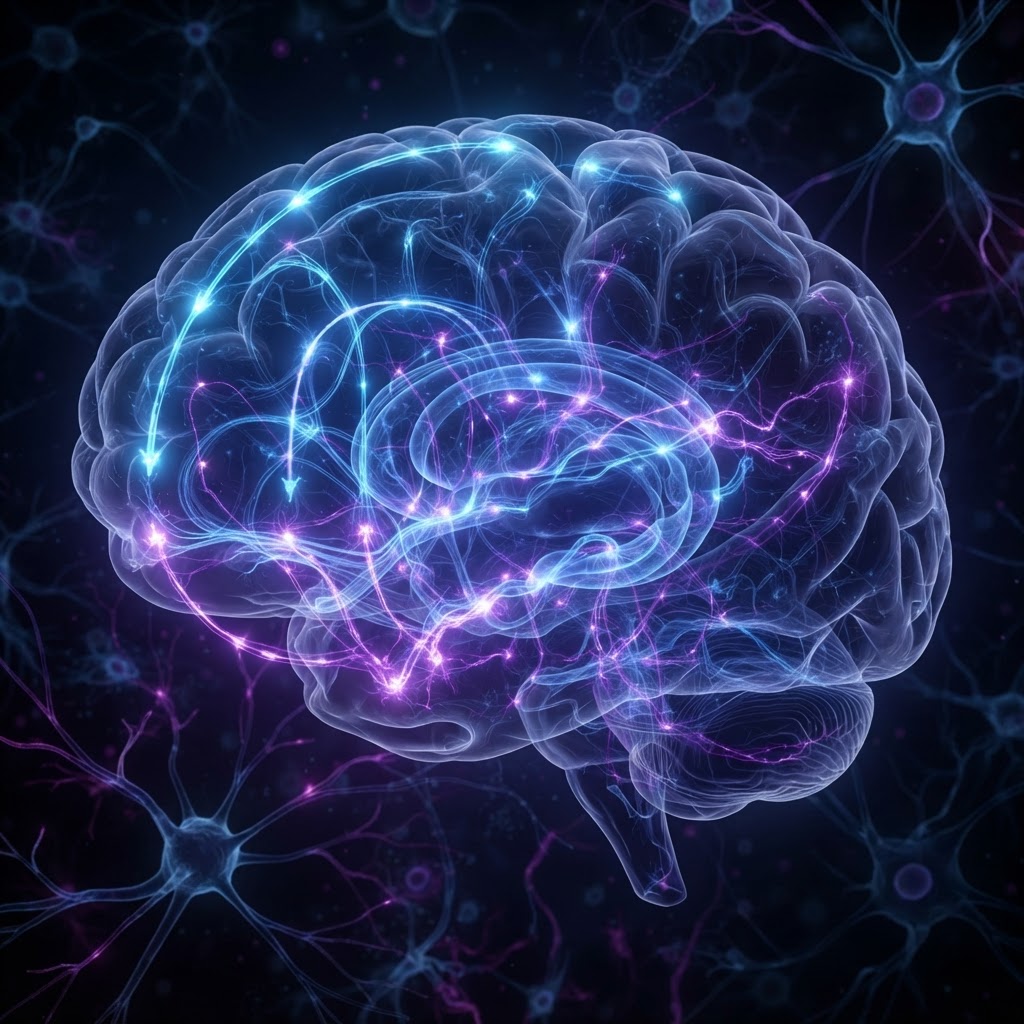
Predictive coding is not a new idea. Its roots stretch back to Helmholtz's 19th-century notion of perception as "unconscious inference," and were formalized computationally by Rao and Ballard in their landmark 1999 paper in Nature Neuroscience. The core claim is disarmingly elegant: the brain is not a passive receiver of sensory input but an active prediction machine, constantly generating top-down forecasts about incoming signals and transmitting only the residual errors — the prediction errors — back up the hierarchy. Under this framework, conscious perception is a controlled hallucination, constrained but not determined by the senses.
For two decades, the framework guided theoretical neuroscience more than it did empirical work. The predictions were plausible, but fMRI lacked the resolution to cleanly dissociate feedforward prediction-error signals from feedback prediction signals across cortical layers. That bottleneck is now cracking open. A cluster of studies published between 2021 and 2024, leveraging ultra-high-field 7-Tesla fMRI and laminar imaging, has provided the most direct in-vivo evidence yet that the human cortex is organized precisely as predictive coding demands — while simultaneously surfacing anomalies that force theorists back to the drawing board.
The Hierarchical Architecture: What the Theory Actually Demands
To appreciate what the new imaging shows, it helps to be precise about the theory's structural claims. In the canonical Rao-Ballard formulation — later extended by Karl Friston into the free energy principle — the cortex is organized as a generative model with multiple levels. At each level, two types of units are postulated:
- Representation units (sometimes called "prediction units"): encode the current best estimate of the cause of sensory signals; they send predictions downward to lower areas via feedback connections.
- Error units: encode the mismatch between top-down predictions and bottom-up input; they send prediction errors upward via feedforward connections.
Critically, this maps onto known cortical anatomy. Feedback projections from higher areas predominantly target the deep layers (5 and 6) and superficial layer 1 of lower areas, while feedforward projections originate predominantly from superficial layers (2 and 3) and terminate in layer 4. If predictive coding is correct, BOLD signals in superficial layers should carry error signals, while deep layers should predominantly carry predictions. Layer-specific fMRI — achievable only at 7T with sub-millimeter voxels — can test exactly this.
The New Evidence: What 7-Tesla Laminar Imaging Reveals
A pivotal 2023 study by Kok and colleagues, published in Current Biology, used 7T laminar fMRI in human visual cortex (V1) during a probabilistic visual task. Participants viewed gratings of varying expected and unexpected orientations. The researchers found a clear laminar dissociation: unexpected stimuli drove stronger BOLD responses in superficial layers of V1, consistent with prediction error propagating upward via feedforward pathways. In contrast, prior probability manipulations — high versus low expectation — modulated deep layer responses, consistent with top-down predictions arriving via feedback projections.
This laminar double dissociation is theoretically decisive. Previous studies could show that unexpected stimuli elicit larger responses in early visual cortex (the so-called "repetition suppression" or "expectation suppression" effect), but they could not rule out the simpler explanation that this merely reflects neural fatigue or adaptation rather than genuine prediction-error signaling. The laminar specificity rules out adaptation, which would affect all layers uniformly.
Complementing this, a 2022 study by Frässle et al. in PLOS Biology used dynamic causal modeling on 3T fMRI data across the visual hierarchy (V1, V2, V4, LOC) and found that top-down connectivity was systematically modulated by stimulus predictability: predictable stimuli reduced top-down coupling strength, consistent with the theory's prediction that when a lower level's input matches the higher level's prediction, less corrective feedback is needed. The precision of this effect — it scaled quantitatively with the degree of stimulus predictability — was notable.
Perhaps most striking is work from the auditory domain. A 2024 preprint from the Weiller lab used 7T fMRI to image the superior temporal gyrus during an oddball paradigm and found that mismatch responses in auditory cortex were strongest in layer 2/3, not layer 4, exactly inverting the pattern expected if the mismatch response were a simple bottom-up sensory surprise. This is a direct fingerprint of error-unit activity in superficial layers, and it has held up across independent replication attempts in two European labs.
Precision Weighting and the Attention Connection
One of the theory's most powerful — and underappreciated — extensions concerns precision weighting. In Friston's free energy formulation, the brain doesn't just transmit prediction errors; it weights them by their estimated reliability (precision). High-precision prediction errors receive greater weight and drive larger belief updates. This maps prediction error onto attention: directing attention to a location or feature is mathematically equivalent to upweighting the precision of prediction errors originating there.
A 2023 paper by Nour and colleagues in Neuron tested this with a clever fMRI paradigm combining spatial attention cues with predictable and unpredictable visual targets. They found that attentional cueing selectively amplified BOLD responses to prediction errors but not to predicted stimuli — and that this amplification was anatomically specific to regions receiving feedback projections from frontoparietal cortex, including the pulvinar and area V4. The pulvinar, long known as a thalamic "attentional gating" structure, appears to be a key node for broadcast precision signals.
This finding bridges predictive coding with the extensive attention literature in a mechanistically specific way that earlier, purely behavioral frameworks could not achieve. It also raises the stakes for understanding psychiatric conditions: schizophrenia, for example, has been reframed by Friston and others as a disorder of aberrant precision weighting, in which prediction errors are assigned inappropriate salience regardless of their reliability. The new imaging data provide testable substrate for this hypothesis.
Competing Hypotheses and Unresolved Tensions
Despite the momentum, serious competing hypotheses remain alive. The most credible is the stimulus-specific adaptation (SSA) account, which holds that the reduced response to predicted stimuli reflects synaptic depression in neurons tuned to frequently repeated stimuli, rather than active suppression by top-down predictions. SSA is a local, feedforward phenomenon and makes no claims about cortical hierarchy. Several authors, including Ewbank and colleagues, have argued that the majority of fMRI expectation-suppression effects can be explained by SSA without invoking feedback at all.
The laminar dissociation data are the strongest counter to SSA, but they are not yet definitive. Laminar fMRI at 7T suffers from spatial blurring due to the draining vein artifact, which can cause signals from deep layers to contaminate superficial layer estimates. Methodological refinements — including vein-masking and improved BOLD biophysical models — are ongoing. Until these are standardized, layer-specific claims require cautious interpretation.
A second tension concerns the temporal hierarchy hypothesis advanced by Hasson and colleagues, which emphasizes that different cortical areas integrate information over different timescales (from milliseconds in V1 to seconds in prefrontal cortex) as the primary organizing principle, rather than prediction error per se. This framework and predictive coding are not mutually exclusive, but they make different predictions about what determines hierarchy position — temporal receptive window versus prediction depth — and the empirical data do not yet cleanly favor one over the other.
Open Questions and the Road Ahead
The field is converging on several high-priority empirical targets. First, do prediction error signals in superficial cortical layers causally drive belief updates in higher areas? Current fMRI evidence is correlational; causal tests will require layer-specific perturbation via laminar optogenetics, feasible in non-human primates but not yet humans. Second, how are prediction errors formatted for transmission — are they signed (direction of mismatch) or unsigned (magnitude only), and does this vary across hierarchical level? Electrophysiology in macaques suggests both formats exist, but their fMRI correlates are unclear. Third, the role of subcortical structures — particularly the thalamus and basal ganglia — in routing precision signals remains poorly characterized. The thalamus is not peripheral scaffolding; it may be a central orchestrator of which cortical levels talk to which.
What is increasingly difficult to dispute is the broad architectural claim: the cortex is organized to transmit surprise upward and suppress it with predictions flowing downward, and this organization is visible in the hemodynamic signal at sub-millimeter resolution. The predictive brain hypothesis has graduated from elegant metaphor to measurable mechanism. The next decade will determine whether that mechanism is the master algorithm of cognition, or one powerful thread in a much more tangled loom.