The universe did not begin perfectly smooth. That slight irregularity is the foundation of everything that followed: galaxies, clusters, cosmic voids, and the vast web of matter connecting them. The leading account traces those primordial differences to quantum vacuum fluctuations—fleeting variations in fields that existed even in the nearly empty space of the very early universe.
This idea has moved from elegant speculation to a quantitatively tested part of modern cosmology. During cosmic inflation, a brief episode of extraordinarily rapid expansion, quantum fluctuations in the fields driving inflation were enlarged to astronomical scales. Once stretched beyond the observable horizon, they could no longer rapidly evolve through ordinary local processes. When inflation ended, those variations re-entered the horizon and became seeds for gravitational growth.
From microscopic uncertainty to galaxies
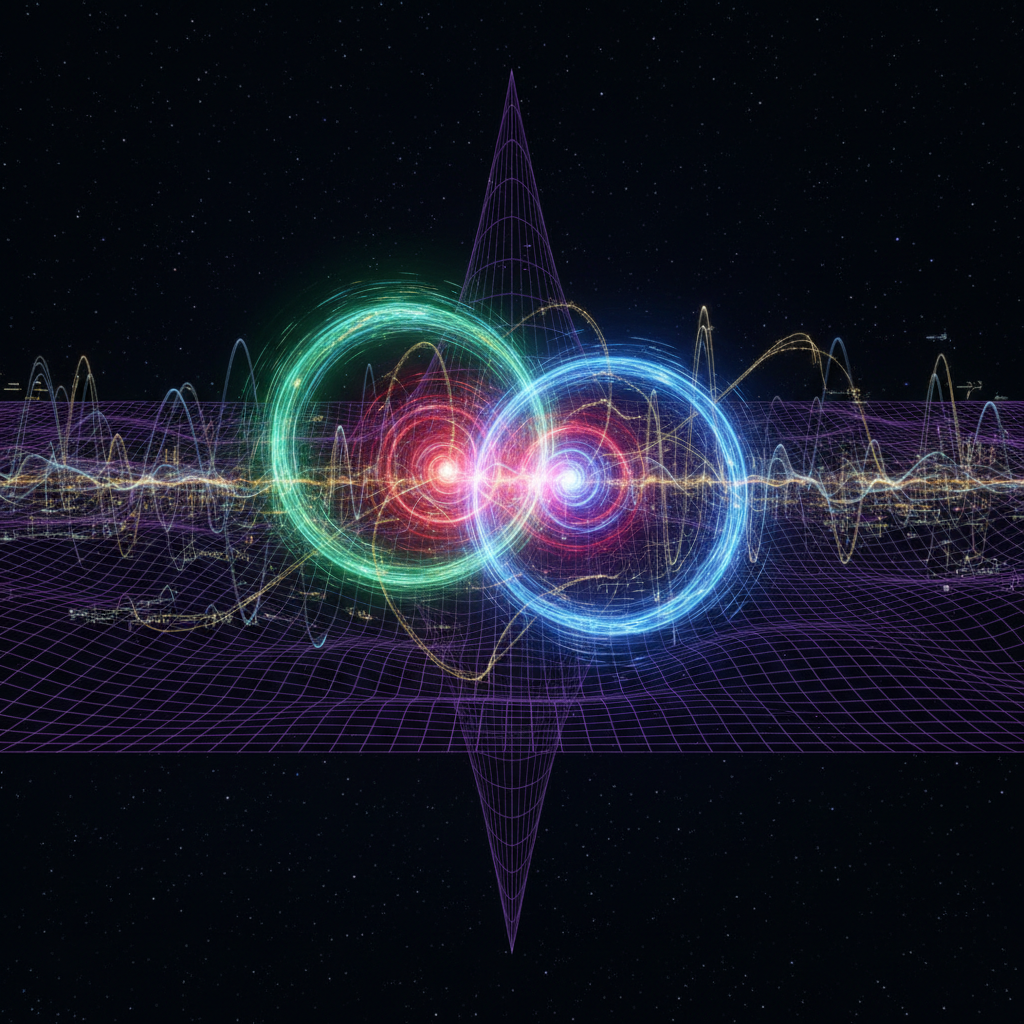
Quantum mechanics forbids a field from having exactly zero uncertainty in both its value and motion. Even its lowest-energy state—the vacuum—contains fluctuations. Inflation transformed these tiny fluctuations into differences in energy density. Regions that were imperceptibly denser exerted slightly stronger gravitational attraction, drawing in more matter as the universe expanded.
The imprint of this process appears most clearly in the cosmic microwave background (CMB), the afterglow released about 380,000 years after the Big Bang. Satellite missions including NASA’s Wilkinson Microwave Anisotropy Probe and ESA’s Planck mapped temperature variations of roughly one part in 100,000. Their statistical pattern is close to what simple inflationary models predict: nearly scale-invariant, predominantly adiabatic, and very nearly Gaussian.
Those properties matter. “Scale-invariant” means fluctuations had comparable strength across a wide range of cosmic sizes, while “adiabatic” means the different components of the primordial plasma varied together in a coordinated way. The agreement between these predictions and observations is one reason inflation remains the dominant framework for explaining the initial conditions of structure formation.
A powerful test, not a completed story
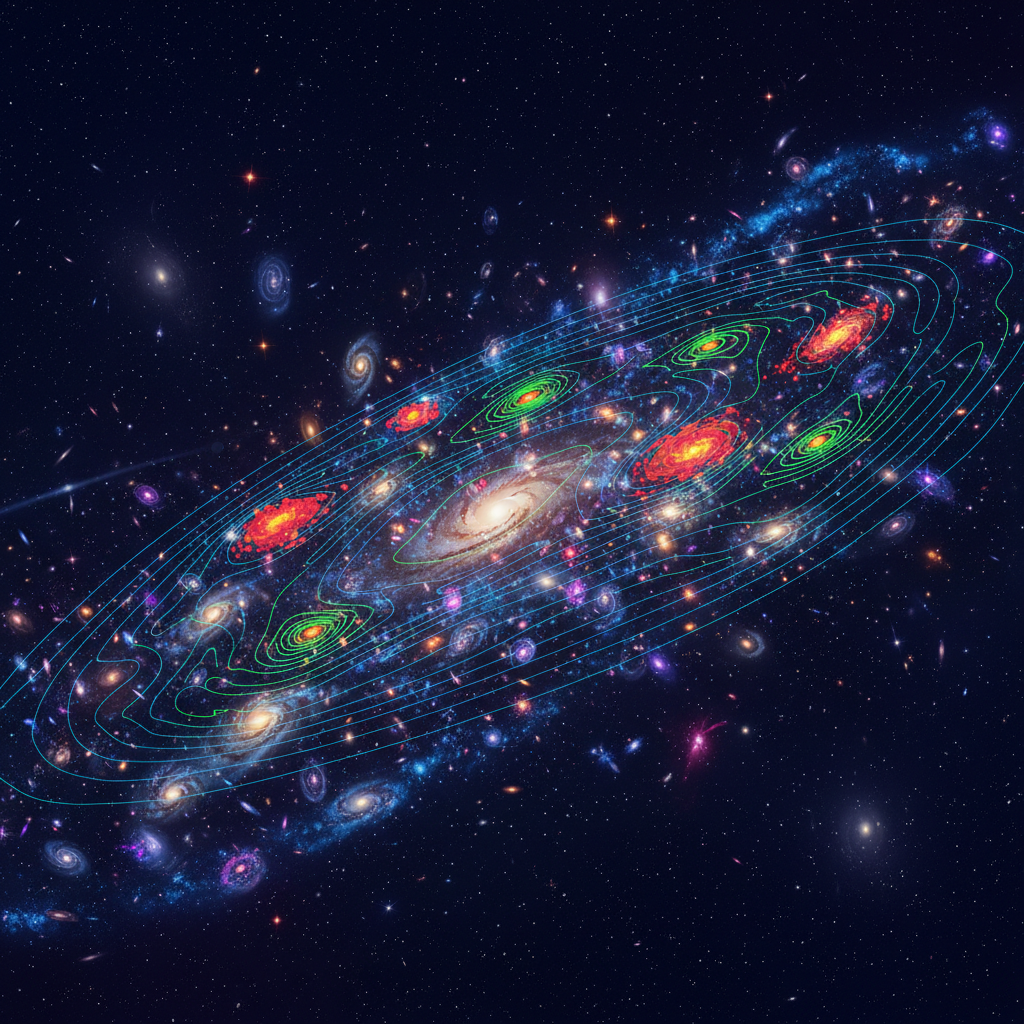
Current surveys are extending the test beyond the CMB. Galaxy maps, gravitational lensing measurements, and observations of the intergalactic gas probe how the original pattern evolved over billions of years. The broad picture continues to hold: quantum-seeded density variations grow under gravity, with dark matter providing the principal scaffolding on which ordinary matter accumulates.
Yet the evidence does not identify a unique inflationary theory. The energy scale of inflation, the identity of the inflaton field, and the mechanism that ended inflation remain unknown. Different models can produce nearly identical density fluctuations while predicting different signals in the polarization of the CMB or in a possible primordial gravitational-wave background.
The frontier: looking for the missing fingerprints
Researchers are now searching for departures from the simplest picture. Non-Gaussian patterns could reveal interactions among the fields present during inflation. A distinctive curl-like polarization pattern, known as a primordial B-mode, could provide evidence for gravitational waves generated by the expansion itself—though foreground emission from galactic dust makes that measurement exceptionally difficult.
Upcoming and developing observatories, including the Simons Observatory, CMB-S4, the Euclid mission, and the Vera C. Rubin Observatory, will sharpen measurements of both primordial fluctuations and their later growth. Their goal is not merely to confirm that quantum fluctuations seeded structure. It is to determine whether the seeds were produced by the simplest inflationary physics or by a richer early-universe mechanism.
The remarkable claim is therefore precise, not mystical: quantum uncertainty may have supplied the initial pattern, but gravity, dark matter, cosmic expansion, and billions of years of nonlinear evolution turned that pattern into the universe we inhabit.