What Happened
On March 4, 2024, the MeerTRAP project on the MeerKAT radio telescope in South Africa caught a millisecond flash: FRB 20240304B. The radio data said it was extremely distant, but the world's largest ground-based telescopes could see no galaxy at that spot. Only Webb could. Its NIRCam camera found the host, and its NIRSpec spectrograph measured the redshift: 2.148 — light that left its source when the universe was about three billion years old, at the height of cosmic noon. It is the most distant fast radio burst ever pinned to a host.
What the Team Actually Found
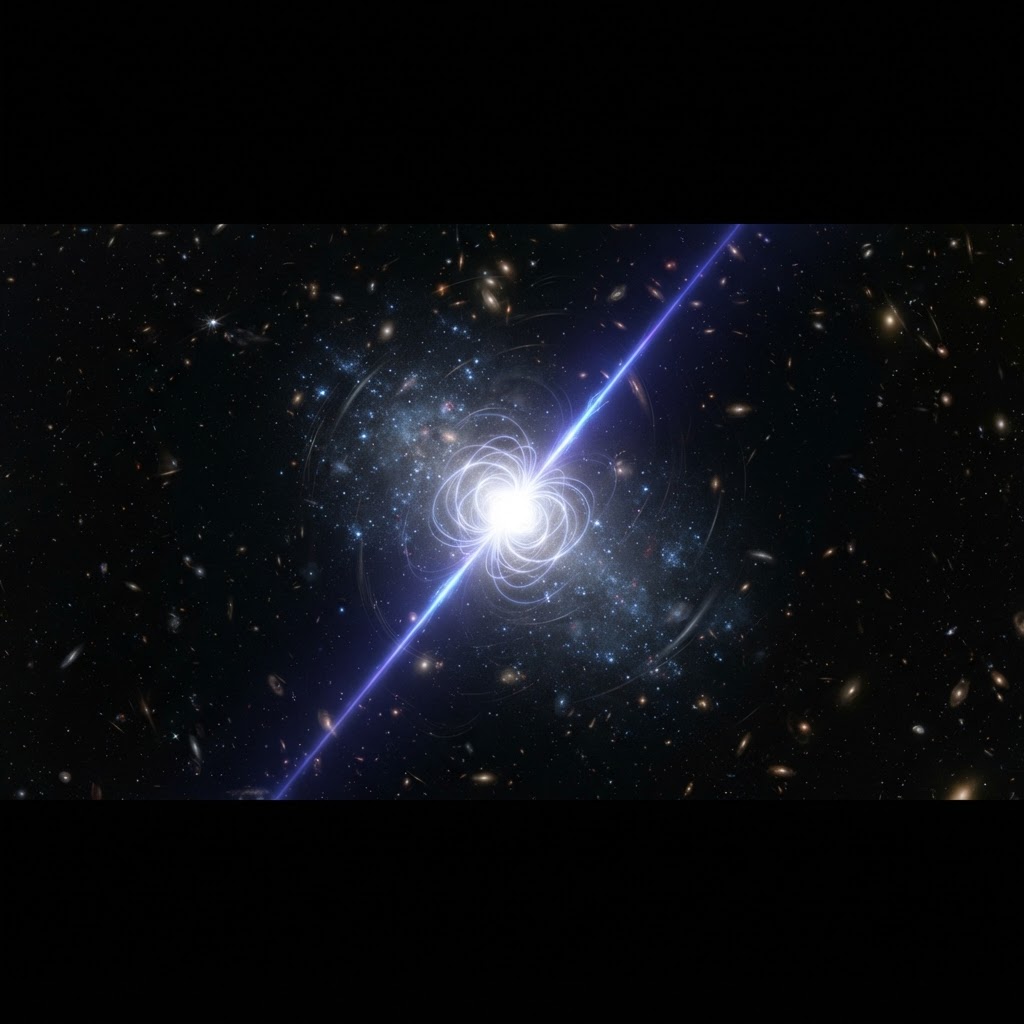
The host breaks the pattern. Most FRB hosts are massive star-forming galaxies; this one is a dwarf about a thousand times less massive than expected, furiously forming stars — most of them within the last thirty million years. "We thought it would be a big, nicely formed galaxy with lots of stars, and instead it was a little dwarf galaxy," said lead author Manisha Caleb of the University of Sydney. That timing is the verdict: neutron-star mergers take billions of years to spiral together, but this galaxy is too young to have waited. A young, highly magnetic neutron star — a magnetar, flaring through something like a starquake — fits without a delay. "Our work suggests that it's very unlikely that this FRB was produced by a merger," Caleb said.
Why It Matters
An FRB releases in a millisecond what the Sun releases in days, and for nineteen years nobody has known the engine. Distance is one of the sharpest constraints there is, and this one leans the whole field toward magnetars. The burst is also a cosmic flashlight: its signal carried the imprint of everything it crossed, revealing a previously unknown galaxy cluster at redshift 0.3 and the Virgo Cluster itself on the way in.
What It Does Not Yet Answer
Conclusive proof of the engine remains open — one spectacular host constrains the candidates; it does not convict one. Whether all FRBs share a single origin stays unresolved.
What We Are Watching
The team estimates MeerKAT alone may localize several bursts per year beyond redshift 1, each needing Webb to read its host. The census of the universe's sharpest flashes has just gained a method.