Prologue: An operation that became an experiment
In the mid-twentieth century, desperate neurosurgeons cut the brain's great commissure—the corpus callosum—to control violent epilepsy. What began as a clinical maneuver became, under the steady curiosity of neuroscientists, one of the most revealing natural experiments in the study of mind. The patients who emerged from these operations taught us not merely which tasks each hemisphere favors but how consciousness itself can be parceled and yet experienced as whole.
Key figures and the birth of split‑brain science
The story threads through surgeons and psychologists. William Van Wagenen performed early callosotomies for epilepsy in the 1940s; later, Joseph Bogen helped revive the operation in the 1960s as a treatment for intractable seizures. Into that clinical context stepped Roger Sperry, whose elegant experimental work on split brains earned him a Nobel Prize in 1981. Michael Gazzaniga, Sperry's most prominent collaborator, carried the work into the clinic and into the public imagination with careful patient studies and vivid writing.
Simple experiments, startling consequences
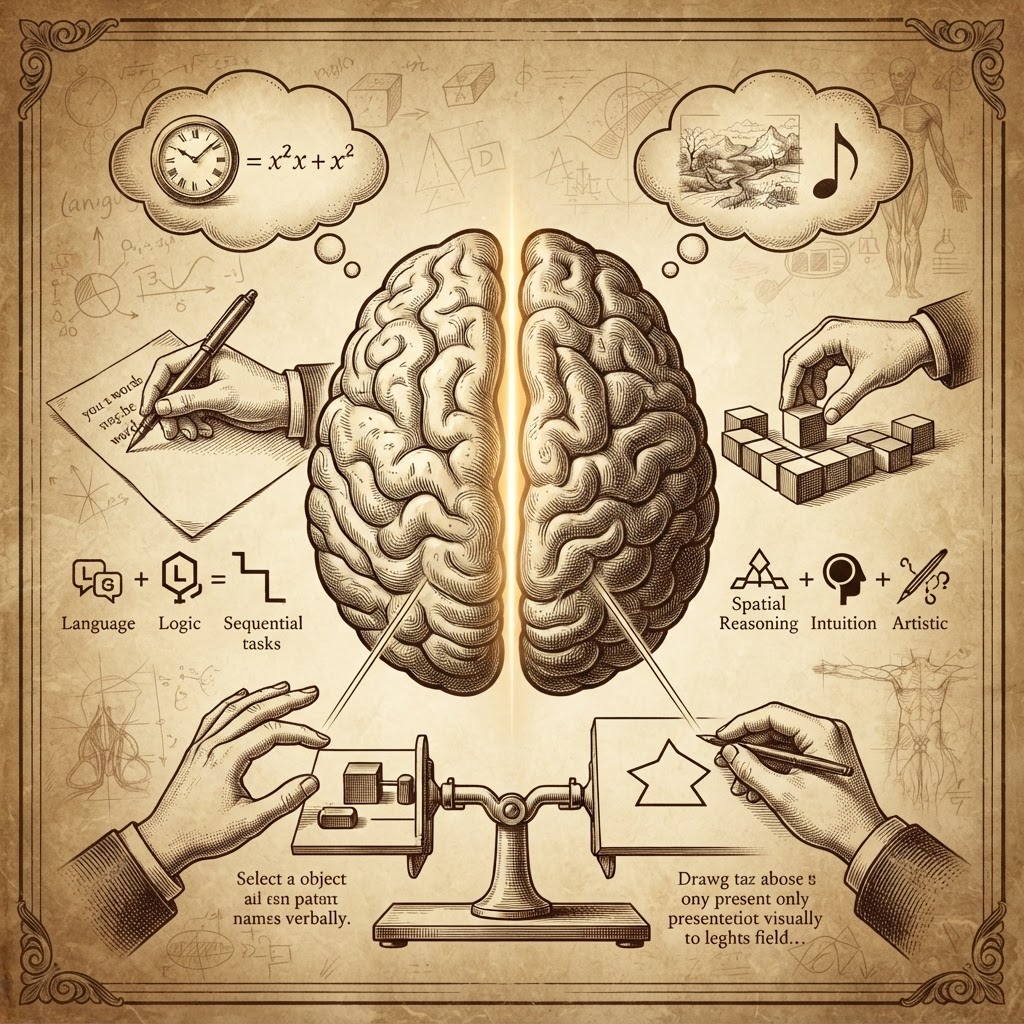
The experiments were deceptively simple because they exploited a quirk of brain wiring: the visual fields project largely to the opposite hemisphere. A word flashed briefly to the right of fixation is processed by the left hemisphere; flashed to the left, it is routed to the right. In split‑brain patients the hemispheres could no longer exchange information directly.
- Language and the left hemisphere: When a word appeared in the right visual field, patients could read it aloud—no surprise, because language centers typically sit in the left hemisphere.
- Recognition without words: The same subject often could not name a word shown in the left visual field, yet could select a matching object with the left hand. The right hemisphere recognized the stimulus but lacked the speech machinery to report it.
- Two responses: In some experiments the two hands behaved as if guided by different priorities: one hand would button a shirt while the other undid the buttons. Patients sometimes described only the action of the hand controlled by the left, verbal hemisphere and remained unaware of the other’s motive.
The interpreter and the illusion of unity
Gazzaniga introduced the notion of the interpreter: a left‑hemisphere tendency to construct causal, verbal explanations for actions, even when those actions were initiated by nonverbal processes in the right hemisphere. This interpreter produced confabulations—plausible but fabricated explanations—revealing that our sense of a single, continuous self can be a post hoc narrative constructed by particular neural systems.
Why this was revolutionary
Before split‑brain work, the dominant image of mind was unitary: a single self animating behavior. Split‑brain studies forced a fundamental reinterpretation. They showed that cognitive functions are lateralized, that consciousness can be fractionated, and that what we call “I” may be an emergent narrative assembled from multiple processors. The findings bridged neurology, psychology, and philosophy—providing empirical ground for debates about modularity, agency, and the neural basis of subjective experience.
Legacy and why it matters today
Split‑brain research reshaped neuroscience. It refined ideas of localization, informed models of inter-regional communication, and seeded questions that today animate connectomics and consciousness science: How does widespread, patterned communication produce unified experience? Clinically, callosotomies remain a treatment for severe epilepsy, guided by the richer understanding of costs and benefits born in these experiments.
Beyond medicine, the split‑brain narrative influences contemporary debates about artificial intelligence and the architecture of cognition. If human mindhood can arise from interacting but semi-independent modules, then questions about how to assemble unified agents from specialized subsystems are no longer purely philosophical—they are engineering problems.
Unresolved threads
Despite its clarity, split‑brain research did not answer the deepest question: what neural dynamics constitute the minimal substrate of conscious unity? Modern imaging and electrophysiology point to complex, dynamic interactions across networks rather than a single locus. But how transient coalitions of neurons yield the seamless flow of experience remains the central open problem—one that the split‑brain experiments framed, but did not resolve.
Epilogue: A lesson in humility
What began in operating rooms and small laboratory booths became a lesson in intellectual modesty: the brain's architecture is both modular and integrative, and our feeling of a singular self is, in part, a story told by the brain itself. The split‑brain patients were not curiosities to be peered at from afar; they were collaborators in a discovery that continues to recalibrate how we think about mind, identity, and the biological roots of consciousness.