Why abrupt thaw matters
For decades climate models treated permafrost carbon release as a slow, nearly linear response to rising Arctic temperatures. That worldview is changing. Field observations, remote sensing of landscape collapse, and updated process models now show that abrupt permafrost thaw — rapid ground collapse, thermokarst lake formation, and deepening taliks — can expose ancient organic matter to microbial decomposition on timescales of years to decades rather than centuries.
From gradual seep to methane leap
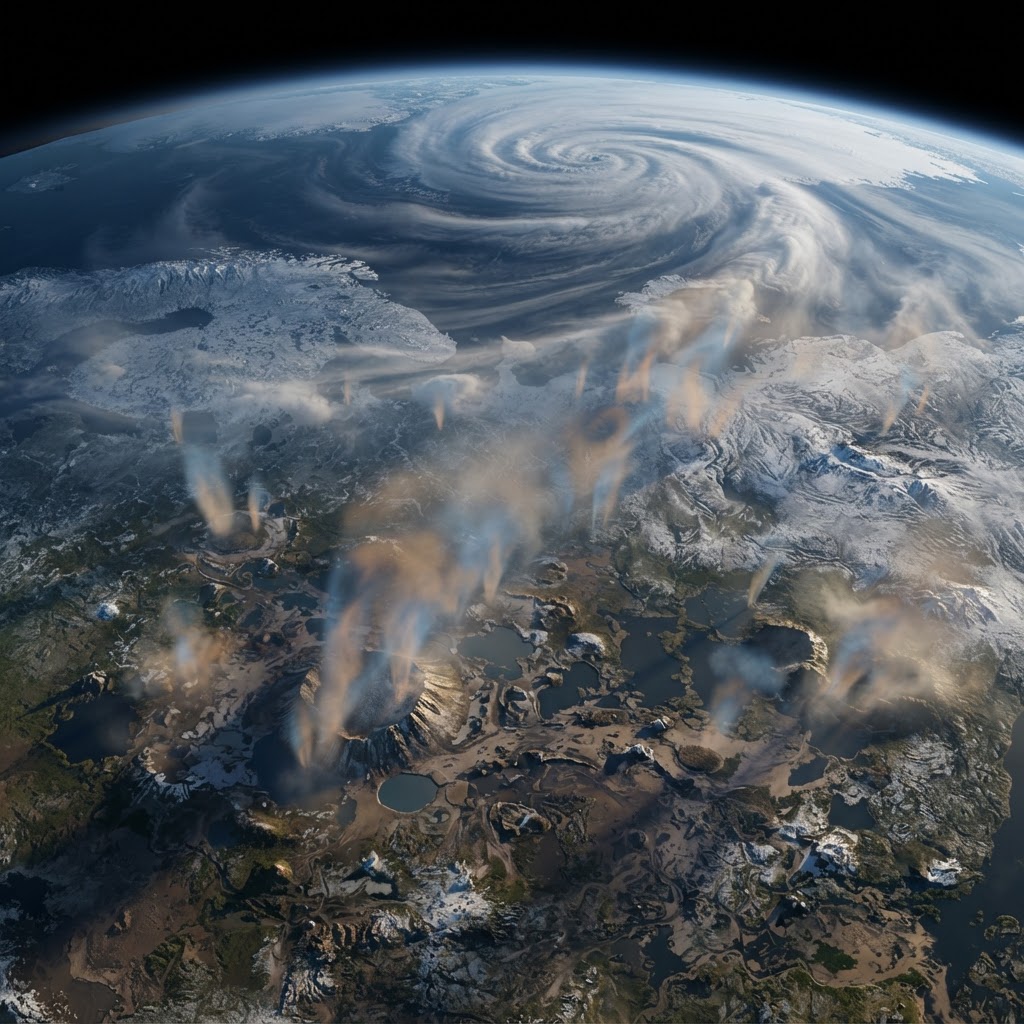
What makes abrupt thaw particularly consequential is the methane pathway. Methane (CH4) is produced under anoxic conditions when microbes break down labile carbon; it is far more potent than CO2 over decades. Abrupt thaw creates precisely the wet, oxygen-poor environments — inundated basins, expanding lakes, and saturated slumps — that favor methane production and release.
Critically, the relationship between thaw and methane is non-linear. Small increases in thaw area or depth can cross thresholds that convert formerly frozen, oxygenated soils into persistent methane-producing zones, producing pulses of emissions rather than a smooth ramp.
What recent work shows
Recent syntheses of field campaigns across Alaska, Siberia and northern Canada document localized hotspots where methane fluxes are orders of magnitude larger than from intact tundra. Remote-sensing studies show accelerating rates of thermokarst expansion in warming years. At the same time, process-rich models that explicitly simulate collapse, hydrology, and microbial dynamics now reproduce abrupt transitions and associated methane pulses, suggesting these are plausible at landscape scales.
Why this is a policy-relevant risk
- Climate forcing: Short, intense methane pulses can materially increase near-term radiative forcing, complicating efforts to meet warming limits tied to 2030–2050 targets.
- Modeling and attribution: Global carbon budgets and Integrated Assessment Models that omit abrupt thaw risk understate potential near-term emissions and may misinform mitigation pathways.
- Local impacts: Abrupt thaw damages infrastructure, alters hydrology, and affects people and ecosystems in Arctic communities — feedbacks that also influence carbon dynamics.
Uncertainties and the research frontier
Key uncertainties remain: the spatial extent of soils vulnerable to abrupt collapse, the proportion of newly thawed carbon that will be emitted as methane versus CO2, and the timescales over which pulses decay or persist. Improving observational coverage (long-term flux towers, high-resolution radar and optical surveillance, and targeted soil cores) and integrating those data into models that capture hydrologic thresholds are priorities.
Practical takeaway: Abrupt permafrost thaw transforms permafrost emissions from a mostly gradual background into a system with potential step-changes. That doesn't guarantee runaway warming, but it raises the odds of near-term methane-driven forcing spikes that amplify risk and complicate near-term climate policy.
Scientists call for explicitly representing abrupt thaw in scenario exercises and for policymakers to recognize that permafrost is not a passive bank of carbon but an active, sometimes volatile, component of the Earth system.