How we found the hole and what makes it grow
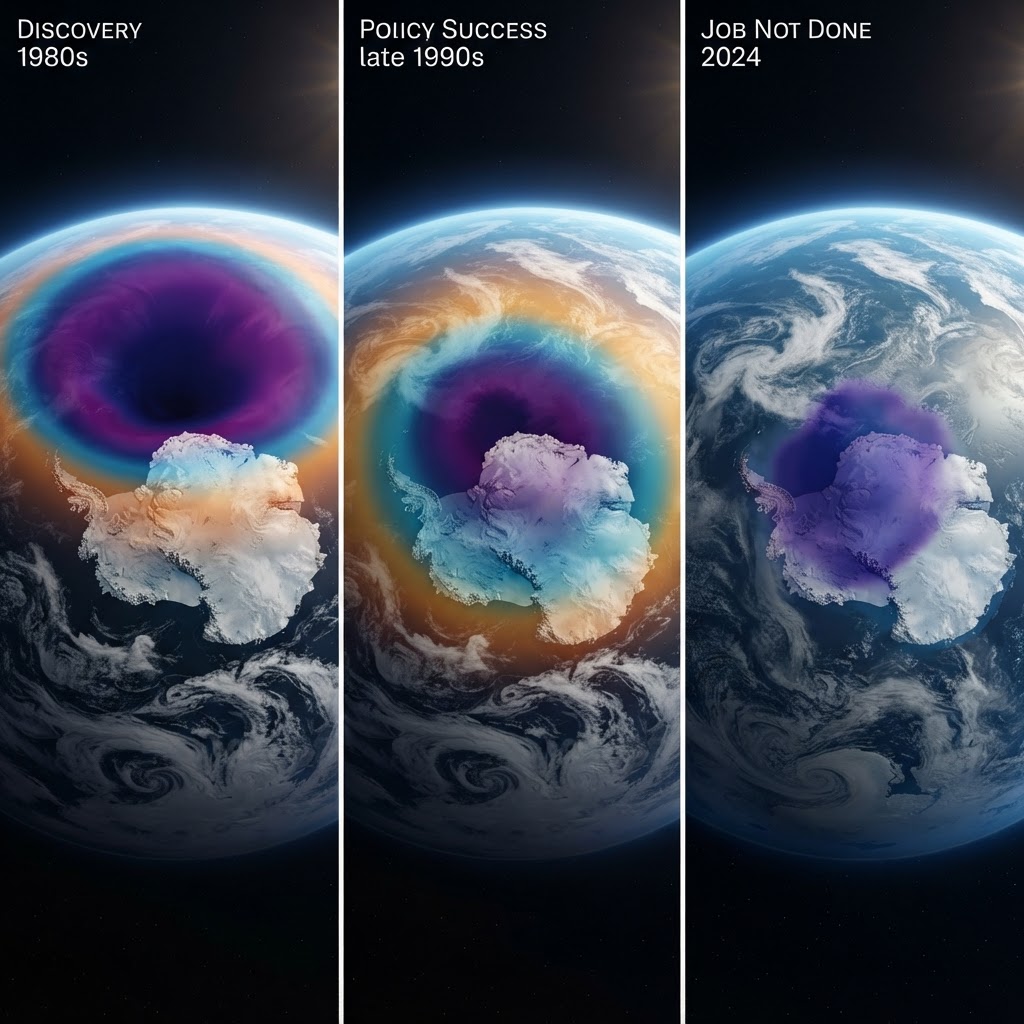
In 1985 a trio of British scientists—Brian Farman, Joe Shanklin and Jonathan Gardiner—published measurements showing dramatic, seasonal losses of total ozone above Antarctica. The result was immediate and unsettling: a persistent, annual "ozone hole" that formed each Southern Hemisphere spring. The mechanism they had revealed is now well understood.
Chlorofluorocarbons (CFCs) and related ozone‑depleting substances (ODS) released at the surface slowly rise into the stratosphere. There, ultraviolet light frees chlorine and bromine atoms that engage in catalytic cycles, destroying ozone molecules much faster than they are created. The Antarctic is especially vulnerable because a strong polar vortex isolates the air in winter, allowing temperatures to fall enough for polar stratospheric clouds (PSCs) to form; chemical reactions on PSC surfaces convert reservoir species into reactive halogens that, when sunlight returns in spring, trigger rapid ozone loss.
Policy response and the Montreal Protocol
The international response was unusually fast and robust. The Montreal Protocol, agreed in 1987 and subsequently strengthened by amendments, phased out the production and use of CFCs, halons and other ODS. It is widely regarded as the most successful multilateral environmental agreement to date: emissions of key ODS fell rapidly, and atmospheric abundances stopped rising and began to decline.
Signs of recovery — and the caveats
Recent assessments from the World Meteorological Organization and the United Nations Environment Programme show clear evidence that the stratospheric chlorine burden is decreasing and that ozone is on a slow path to recovery. Models and observations indicate a return to near‑pre‑1980 ozone levels across much of the globe by mid‑century, though the Antarctic springtime hole is expected to take longer — commonly projected into the 2060s or later.
But recovery is conditional. Two main complications complicate the simple headline of "success":
- Climate interactions. A warming troposphere implies a cooler stratosphere, which favors PSC formation and can strengthen polar depletion events. Changes in large‑scale circulation (the Brewer–Dobson circulation) also redistribute ozone differently, so regional recovery timelines vary and are sensitive to greenhouse‑gas trajectories.
- Human noncompliance and surprises. The detection in the late 2010s of unexpected emissions of CFC‑11 showed that illegal production or unreported sources can blunt progress if not caught and stopped. Vigilant atmospheric monitoring remains essential.
Why the ozone story still matters now
The ozone story is not merely historical: it is a live case study in how global chemistry, climate, and policy interact. The Montreal Protocol’s success offers two immediate lessons. First, robust monitoring and adaptive governance can detect and correct deviations (as happened after the CFC‑11 episode). Second, addressing ozone through production bans also produced climate co‑benefits: many ODS are potent greenhouse gases, and their phase‑out has avoided additional warming.
Looking ahead: scientists will track the interplay between ozone recovery and climate change, refine regional projections, and sustain observations of trace gases. The headline is hopeful: coordinated, science‑based policy has set the ozone layer on a path to recovery. The fine print is ongoing work — and a reminder that global environmental repair requires both soft power and continuous scientific vigilance.