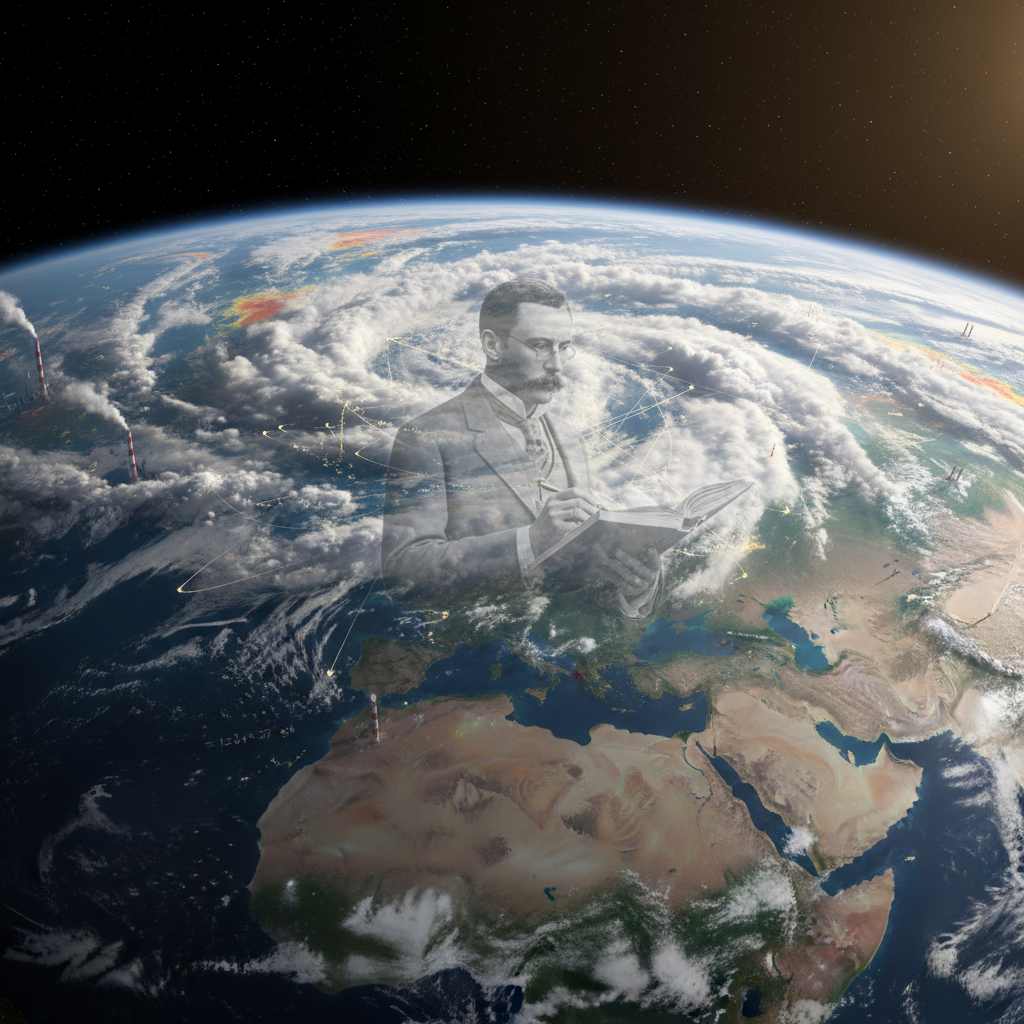
On a winter evening in 1895, Svante Arrhenius sat down in Stockholm to perform a calculation that would eventually reshape humanity’s understanding of climate. He was not studying smokestacks or predicting modern carbon emissions. His question was more remote: why had Earth emerged from the last ice age, and could changes in atmospheric carbon dioxide help explain it?
Arrhenius, a Swedish physical chemist already famous for his theory of electrolytic dissociation, approached the atmosphere as a planetary laboratory. The essential insight was not new. In 1824, the French mathematician and physicist Joseph Fourier had argued that Earth’s atmosphere must retain heat, helping explain why the planet was warmer than a bare rock exposed to sunlight. In the 1850s, Eunice Foote and, independently, John Tyndall demonstrated that gases including carbon dioxide and water vapor absorb radiant heat. Tyndall’s experiments were especially influential: they showed that the atmosphere could be transparent to incoming sunlight yet selectively opaque to outgoing infrared radiation.
What remained was to calculate the climate consequence.
From laboratory absorption to a planetary forecast
Arrhenius drew on measurements by Tyndall and other researchers, along with estimates of how radiation moved through the atmosphere. He divided the atmosphere into layers and considered how changes in carbon dioxide would alter the balance between energy arriving from the Sun and heat escaping to space. The physics was approximate by modern standards, but the conceptual architecture was remarkably sound.
In his 1896 paper, published in the Philosophical Magazine, Arrhenius estimated that doubling atmospheric carbon dioxide could raise global mean temperature by roughly 5–6 °C. He also calculated that halving carbon dioxide could produce cooling of a similar order, an effect he proposed might help account for glacial climates. Later revisions reduced his estimate for doubled carbon dioxide; contemporary assessments place the direct equilibrium response, including important feedbacks, near 3 °C, with a likely range around it. Yet Arrhenius had identified the governing relationship: more carbon dioxide means less infrared heat escapes to space until the surface and lower atmosphere warm enough to restore the planetary energy balance.
A calculation made by hand
The achievement is easy to underestimate because the modern greenhouse effect is often presented through computer models and satellite observations. Arrhenius had neither. His work required laborious numerical tables, hand calculations, and physical approximations about cloud cover, water vapor, snow, and the atmosphere’s vertical structure. He reportedly enlisted his colleague Arvid Högbom, a geologist, to help estimate carbon dioxide sources and sinks.
Arrhenius’s calculations were also motivated by a distinctly nineteenth-century question: whether human industry might eventually influence climate. In a 1906 revision, he wrote that coal burning could produce a perceptible warming and even imagined this as a future benefit for colder regions. His estimate of the rate of emissions was too low, and he did not foresee the scale and speed of twentieth- and twenty-first-century fossil-fuel use. But the central possibility was unmistakable: civilization could become a geological force.
Why the idea met resistance
Arrhenius’s proposal entered a scientific world still struggling to understand atmospheric physics. Some researchers believed water vapor, not carbon dioxide, was the dominant greenhouse gas; others suspected that infrared absorption would quickly saturate and cease to matter. The role of clouds and atmospheric convection was poorly understood. Even Arrhenius’s own paper contained assumptions that would not survive modern scrutiny.
Those limitations did not invalidate the mechanism. They marked the normal boundary between a pioneering calculation and a mature science. Subsequent work by researchers including Guy Stewart Callendar in the 1930s, Gilbert Plass in the 1950s, and Charles Keeling from the late 1950s onward progressively connected theory, spectroscopy, measurements, and observed atmospheric change. Laboratory physics established the absorption properties of carbon dioxide with increasing precision; ice cores revealed the intimate relationship between greenhouse gases and past climate; instruments recorded the steady rise of carbon dioxide from fossil-fuel burning.
The legacy of a planetary thought experiment
Arrhenius’s great contribution was not a perfectly accurate number. It was the act of making climate sensitivity calculable. He transformed the greenhouse effect from a qualitative description into a quantitative planetary problem—one in which a trace atmospheric constituent could alter the temperature of the entire world.
That insight remains foundational today. Climate models are vastly more detailed than Arrhenius’s layered atmosphere, incorporating oceans, ice sheets, ecosystems, aerosols, clouds, and circulation. Yet their basic energy constraint is the same one he recognized: Earth must balance absorbed sunlight against emitted infrared radiation. Increasing carbon dioxide shifts that balance, and warming follows.
More than a century later, the significance of Arrhenius’s calculation is both scientific and historical. It reminds us that climate change was not discovered by a single satellite or a recent computer model. Its physical basis was assembled through generations of experiments and, in Arrhenius’s case, an audacious attempt to make an entire planet yield an answer on paper.