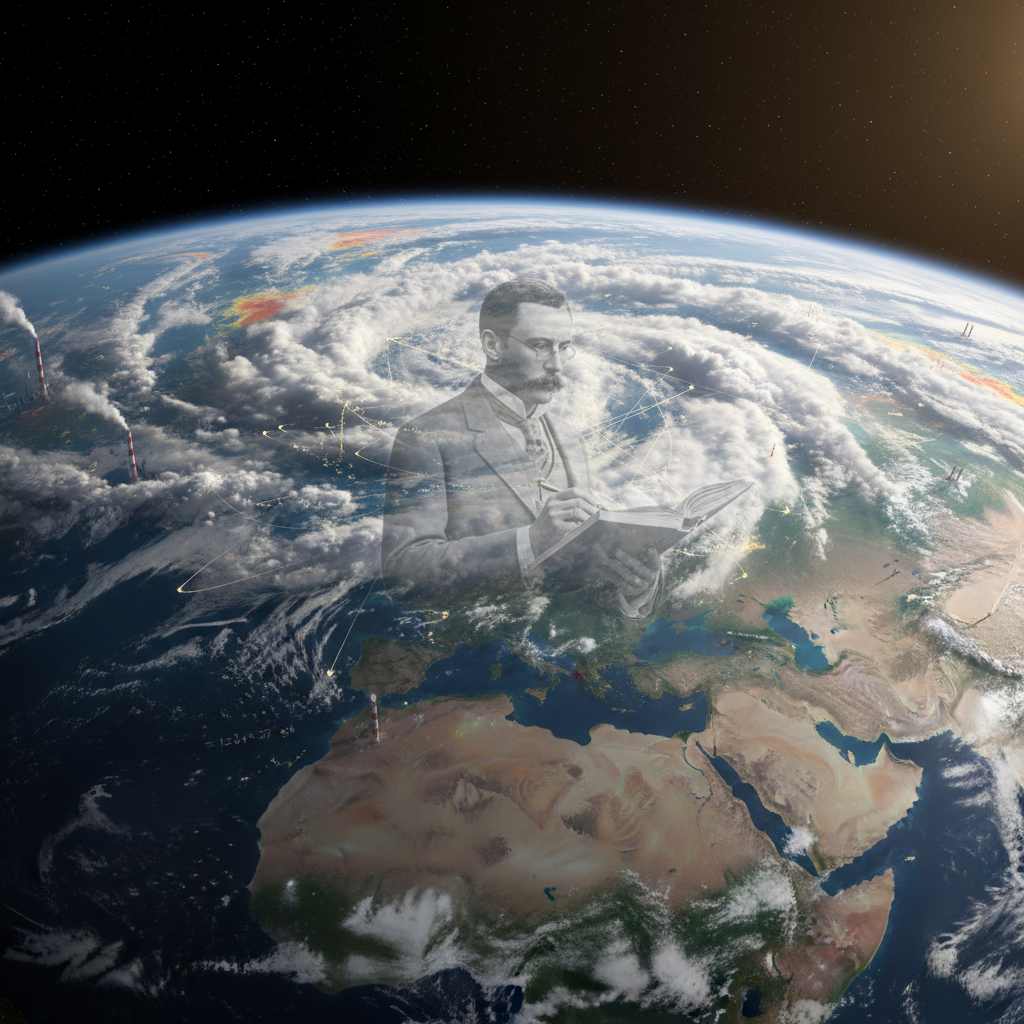
Origins: A Planetary Anomaly and a Bold Inference
In the late 1960s, James Lovelock was working for NASA on methods to detect life on Mars when he made an observation that would reorient his career. The Martian atmosphere, he noted, was dominated by carbon dioxide and sat close to thermodynamic equilibrium — exactly what chemistry predicts in the absence of life. Earth's atmosphere, by contrast, was a riot of disequilibrium: oxygen at 21%, methane coexisting with that oxygen despite rapid mutual oxidation, and a nitrogen-rich envelope that no purely geological process would maintain. Something was continuously doing work to keep Earth's atmosphere far from equilibrium. Lovelock's inference was radical: the biosphere was not merely inhabiting Earth's surface, it was regulating it.
Collaborating with microbiologist Lynn Margulis through the 1970s, Lovelock formalized this as the Gaia hypothesis — named at the suggestion of novelist William Golding. The core claim was that living organisms and their inorganic surroundings form a tightly coupled system that self-regulates surface temperature, ocean salinity, atmospheric composition, and soil chemistry within ranges conducive to life. The planet, in this framing, behaves analogously to a physiological organism maintaining homeostasis.
The Mechanistic Core: Feedback Loops, Not Teleology
Early criticism centered on the apparent teleology: how could the biosphere have a purpose without an intentional agent? Lovelock's answer, refined over decades, was that Gaia requires no foresight. It operates through emergent feedback loops — the same logic that governs a thermostat or a predator-prey oscillation. Several well-characterized mechanisms illustrate the principle.
The carbonate-silicate cycle is perhaps the most powerful long-term thermostat. When CO₂ rises and temperatures increase, silicate weathering accelerates — biologically enhanced by root systems and mycorrhizal fungi, which can increase weathering rates by one to three orders of magnitude compared to abiotic baselines. This draws CO₂ from the atmosphere into carbonate sediments, cooling the planet. Life is not incidental to this cycle; it is the dominant driver of its sensitivity.
Dimethylsulfoniopropionate (DMSP) and the CLAW hypothesis proposed by Charlson, Lovelock, Andreae, and Warren in 1987 offers a finer-scale example. Marine phytoplankton produce DMSP, which degrades to dimethylsulfide (DMS). DMS oxidizes in the atmosphere to sulfate aerosols, which seed cloud formation, increasing albedo and cooling surface waters. Cooler, more nutrient-rich upwelling should favor phytoplankton growth, completing a negative feedback loop. Quantitative assessments have complicated the picture — the feedback's sign and magnitude remain debated — but the mechanism itself is real and measurable, with DMS flux representing roughly 50% of global biogenic sulfur emissions.
Oxygen regulation represents another compelling case. Atmospheric O₂ has remained between approximately 15% and 35% for the past 350 million years, never dropping below the threshold for animal respiration or rising to levels where forests would combust spontaneously. Geochemical models suggest purely abiotic processes cannot explain this stability. Biological feedbacks — including the burial of organic carbon, methane oxidation by methanotrophs, and fire-vegetation interactions — appear to stabilize O₂ within viable bounds.
Daisyworld and the Thermodynamics of Regulation
To demonstrate that planetary regulation could emerge without teleology, Lovelock and Andrew Watson introduced the Daisyworld model in 1983. The model populates a planet with only two species: black daisies that absorb heat and white daisies that reflect it. As solar luminosity increases, white daisies — which thrive in warmer conditions and cool their local environment — outcompete black ones, raising planetary albedo and resisting warming. The system stabilizes temperature across a wide range of solar inputs far more effectively than a lifeless planet would.
Daisyworld has been extended and critiqued extensively. Adding herbivores, mutation rates, and multiple species generally preserves the regulatory behavior. The model's deeper significance is thermodynamic: Axel Kleidon and others have argued that living systems maximize entropy production and free energy dissipation in ways that structurally couple to planetary-scale stabilization. This connects Gaia to non-equilibrium thermodynamics, giving the hypothesis a firmer physical foundation than biological analogy alone.
Evidence, Tensions, and the Limits of Gaia
The empirical record offers partial but meaningful support. Palaeoclimatic data show that despite a ~30% increase in solar luminosity since life's origin 3.8 billion years ago — the so-called Faint Young Sun paradox — surface temperatures have remained within liquid-water bounds. No purely geological explanation fully accounts for this stability; biological modulation of greenhouse gases and albedo is a leading candidate. Similarly, the Great Oxidation Event (~2.4 billion years ago) and subsequent oxygen fluctuations track closely with biological innovations, demonstrating life's capacity to fundamentally reshape atmospheric chemistry.
Yet Gaia has genuine limits. Evolutionary biologists, most famously Richard Dawkins and Ford Doolittle, objected that natural selection operates on individual organisms, not planetary systems. There is no mechanism by which a trait that benefits the whole biosphere is selected for at the organism level — in fact, organisms that over-exploit their environment may outcompete those that regulate it. Lovelock's response — that Gaia is not optimized but simply the survivor among possible biospheres — is logically coherent but difficult to test. Some planetary transitions, including Snowball Earth episodes (~700 million years ago), suggest that biological feedbacks can fail catastrophically and that the system does not always self-correct.
The relationship between Gaia and biodiversity is also unresolved. Models suggest that higher species diversity typically increases regulatory robustness — consistent with a Gaia-like view — but empirical tests across ecosystems yield mixed results. Whether the planetary-scale system is more or less resilient than its components remains an open empirical question.
Gaia in the Anthropocene: From Theory to Urgency
The hypothesis has acquired new relevance as humans become a geological force. Lovelock himself argued in his later work that anthropogenic emissions represent a perturbation at a scale that Gaian feedbacks may be too slow to counter on human timescales. The carbon cycle's biological components — forests, soils, marine phytoplankton — currently absorb roughly half of anthropogenic CO₂ emissions, a Gaian buffer of extraordinary practical importance. Yet deforestation, ocean acidification, and warming-induced permafrost thaw risk converting these sinks to sources, potentially triggering positive feedbacks that overwhelm regulatory mechanisms.
The Tipping Elements framework developed by Lenton, Schellnhuber, and colleagues explicitly draws on Gaian thinking, identifying subsystems — the West Antarctic Ice Sheet, the Amazon rainforest, Atlantic Meridional Overturning Circulation — whose crossing of thresholds could cascade into planetary-scale regime shifts. A 2018 analysis in PNAS warned of a potential "Hothouse Earth" trajectory in which interconnected tipping cascades push the system to a new, hotter stable state — a Gaian system, but one radically less hospitable to human civilization.
Open Questions and the Future of Earth System Science
Modern Earth system science has largely absorbed Gaian thinking without fully endorsing its strongest claims. The field accepts that life and geochemistry are deeply coupled; it remains agnostic on whether this coupling constitutes regulation in any rigorous sense. Key unresolved questions include:
- Quantifying biological versus abiotic contributions to major geochemical cycles across timescales — a problem requiring better integration of isotope geochemistry, Earth system modeling, and palaeobiology.
- The evolutionary mechanism problem: Can multilevel selection theory, niche construction, or ecosystem engineering provide a Darwinian pathway to planetary-scale regulation without invoking group selection at implausible scales?
- Exoplanetary biosignatures: If Gaia is correct, a living planet should show persistent atmospheric disequilibrium detectable from afar. This connects the hypothesis directly to the search for life beyond Earth — arguably its most testable frontier.
- Resilience thresholds: At what point do anthropogenic pressures exceed the regulatory capacity of Earth's biotic systems, and how would we know before we crossed that line?
Lovelock, who died in 2022 at the age of 103, lived to see the hypothesis he once advanced in relative isolation become a structuring principle of Earth system science — if not under his name, then certainly in its spirit. The Earth is not simply a stage on which life performs; it is, in some meaningful sense, a system that life has built and continues to maintain. The precise boundaries of that claim remain science's work to define.