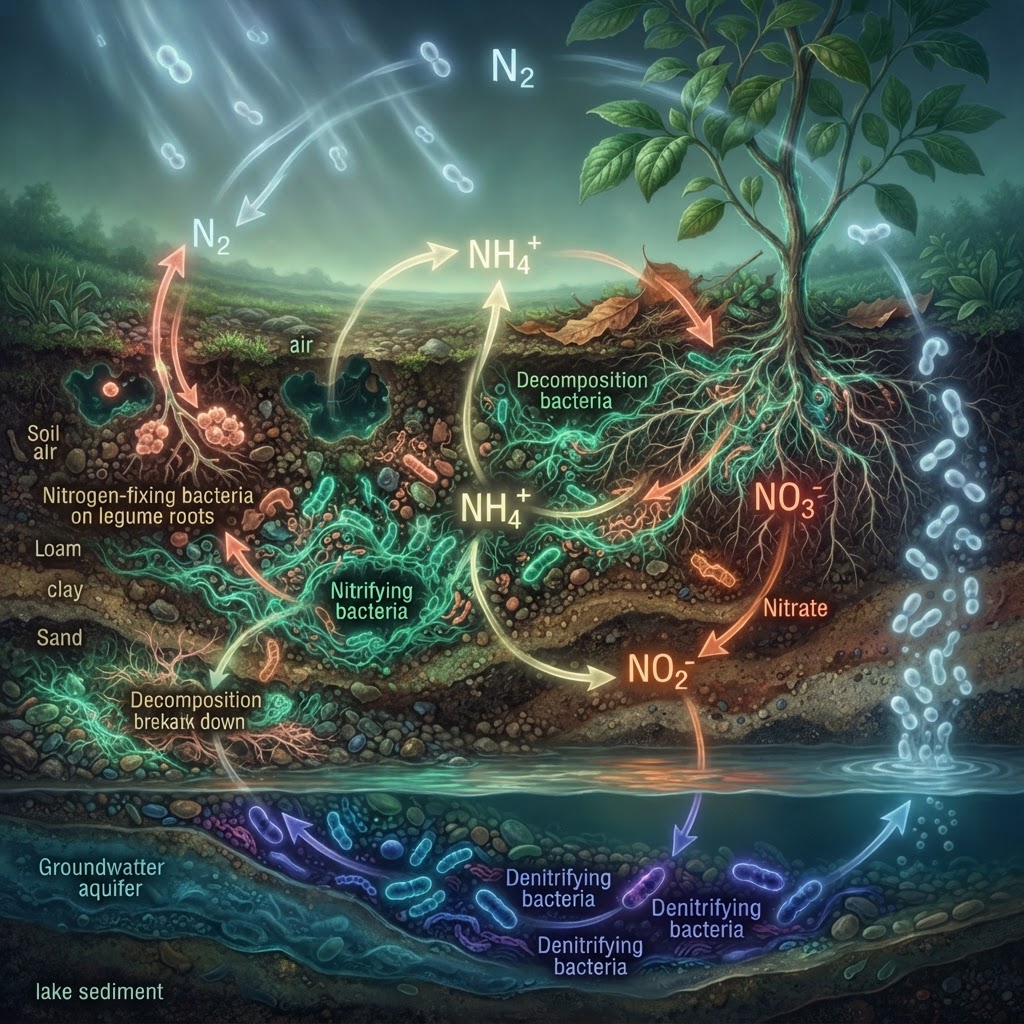
The hidden circuitry of life
Nitrogen is essential for proteins, DNA and the cellular machinery of every living thing, yet most of the planet’s nitrogen—molecular N2 in the atmosphere—is chemically inert. The conversion between inert N2 and bioavailable forms (ammonium, nitrate, organic N) is performed almost entirely by microbial metabolism. That planetary choreography — the nitrogen cycle — is not a static backdrop to ecology but a dynamic, microbial-powered engine that responds to climate, human action and evolutionary innovation.
Who does the work — and how?
Diazotrophs (nitrogen-fixing microbes) break the triple bond of N2 using the nitrogenase enzyme family and supply new reactive nitrogen to ecosystems. Traditionally, cyanobacteria and symbiotic Rhizobia dominated the story; recent metagenomic surveys have drastically broadened the cast, finding nitrogenase genes across unexpected bacterial lineages and environments from oxygenated surface oceans to dry soils.
Nitrifiers oxidize ammonium to nitrite and nitrate, processes long thought to require two cooperating microbes. The 2010s discovery of comammox organisms that perform complete nitrification in a single cell upended that tidy division of labor and forced modelers to reevaluate nitrogen turnover rates in soils and engineered systems.
Denitrifiers, anammox and DNRA return reactive nitrogen to inert N2 or to other reduced forms. These pathways determine whether a system removes excess nitrogen or instead releases nitrous oxide (N2O), a potent greenhouse gas and ozone-depleting compound. Microbial community composition, oxygen levels and carbon availability steer these alternative fates.
Why this is a current story
- Metagenomics and single-cell sequencing are uncovering new diazotrophs and expanding the taxonomic breadth of nitrogen-cycling taxa, forcing recalibration of global nitrogen budgets.
- Observations from oxygen minimum zones, wetlands and agriculture show that small shifts in microbial community structure can alter whether an ecosystem is a net N2O source—relevant to climate mitigation.
- Applied biology is pushing the boundary: companies and academic consortia are racing to reduce fertilizer dependence by engineering crop–microbe associations or deploying microbial inoculants, translating basic ecology into near-term interventions.
Practical stakes: climate, food and water
Human Haber–Bosch fertilizer production now rivals natural biological fixation in magnitude, transforming terrestrial nitrogen budgets, driving eutrophication and fueling N2O emissions. Because microbes determine whether added nitrogen is retained in soils, leached into waterways or emitted as N2O, understanding and managing microbial processes is central to decarbonization and sustainable agriculture.
What’s unsettled
Genomes have exposed microbial potential, but linking genes to in situ rates at landscape-to-global scales remains difficult. Key open questions: which microbes control N2O hotspots under realistic field conditions; how will warming, drought and changing land use rewire nitrogen metabolisms at scale; and can engineered microbial solutions be made reliable and safe across diverse soils?
Bottom line: bacteria are not passive components of a chemical cycle; they are active engineers whose diversity, physiology and ecological interactions determine where nitrogen flows — and how much of it ends up warming the planet or feeding the next harvest. Recent genomic and ecological work has widened the view of who performs these roles, but turning that knowledge into predictive models and robust interventions is the urgent, practical frontier.