The Classical Limits of the Induced Fit
For decades, the "induced fit" model has served as the cornerstone of enzymology. When a substrate binds to an allosteric site, the enzyme undergoes a conformational change, transmitting mechanical information across nanometers to the active site. Yet, classical thermodynamics and molecular dynamics struggle to fully explain the sheer speed and efficiency of these structural shifts. How does a localized binding event propagate a deterministic, long-range structural wave through a noisy, viscous cellular environment in mere picoseconds?
Classical models often treat proteins as Newtonian machines, relying on thermal fluctuations to cross activation barriers. However, recent advances in quantum biology suggest that classical mechanics alone cannot account for the sub-nanosecond timescales observed in biological catalysis. The energy required to drive these massive conformational changes must be transported without dissipating into the surrounding thermal bath. If enzymes relied solely on random thermal jiggling, the precise, coordinated movements required for allosteric regulation would be statistically improbable within the observed timeframes.
Enter the Davydov Soliton
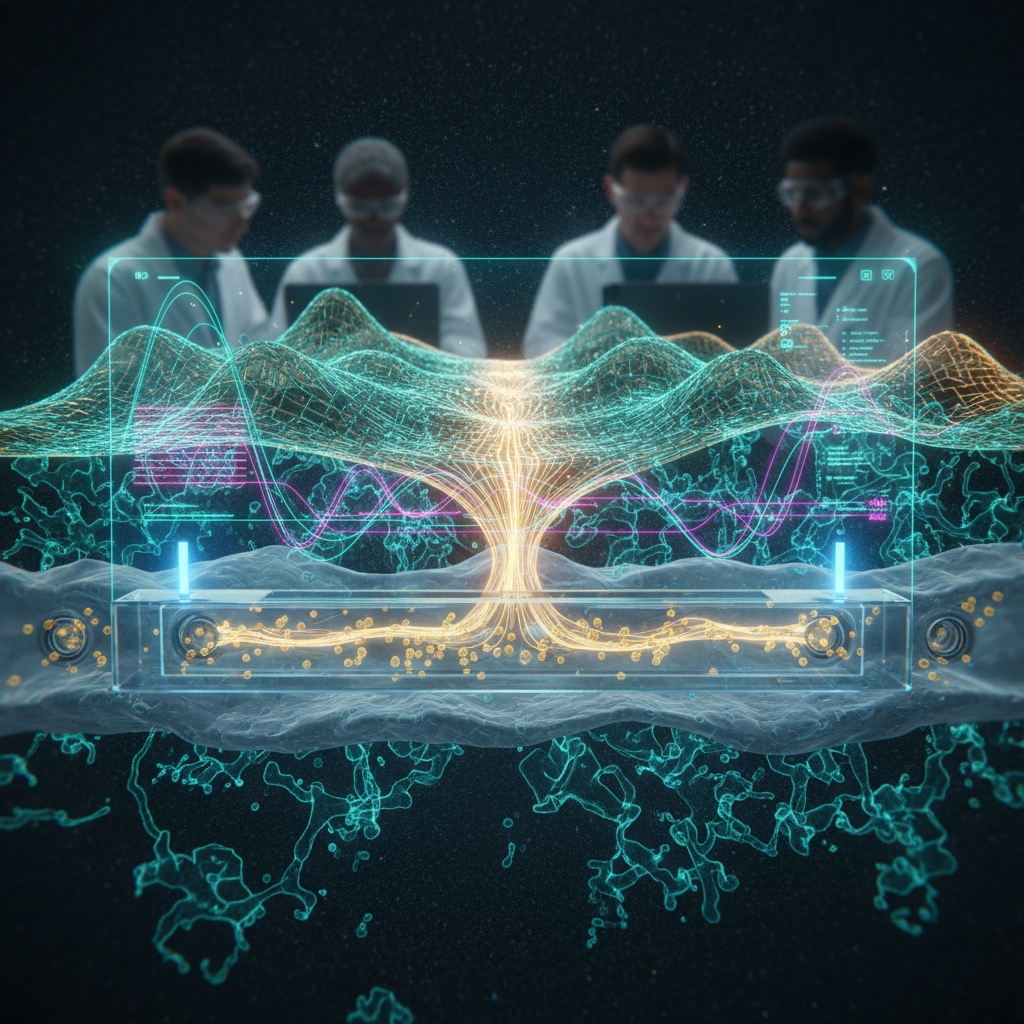
In the 1970s, physicist Alexander Davydov proposed a radical solution: the biological soliton. He theorized that the energy released by ATP hydrolysis or substrate binding could be trapped in the amide I vibrational modes of a protein's alpha-helices. Through nonlinear interactions with the protein lattice, this localized energy could propagate as a self-sustaining wave—a vibrational exciton, or Davydov soliton. As detailed in computational studies like On the quantum dynamics of Davydov solitons in protein - α, these solitons can theoretically travel along the hydrogen-bonded spines of alpha-helices, providing a mechanism for directed energy transfer without thermal degradation.
However, the existence of Davydov solitons in biological systems has remained highly controversial. Critics argue that the lifetime of such quantum states at physiological temperatures (300 Kelvin) would be too short, succumbing to decoherence before any meaningful biological work could be accomplished. The challenge has been to reconcile the elegant mathematics of soliton theory with the messy reality of wet, warm biology. Moving solitons were computationally shown to launch when amide I energy was applied at helix ends, but translating this to a universal mechanism for allostery required a more robust theoretical bridge.
Quantum Perturbation and the Energy Gap
A breakthrough in this theoretical impasse comes from a 2026 study, Quantum mechanical justification for induced fit model conformational changes in allosteric enzymes based on the quantum perturbation theory and Davydov’s soliton theory. Researcher Farzam Faeznia developed a refined quantum framework that applies open-system perturbation theory to the induced-fit model. By evaluating realistic biochemical parameters, the study found a critical limitation: under normal assumptions, the quantum excitation energy generated by substrate binding remains orders of magnitude below the threshold needed to drive a stable classical Davydov soliton.
This finding implies that classical Davydov conditions alone are insufficient to explain enzyme catalysis on sub-nanosecond timescales. To bridge this energy gap, the framework identifies the necessity of multi-state energy accumulation and strong quantum-coherent processes. Rather than a single, massive energy injection, the enzyme must harness multiple, coupled vibrational states, utilizing quantum coherence to amplify the signal and drive the conformational shift before decoherence takes over. This open-system perturbation approach provides a rigorous mathematical justification for how an enzyme might "cheat" classical thermodynamics by operating as a coherent quantum network.
Competing Hypotheses and the Role of Tunneling
While the soliton-perturbation model offers a compelling explanation for long-range allostery, it must be situated within the broader landscape of quantum enzymology. The most well-documented quantum effect in biology is nuclear quantum tunneling, particularly proton and hydride tunneling during the chemical step of catalysis. As noted in Quantum Catalysis in Enzymes, the transfer of light particles is almost always dominated by quantum-mechanical tunneling, highly dependent on the evolution of zero-point energy along the reaction path.
Furthermore, research such as Nuclear quantum tunnelling in enzymatic reactions – an overview highlights the coupling of specific substrate and protein vibrations to the chemical coordinate. The competing hypothesis to the soliton model is that these localized, compressive dynamics—rather than long-range excitons—are sufficient to lower the activation barrier. The new perturbation framework attempts to unify these views, suggesting that while localized tunneling handles the chemical transformation, macro-quantum effects like coherent exciton transport are required to set the physical stage via the induced fit. In this unified view, the enzyme is a dual-action quantum machine: using solitons for structural preparation and tunneling for chemical execution.
Open Questions and Future Directions
The integration of quantum perturbation theory with Davydov's solitons represents a bold leap forward, but it leaves several critical questions unresolved. First, how exactly do enzymes achieve the multi-state energy accumulation required to overcome the excitation threshold? The precise molecular mechanisms that allow a protein to act as a quantum capacitor, storing and synchronizing vibrational energy across multiple states, remain purely theoretical.
Second, experimental verification is desperately needed. While computational models and perturbation theory provide a rigorous mathematical foundation, detecting transient quantum coherence in large macromolecules at room temperature requires next-generation spectroscopic techniques. Future research must focus on ultrafast two-dimensional infrared (2D IR) spectroscopy and advanced femtosecond laser techniques to observe these vibrational excitons in real-time.
Ultimately, if this quantum mechanical justification holds true, it will fundamentally rewrite our understanding of biological catalysis. Enzymes would no longer be viewed merely as classical lock-and-key mechanisms, but as sophisticated quantum machines, exquisitely tuned by evolution to exploit the deepest laws of physics to sustain life.