Summary of recent reports
Over the past two decades a small but growing literature has shifted the question from whether quantum coherence exists in biology to how coherence and decoherence participate in biological information processing. Landmark experiments — most notably 2D electronic spectroscopy studies that revealed long-lived excitonic coherences in photosynthetic complexes (Engel et al., 2007; Collini et al., 2010) — catalyzed theoretical work showing that environmental interactions can assist rather than simply destroy information transfer. More recent theoretical and experimental reports synthesize these ideas into an operative framework: short-lived phase coherence creates temporally structured correlations, and controlled decoherence converts those correlations into reliably readable population differences that downstream biomachinery can exploit.
How coherence shapes information flow
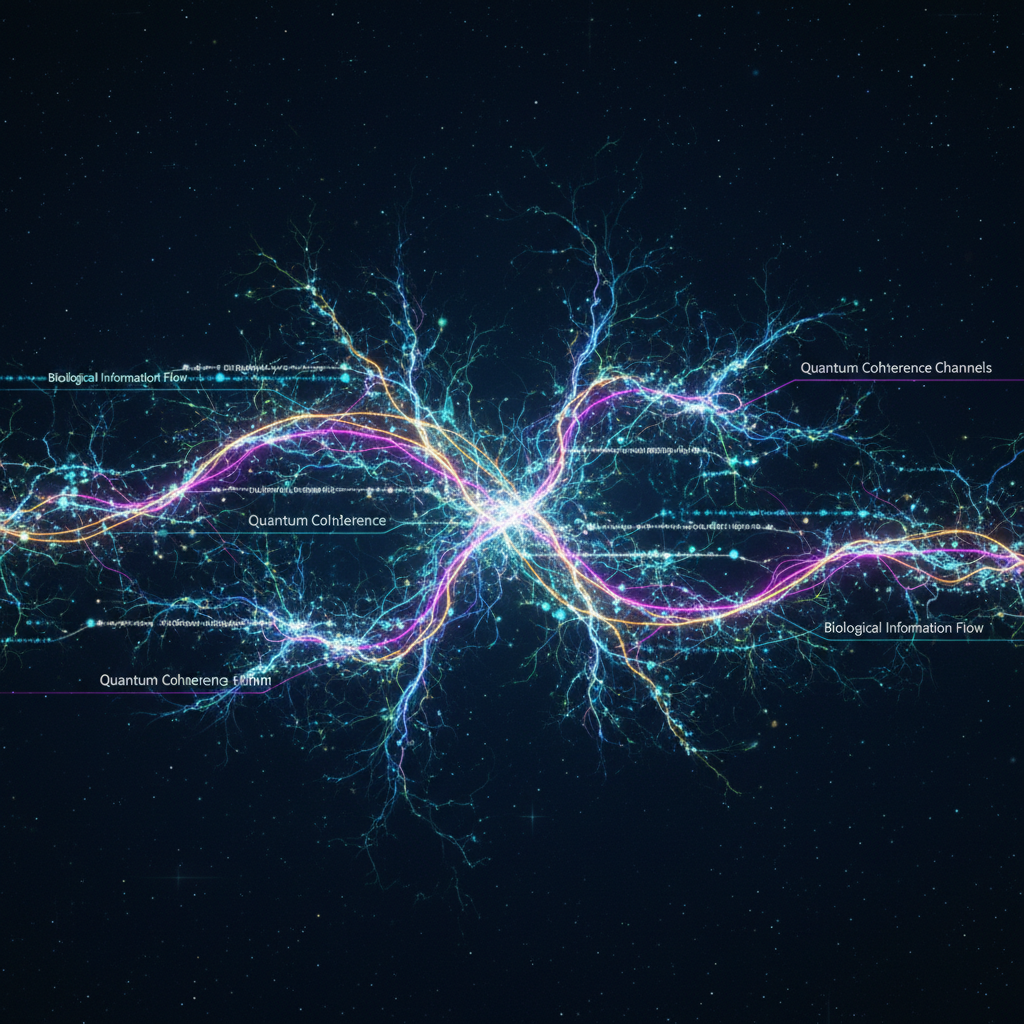
Coherence in molecular aggregates creates superposition states across pigment sites. Those superpositions are not long-lived quantum computers, but they do generate phase relationships that bias the route and timing of excitation transfer. In this view coherence functions as a temporal multiplex: phase encodes multiple possible transfer trajectories simultaneously, and interferometric effects boost transfer along productive routes. The environment — vibrations of the protein scaffold and solvent fluctuations — imposes decoherence, but not uniformly. A moderate, structured noise spectrum can suppress destructive interference and thereby enhance net information throughput, a phenomenon often described as environment-assisted quantum transport (ENAQT).
Decoherence as a functional operation
Recent analyses reframe decoherence from a failure mode into an operational step: the collapse-like mapping of phase information into populations is akin to a biological readout. When coherence endures long enough to coordinate pathways but decoheres on the timescale of biochemical coupling, the system converts transient quantum correlations into deterministic chemical outcomes. This two-step sequence — coherent routing followed by controlled decoherence — implements a form of signal conditioning that is familiar in engineered information systems. The radical-pair hypothesis for avian magnetoreception, strengthened by modeling studies (Gauger et al., 2011), provides an independent exemplar where entanglement and decoherence conspire to produce a magnetically sensitive chemical signal.
Evidence and limits
Key empirical tools remain ultrafast spectroscopy, spin-sensitive measurements, and cryogenic-to-room-temperature comparisons. Engel et al. (Nature, 2007) first observed quantum beats in a photosynthetic complex at low temperature; Collini et al. (Nature, 2010) extended the observation to room-temperature light-harvesting complexes, making biological relevance plausible. Complementary theoretical surveys synthesize these findings into testable mechanisms (Lambert et al., 2013), emphasizing that non-Markovian environments and discrete vibrational modes can prolong functional coherences.
Why this matters for complexity and emergence
If coherence/decoherence operate as information channels, then biological organization exploits a hybrid physics: classically staged biochemical networks augmented by transient quantum correlations. This hybridization expands the repertoire of emergent behaviors available to living systems without invoking long-lived macroscopic quantum states. It suggests new constraints on evolvability — organisms may tune molecular structure and environmental coupling to optimize information throughput under energetic and noise constraints.
Outstanding challenges and next steps
Despite progress, decisive demonstrations that living cells use quantum-coherent channels to perform real-world information tasks are still missing. Key unresolved items include: unambiguous in vivo measurements of coherence in intact cells, causal manipulations that alter coherence and measurably change organismal behavior, and quantitative accounting of the thermodynamic costs and reliability trade-offs of coherence-based signaling. The field needs targeted experiments: genetically encoded perturbations of pigment–protein coupling, in situ ultrafast spectroscopy with operando control of local noise, and synthetic bio-inspired systems that replicate putative quantum information operations under controlled conditions.
Bottom line: the narrative has evolved from ‘‘can quantum effects be observed?’’ to ‘‘how do transient quantum correlations and regulated decoherence function as information-processing primitives?’strong>. The coming years will test whether these primitives are incidental physical epiphenomena or evolved information channels — a distinction with broad implications for complexity science, synthetic biology, and the physics of life.