Introduction: a scientist wary of silos
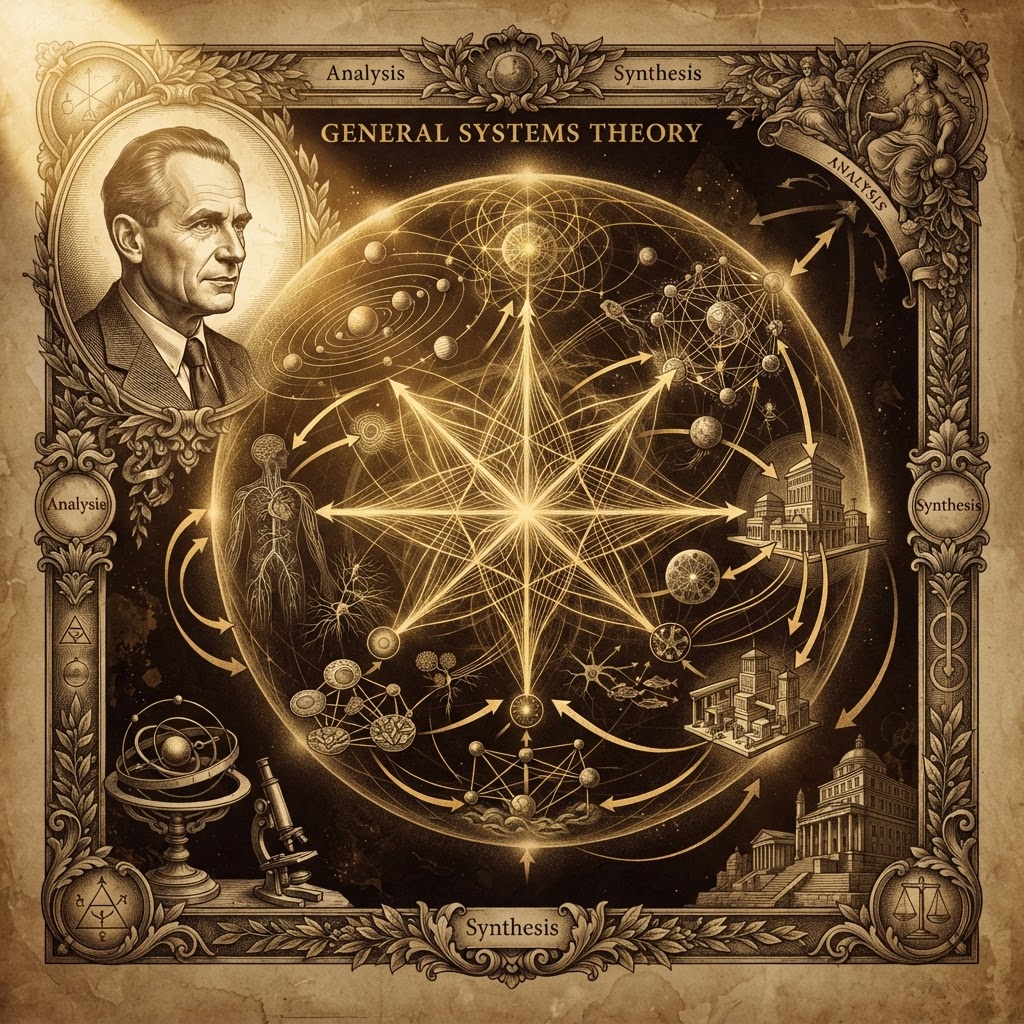
In the interwar and postwar years, sciences fractured into ever smaller specialties. Into that fragmentation stepped Ludwig von Bertalanffy, an Austrian biologist whose restless mind sought principles that transcended disciplines. He argued that certain patterns — feedback, stability, organization, emergence — recur across living organisms, machines, societies and ecosystems. His idea, christened General Systems Theory (GST), was not a manifesto of mysticism but an effort to build a rigorous language for relations.
Roots and historical context
Bertalanffy (1901–1972) worked amid a century of upheaval: shifting political borders, the rise of cybernetics, and a biology struggling to integrate genetics, physiology and ecology. He drew on earlier strands — Alexander Bogdanov’s Tektology (1913), which proposed universal organizational laws, and the simultaneous emergence of cybernetics under Norbert Wiener and Ross Ashby — but he insisted on an organic, open‑system view. Where much of classical physics emphasized closed systems and reduction to parts, Bertalanffy turned attention to exchange, boundary conditions and steady states in systems that interact continuously with their environment.
Core ideas made simple
Bertalanffy proposed several concepts that became canonical:
- Open systems: living and many social systems are open to matter, energy and information flows; their dynamics cannot be fully captured by isolated, closed‑system models.
- Equifinality: different initial conditions can lead to similar end states — a property of organized systems often invisible under reductionist analysis.
- Isomorphisms: recurring structural patterns across disciplines allow transfer of models and metaphors — feedback loops in physiology resemble regulation in engineering or homeostasis in ecology.
- Hierarchy and emergence: higher‑level properties arise from interactions among parts and are not trivially deducible from them.
Key figures and intellectual neighbors
GST did not arise alone. Norbert Wiener’s cybernetics (feedback and information theory), Ross Ashby’s work on adaptive systems, and Kenneth Boulding’s classification of systems enriched the conversation. Gregory Bateson brought anthropological and communication perspectives; Margaret Mead and Anatol Rapoport applied systems thinking to social and political problems. Together they formed a loose movement that reframed problems as questions of relation, boundary and flow.
Why it was revolutionary
GST changed the stakes. Instead of treating systems as mere collections of parts, it put relations first. That shift undermined the confidence that reductionism alone could explain life, mind and society. It offered a toolkit to recognize and formalize patterns shared across fields, legitimizing cross‑disciplinary transfer of ideas — from ecological models of resilience to organizational designs that mimic feedback control.
From theory to today: living legacies
General Systems Theory is not an antiquated intellectual artifact; it is the scaffolding under many modern endeavors. Systems biology models cellular networks rather than isolated genes. Climate science treats the Earth as a coupled system of atmosphere, biosphere and human activity. Supply‑chain fragility and pandemic responses are analyzed with systems maps and feedback reasoning. In management, Peter Senge’s learning organizations and Donella Meadows’ leverage points are direct heirs of GST.
Limits and the open questions
GST was bold in scope, modest in prediction. Critics argued it offered metaphors more than mechanistic predictions. The central unresolved challenge remains: how to convert the language of relations and emergence into precise, multiscale, predictive models without losing the qualitative insight that made GST powerful. As we build models for coupled human‑environment systems or for socio‑technical AI ecosystems, that tension between generality and rigor persists.
Conclusion: why it matters now
Bertalanffy taught a simple but radical lesson: phenomena make sense only in context. In an era of interconnected crises — climate change, global pandemics, algorithmic infrastructures — the insistence that 'everything is connected' is not an aphorism but a methodological demand. The gift of General Systems Theory is a disciplined habit of attention to boundaries, flows, feedbacks and emergent properties. It asks us to look up from parts and to think in the language of relations — and in doing so it remains a foundational lens for 21st‑century science.