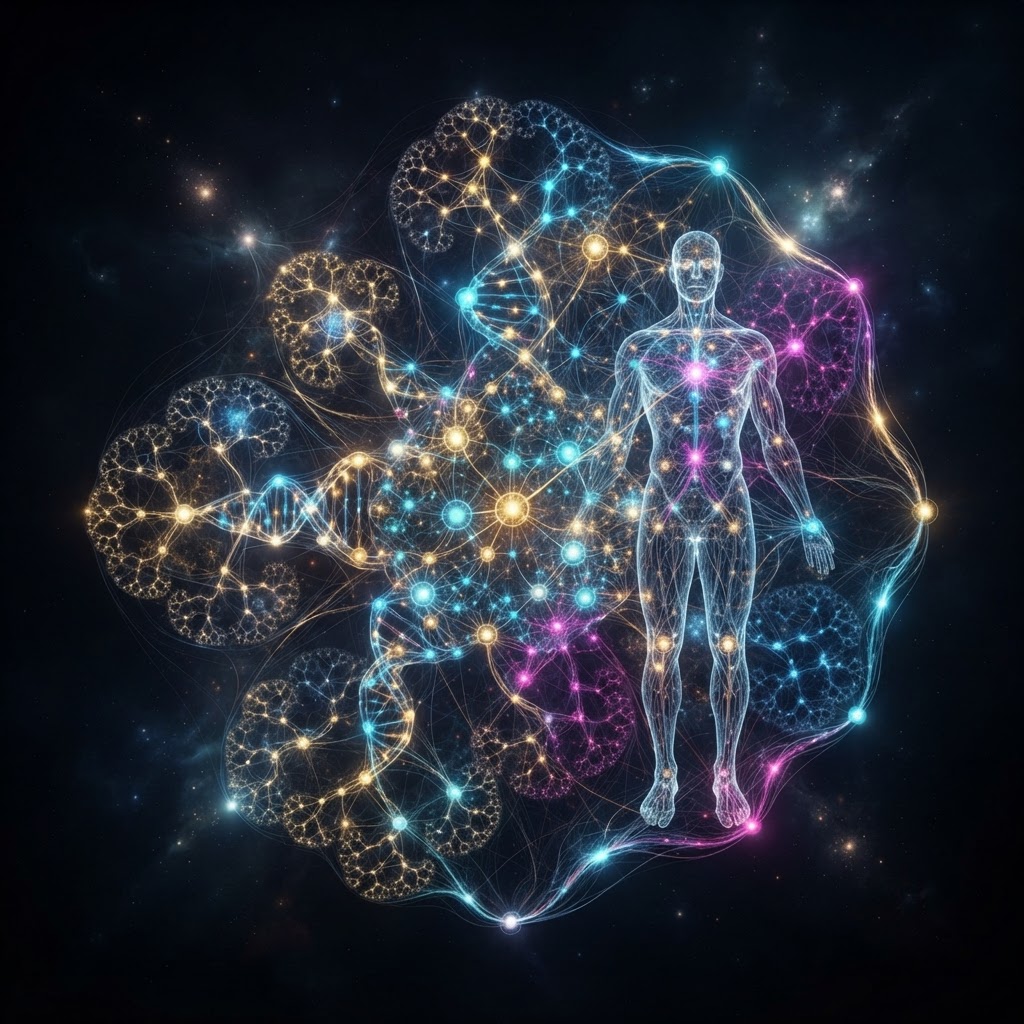
Biology has no single meter for complexity. A cell, a nervous system, and an ecosystem can all be called complex, yet they differ in ways that ordinary measures—genome size, species count, or Shannon entropy—do not capture. The current research frontier is therefore shifting from asking how much information a living system contains to asking how that information is organized, stored, and used.
Information theory provides several increasingly sophisticated tools. Entropy measures uncertainty or diversity in a signal. Mutual information quantifies statistical dependence between variables: how much knowing one part tells us about another. Transfer entropy extends that idea toward directed, time-dependent influence, helping researchers estimate whether activity in one component improves predictions of another.
These measures are now being applied to neural recordings, gene-regulatory networks, immune responses, microbial communities, and ecological time series. The aim is not simply to rank systems from simple to complex. It is to separate different forms of organization that can produce similar-looking data.
Complexity is not randomness
A random signal can have high entropy, because its next state is difficult to predict. But randomness lacks stable structure. A perfectly periodic signal is highly predictable, yet it may also be too orderly to support flexible behavior. Living systems often operate between these extremes, maintaining coherent patterns while retaining the capacity to respond to changing conditions.
This intermediate regime has inspired measures such as statistical complexity, which estimates the information stored in a system’s predictive state—the minimal knowledge needed to forecast its future. Other approaches examine multiscale entropy, asking whether meaningful structure persists when data are viewed at different temporal or spatial resolutions. A healthy physiological signal, for example, may display rich correlations across scales that disappear under severe disease or rigid external control.
Researchers are also using partial information decomposition to ask whether a system’s components contribute information independently, redundantly, or synergistically. Synergy is especially important in biology: a function may become predictable only when several variables are considered together. In a neural circuit, for instance, no single neuron may encode a stimulus completely, while a population collectively carries a robust signal.
From description to mechanism
The promise of these methods is greatest when information measures are linked to mechanisms. A high mutual-information score does not by itself prove causal influence, and transfer entropy can be distorted by common inputs, sampling limits, or hidden variables. Current studies increasingly combine information-theoretic analysis with perturbation experiments, dynamical models, and causal inference.
This matters because living systems are not just statistical patterns. They are physically embodied networks that regulate energy, repair damage, preserve identity, and generate adaptive action. Information measures can reveal how those capacities are distributed: where signals are integrated, how feedback stabilizes a system, and when coordination breaks down.
An active debate
A central unresolved issue is whether one universal complexity measure is possible—or even desirable. Different measures answer different questions. Entropy describes uncertainty; predictive information describes learnable structure; integrated-information approaches emphasize irreducible whole-system interactions; algorithmic measures focus on the shortest description of a pattern. These concepts overlap, but they are not interchangeable.
The field is converging instead on a pluralistic view. Complexity in living systems is likely to be a profile rather than a number: a system may be highly integrated but weakly adaptable, diverse but poorly coordinated, or predictable at one scale and richly variable at another.
That shift is timely. As experiments produce increasingly large, dynamic datasets, the challenge is no longer merely to collect biological information. It is to determine which information is functional, which is redundant, and which emerges only through interaction. Information theory is becoming less a metaphor for life than a quantitative toolkit for testing those distinctions.