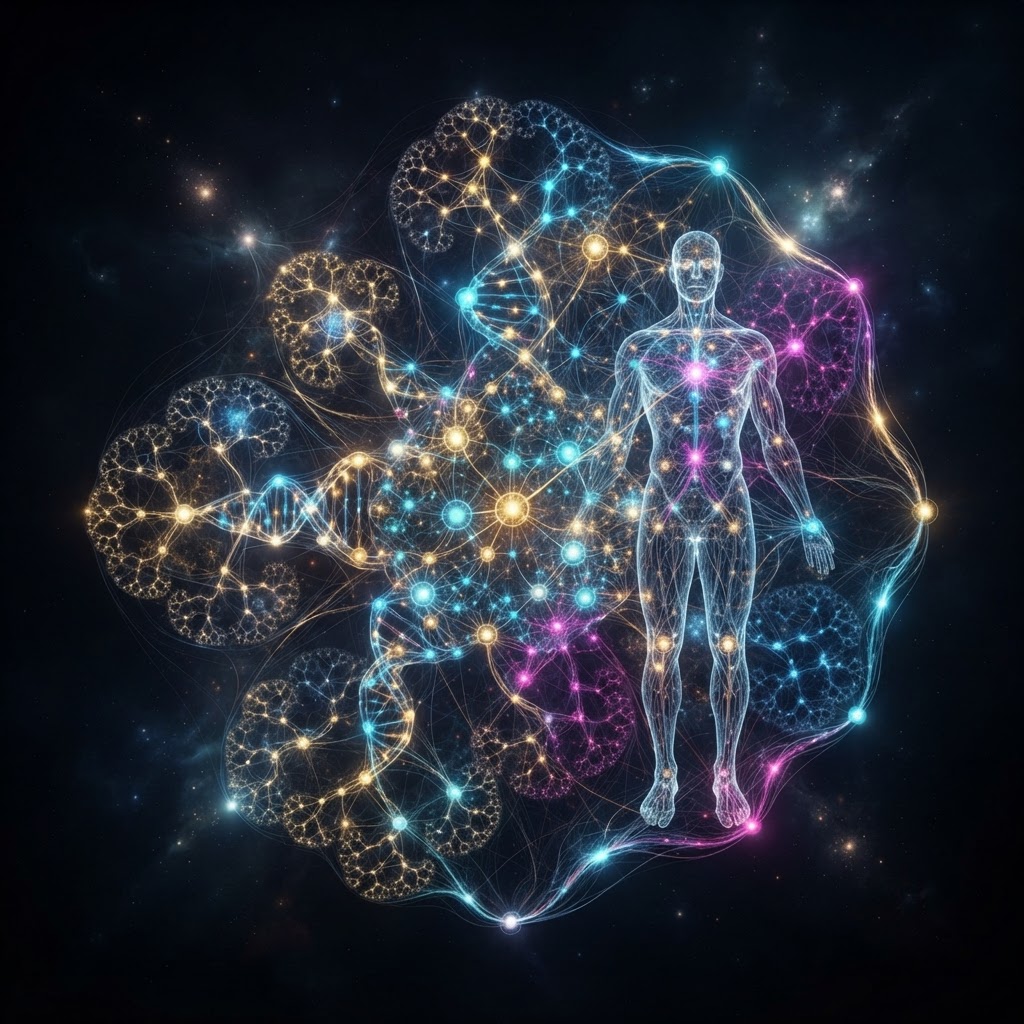
In the early 1980s, a group of physicists, biologists, economists, and computer scientists gathered in Santa Fe, New Mexico, around a question that conventional science had often treated as a nuisance: how does organized complexity arise?
The question was not new. Darwin had shown how natural selection could build astonishing adaptations without foresight. Norbert Wiener’s cybernetics had linked machines, organisms, and feedback. Ludwig von Bertalanffy had argued for a general systems theory. But academic disciplines still tended to divide the world into manageable pieces. Physics excelled at simple laws; biology, economics, and social science confronted systems in which many agents interacted, adapted, and changed the rules of the game.
The Santa Fe Institute, founded in 1984, became a deliberate experiment in crossing those boundaries. Its founders included the physicist George Cowan, former director of research at Los Alamos National Laboratory; the physicist Murray Gell-Mann, who had won the Nobel Prize for work on elementary particles; and the mathematician David Pines. They were joined by figures such as the economist Kenneth Arrow, the biologist Stuart Kauffman, the physicist-turned-economist W. Brian Arthur, and the computer scientist John Holland.
A new object of scientific attention
What these researchers shared was less a single theory than a style of inquiry. They studied complex adaptive systems: collections of interacting components whose local decisions produce large-scale patterns, and whose behavior changes as they learn or evolve.
An ant colony has no supervisor issuing a master plan, yet it can forage efficiently. A market has no central engineer, yet prices and industries shift through countless individual choices. The immune system distinguishes friend from foe, ecosystems reorganize after disturbance, and brains produce coherent thought from networks of cells. In each case, the whole is not merely a larger version of its parts.
This was the central conceptual break. Traditional reductionism asks what the components are and what laws govern them. Complexity science asks an additional question: what happens when those components interact repeatedly, adapt, and feed information back into the system?
From equations to experiments
Computers made the new science practical. Holland’s work on genetic algorithms demonstrated how populations of simple rule-followers could evolve solutions through selection and recombination. Kauffman used models of interacting genes to explore how biological order might arise without a detailed blueprint. Arthur studied increasing returns, showing how small historical advantages could lock economies into particular technologies—even when better alternatives existed.
Researchers at and around Santa Fe developed tools for examining phenomena that resisted neat analytic solutions: cellular automata, agent-based models, network analysis, and computational experiments. These methods did not replace mathematics or observation. They supplied a laboratory for systems whose behavior emerges from many interacting parts.
The institute also cultivated an unusual social technology. Workshops brought Nobel laureates into conversation with ecologists, anthropologists, computer scientists, and economists. The aim was not to erase disciplinary expertise, but to make translation itself productive. A metaphor from evolution could become an algorithm; a physical model of phase transitions could illuminate a market; network theory could connect epidemics, food webs, and information cascades.
What “emergence” really means
Emergence is sometimes presented as mystery: complexity appearing from nowhere. Santa Fe’s contribution was more disciplined. Emergent behavior can arise from simple, explicit interactions while remaining difficult to predict from those interactions alone.
Weather is governed by physical laws, yet a precise long-range forecast is limited by sensitivity to initial conditions. A traffic jam can form without an accident or a deliberate decision to stop. Online rumors spread through individual acts of sharing, but the resulting cascade has a structure no single participant controls. The difficulty is not that the system lacks rules. It is that feedback, scale, and adaptation generate new collective behavior.
A field still in formation
Complexity science has influenced epidemiology, climate research, finance, artificial intelligence, conservation, urban planning, and the study of technological change. During disease outbreaks, network models help explain why connectivity can accelerate transmission and why targeted interventions may outperform uniform ones. In ecology, resilience research asks how much disturbance a system can absorb before it shifts into a different regime. In machine learning, researchers confront systems whose capabilities can emerge from interactions among architecture, data, and training.
Yet the field’s ambitions demand caution. A simulation is not automatically an explanation, and the vocabulary of emergence can become a way of naming ignorance. Models must be tested against data, assumptions made visible, and claims calibrated to uncertainty. Social systems also contain power, institutions, and meaning—features that cannot always be compressed into elegant rules.
The lasting achievement of Santa Fe was therefore not a universal equation for complexity. It was a change in scientific posture. The institute made it respectable to study the space between levels of description: how genes become traits, individuals become societies, and interactions become institutions.
That question remains open because complex systems are not merely complicated machines. They evolve, remember, and sometimes respond to being studied. Santa Fe’s enduring lesson is that understanding the world requires both reduction and reconstruction: taking systems apart, then learning how their pieces make a world together.