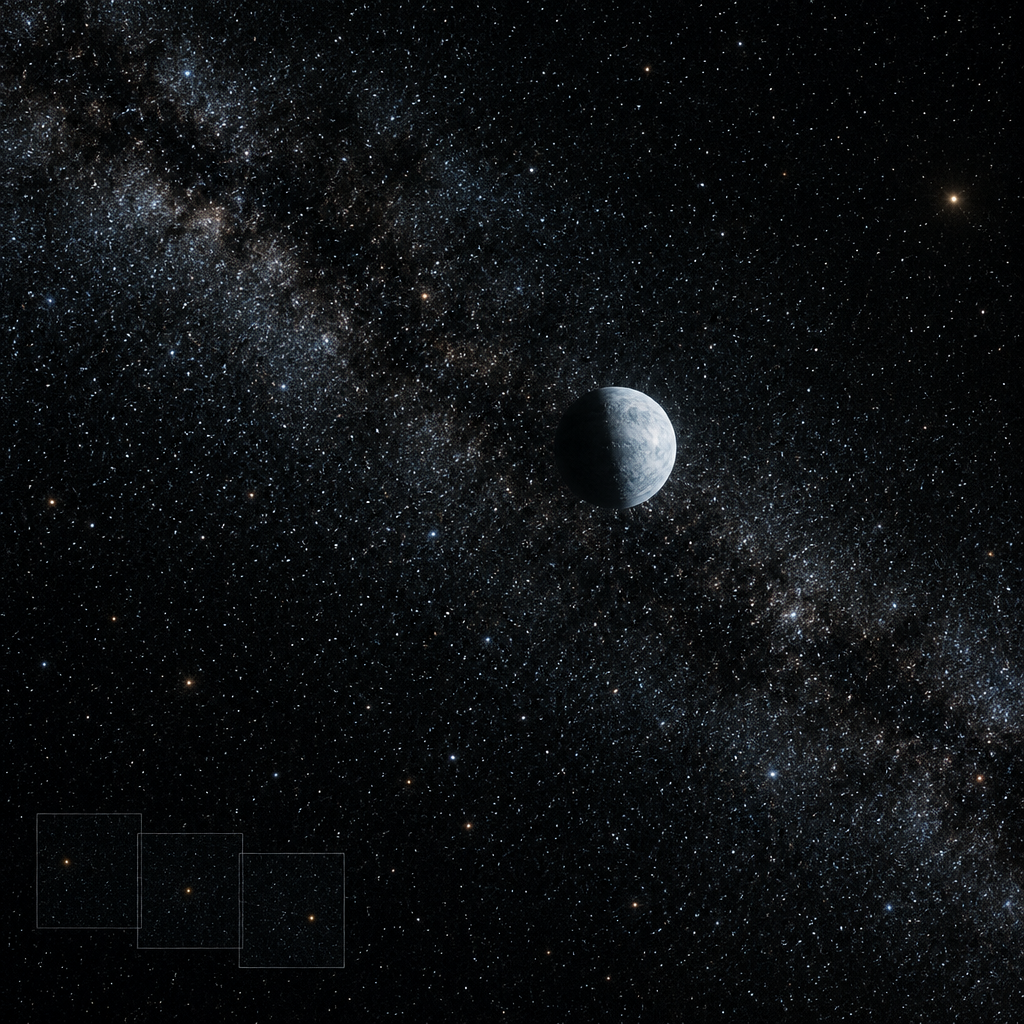
A world roughly a thousand kilometres wide was found this month in data that had been sitting in an archive since 2016. That is the story here, more than the object itself.
What was announced, and when
On 27 October 2026 the IAU Minor Planet Center issued a circular for 2026 ED138, a trans-Neptunian object detected in NSF-DOE Vera C. Rubin Observatory data (announced). Matthew Holman, of the Center for Astrophysics, linked it on the evening of 13 October while running a search code he developed with Kevin Napier; Mario Juric of the University of Washington presented the result with him at the 58th Division for Planetary Sciences meeting in Spokane. Rubin is still in commissioning. Holman's own words: excited disbelief, followed immediately by checking whether he or the code had done something wrong. That is the correct first reaction.
It has been in the archive for a decade
The Simonyi Survey Telescope recorded it 30 times across 20 nights between 4 March and 11 July 2026 (measured). Juric then recovered 20 further detections from the same season. Archival images from the Dark Energy Camera, surfaced by the Asteroid Institute's ADAM precovery service, pushed the arc back to 2016 (measured). Ten years of orbit, from photons already on disk. Nothing new was seen to make this discovery; detections were linked. Precovery is the quiet half of astronomy, and this is the cleanest recent case of it paying off.
Why nobody had seen it
Two reasons, both mundane. It sits far south, in sky crowded with the Milky Way's own star clouds, where a slow point of light has a million lookalikes (measured). And at about 46 AU it barely moves against that background. Earlier surveys did not skip it out of carelessness; they were looking where the field was less crowded and the motion less patient.
The size is an inference, not a measurement
Brightness at a known distance gives an absolute magnitude. Diameter needs something else: geometric albedo, how much light the surface reflects. Because diameter scales as albedo to the power of minus one half, the quoted 600 to 1,500 kilometres (derived, albedo-dependent) is exactly that unfixed term, a factor of about six in reflectivity:
| Assumed albedo | Implied diameter | Composition analogue |
|---|---|---|
| 0.50 | 600 km | bright, fresh ice |
| 0.30 | 775 km | |
| 0.15 | 1,095 km | |
| 0.08 | 1,500 km | dark, irradiated crust |
At the midpoint lie the famous comparisons. Pluto is 2,377 km, Eris 2,326, Haumea near 1,560, Makemake about 1,430, Ceres 946. So the range does not slot neatly between them: at the low end ED138 is a slightly larger Ceres, at the high end it approaches Haumea. Claims that it is the third largest known dwarf planet are hostage to an unmeasured albedo.
Dwarf planet is a status, not a size
The IAU definition requires an object that orbits the Sun, is not a satellite, is massive enough for its own gravity to make it nearly round, and has not cleared its neighbourhood (established). At 46 AU, a thousand-kilometre body is a fraction of a pixel even for Hubble. Its roundness cannot be seen; it is inferred from being large enough to be round. The Minor Planet Center designation is a candidate, and the five recognized dwarf planets remain the five. Sixth is shorthand for what would follow confirmation, not a status that exists today.
One check on the orbit
Early orbit solutions place it in a 7:12 resonance with Neptune, the same family Haumea occupies (preliminary, unrefereed). The arithmetic only closes one way. Twelve orbits of ED138 per seven of Neptune gives a period near 283 years and a semi-major axis near 43 AU, which is consistent with a body at 46 AU today. The inverted reading, seven per twelve, gives 96 years and 21 AU, which would put it inside Neptune's orbit and cannot describe this object. Resonance assignments from a short arc are provisional; the internal consistency test is not.
What would actually settle it
Thermal emission, measured by JWST's MIRI or ALMA, breaks the albedo degeneracy directly and turns 600 to 1,500 into a diameter. A rotation light curve gives shape, spin, and eventually density. Spectroscopy separates a methane-frosted surface, Pluto and Eris and Makemake, from a water-ice one like Haumea's. Years of astrometry fix the orbit. A satellite, if one exists, would give mass outright.
Why this one matters beyond itself
Rubin will image the southern sky repeatedly for ten years. ED138 was found before the survey proper began, in sky other surveys passed over, and it was recoverable from data a decade old. The implication is not that giant worlds are common. It is that the census of the outer solar system is still incomplete in the places nobody was staring.
Related on Star-Field: Absence of Data Is Not Data of Absence; The Fireball Stream; The Orionid Meteor Shower Peaks Tonight.