The Fireball Stream: Why the Taurids Are Worth Staying Up For
Five meteors an hour is a terrible number and a wonderful night. The Taurids are the year's slow, bright, fragmentation-prone stream, and in 2026 the Moon largely gets out of the way.
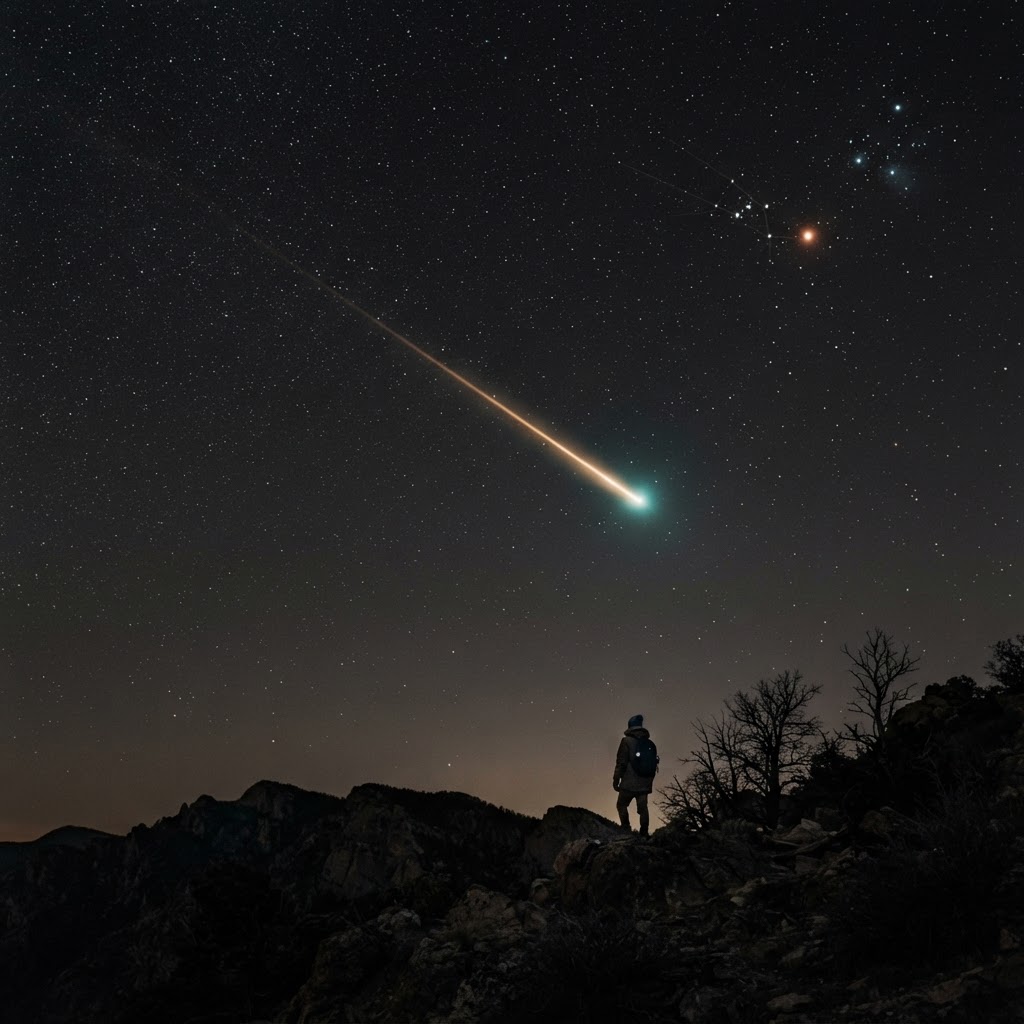
Every November the sky offers two very different kinds of meteor shower, and the internet only talks about one of them.
The Leonids get the mythology: a 33-year comet, storms that once terrified whole towns. The Taurids get a rate of about five meteors an hour, which sounds like nothing, and are quietly responsible for more "what was *that*?" phone calls than any other shower of the year. Those calls are about fireballs.
## What the Taurids actually are
The Taurids aren't one stream. They're two, and both are debris from comets that shed material across a wide, diffuse corridor of the inner solar system:
- **The South Taurids** peak the night of **November 4–5**. Their parent is comet **2P/Encke**, the shortest-period comet known, which rounds the Sun every 3.3 years.
- **The North Taurids** peak the night of **November 11–12**. Their parent is comet **7P/Pons-Winnecke**, with asteroid 2004 TG10 a candidate contributor.
Neither comet is dramatic on its own. What makes the Taurids interesting is the shape of the debris: it's spread thin over an enormous volume, so the shower doesn't spike. It *lingers*, from late September into early December, and it delivers fewer but larger particles than a tight, young stream like the Leonids.
Larger particles mean brighter meteors. Brighter meteors mean fireballs, the kind that cast shadows, leave persistent trains, and occasionally rival Venus.
## The number that matters isn't the rate
Five per hour is the *average*, and averages are how showers get dismissed. Two things make the average misleading for the Taurids:
**Speed.** Taurid meteors strike the atmosphere at roughly 27 kilometers per second, less than half the Leonids' 71 km/s. Slow meteors spend longer in the upper atmosphere, which means they're visible longer, and they're far easier for an unaided eye to catch. A two-second Leonid streak is a flicker; a slow Taurid is an event.
**Mass.** Bigger grains produce brighter, longer-lived flares and more visible fragmentation. A single Taurid fireball outweighs an hour of faint meteors in memory. This is the shower people describe years later.
## What the Moon does for you in 2026
Moonlight is the deciding variable for every shower, and this year it cooperates:
- **South Taurids (Nov 4–5):** the Moon is a waning crescent around **24% illuminated**, rising in the small hours. The evening and early night are dark.
- **North Taurids (Nov 11–12):** the Moon is nearly new, on the order of **5% illuminated**. This is the darker of the two peaks, and the night to plan around.
A caveat we'd rather state than skip: 2026 is **not** a Taurid "swarm" year. Swarm years, when Earth crosses denser filaments of the stream, come along every few years and can lift fireball reports noticeably. This is a normal year for the Taurids, which still means the best fireball odds of the autumn.
## How to watch
No equipment. No app. No schedule beyond "after midnight, look up."
1. **Pick the darkest sky you can reach**, facing south to southeast, with Taurus and the Pleiades in view.
2. **Look 30–45 degrees above the horizon** and let your eyes wander. Fireballs don't arrive where you're staring.
3. **Give your eyes 20 minutes** away from screens and streetlights.
4. **Watch the night of Nov 11–12** if you only pick one night, for the North Taurids; the Moon is nearly absent.
5. **Note the time, direction, and duration** of anything bright. Those reports are real data.
## Why it's worth the attention
Fireball networks triangulate bright meteors from multiple cameras and back out their orbits, which ties individual meteors to specific debris filaments and, ultimately, to the parent comets. The Taurid complex is one of the messiest, most debated structures in near-Earth space. Some researchers have argued it is the wreckage of a much larger body that broke up millennia ago, a hypothesis that remains contested rather than settled. Either way, every well-documented fireball is a data point about a population of objects we share space with.
The Taurids won't give you a storm. They'll give you a handful of slow, brilliant, unforgettable visitors, and in 2026, a sky dark enough to see them properly.
Go outside on November 11.
---
*Data: International Meteor Organization shower calendar; American Meteor Society fireball reporting; NASA/JPL small-body orbit data for 2P/Encke and 7P/Pons-Winnecke. Moon illumination computed for peak nights at 03:00 local.*
Sources
- 1.International Meteor Organization, meteor shower working list (2026) — south and north Taurid activity dates, peak nights, and quoted hourly rates
- 2.American Meteor Society, fireball reporting and shower calendar — Taurid fireball character, ~27 km/s entry speed, radiant position in Taurus
- 3.NASA/JPL Small-Body Database — orbital elements for 2P/Encke (3.3-year period) and 7P/Pons-Winnecke
- 4.Moon illumination at the two peak nights computed from the synodic phase (03:00 local, peak night): South ~24% waning crescent, North ~5%; full Moon falls Nov 24, 2026, which places the Nov 11-12 peak on the dark side of the cycle
Related Research
astronomy_night_skyCurrent
It Waited Ten Years in the Archive: Rubin's First Dwarf Planet Candidate
2026 ED138 is real, roughly a thousand kilometres across, and 46 AU out. Whether it is a dwarf planet depends on a number nobody has measured yet.
E. L. Corvin· 2026-10-31· 7 min
astronomy_night_skyCurrent
The Orionid Meteor Shower Peaks Tonight, and the Moon Sets the Schedule
Halley's old dust burns at sixty-six kilometers a second, ten to twenty streaks an hour under dark skies. A bright gibbous Moon owns the evening; the honest window opens when it leaves.
E. L. Corvin· 2026-10-21· 4 min