What the new models do differently
Recent modeling efforts of Arctic permafrost and methane incorporate far more process detail than legacy approaches. Instead of treating permafrost carbon as a static stock that is released according to simple temperature scaling, the new models couple (a) seasonal thaw-freeze cycles that control active-layer depth, (b) lateral hydrology and thermokarst formation that create new wetlands and lakes, and (c) microbial kinetics that govern when and how organic carbon is converted to methane versus CO2. The result is a fundamentally different portrait of risk: emissions that are spatially heterogeneous, temporally episodic, and tied closely to hydrological state and substrate availability.
Key findings from the latest work
1) Emissions are likely larger than older, simplistic models predicted, but spread over decades to centuries. When thaw, ponding and thermokarst processes are modeled explicitly, more previously frozen organic matter becomes substrates for anaerobic methanogenesis. Several model intercomparisons now find higher cumulative methane outputs by 2100 under high-warming scenarios than earlier projections, but the release is gradual at continental scales rather than instantaneous.
2) Thaw cycles and hydrology control methane production more than temperature alone. Freeze-thaw dynamics determine active-layer depth in summer and the degree of saturation and anoxia. Where thaw deepens and water tables rise, conditions favor microbial methanogenesis (both acetoclastic and hydrogenotrophic pathways). Where thaw creates drier soils, decomposition shifts toward aerobic pathways, producing CO2 instead.
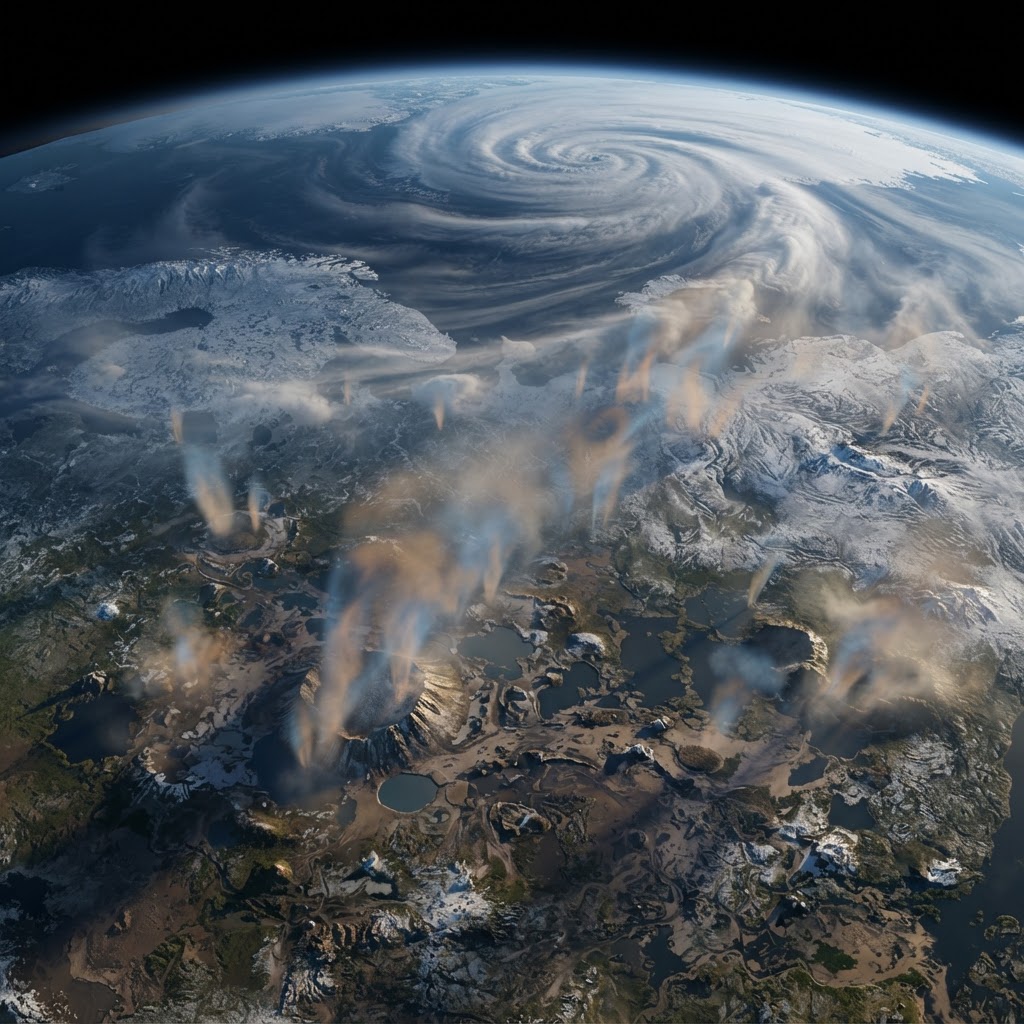
3) Lakes and thermokarst features produce episodic, high-flux hotspots. New thermokarst lakes often bubble methane (ebullition), producing concentrated pulses that can dominate local budgets. These hotspots can be abrupt at the landscape scale but do not translate into a synchronous, region-wide methane bomb.
4) Subsea permafrost and clathrates remain low-probability, high-uncertainty contributors over this century. Models that include subsea permafrost thaw and hydrate destabilization show these sources respond slowly to climate forcing—mediated by ocean heat transport—making abrupt, large-scale hydrate collapse within decades unlikely under most scenarios. That does not eliminate longer-term risk, especially with accelerated ocean warming.
Clearing up a persistent misconception
The myth of a sudden, catastrophic Arctic methane release—a 'clathrate bomb' that would instantly spike global methane concentrations and trigger runaway warming—does not square with new mechanistic models. The models show mechanisms for rapid local release (e.g., lake drainage or thaw slumps) but not for a synchronous pan-Arctic discharge on timescales of months to a few years. Methane hydrates at depth are buffered by slow heat transport and are unlikely to destabilize wholesale on decadal timescales. That said, the aggregate of many localized abrupt events and enhanced background emissions could still materially accelerate warming over the coming decades.
Deep dive: microbial drivers and thaw-cycle mechanics
Methane production in thawing soils is a microbial story. When oxygen is absent, methanogens (archaea) metabolize labile organic compounds into methane via two dominant pathways: acetoclastic methanogenesis (splitting acetate) and hydrogenotrophic methanogenesis (reducing CO2 with hydrogen). The relative share of these pathways depends on substrate quality (labile vs. refractory carbon), temperature, and competing microbial processes such as sulfate reduction and iron reduction.
Freeze-thaw cycles modulate substrate availability. Winter freezing protects organic matter from decomposition; the first thaw flush can leach labile compounds into porewaters and create anaerobic microenvironments ideal for methanogens. Repeated cycles can fragment organic material, increasing microbial access. Hydrological shifts—whether from permafrost collapse, ice-wedge degradation, or altered precipitation—govern the balance between aerobic CO2-producing decomposition and anaerobic methane production.
Models now use kinetic rate laws for microbial activity including temperature sensitivity (Q10-like formulations), substrate pools with different labilities, and explicit redox layering within soils. This lets them reproduce observed phenomena: springtime bursts, summertime ebullition from lakes, and wintertime outgassing from unfrozen soil pockets. Importantly, it also highlights where uncertainty concentrates: the adaptability of microbial communities to warming, the fraction of old versus young carbon mobilized, and the pace of landscape change (thermokarst, river and coastal erosion).
What this means for policy and monitoring
Practically, the new models redirect attention from improbable single-event catastrophes to a mosaic of processes that can produce sustained and locally intense emissions. That implies priorities: expand year-round monitoring (including winter and subsurface observations), invest in high-resolution landscape-change detection, and reduce global warming to limit the baseline forcing that drives permafrost degradation. In short, the risk is neither negligible nor sensationally instantaneous; it is real, mechanistic, and manageable only by curbing overall warming and improving targeted observation and model fidelity.