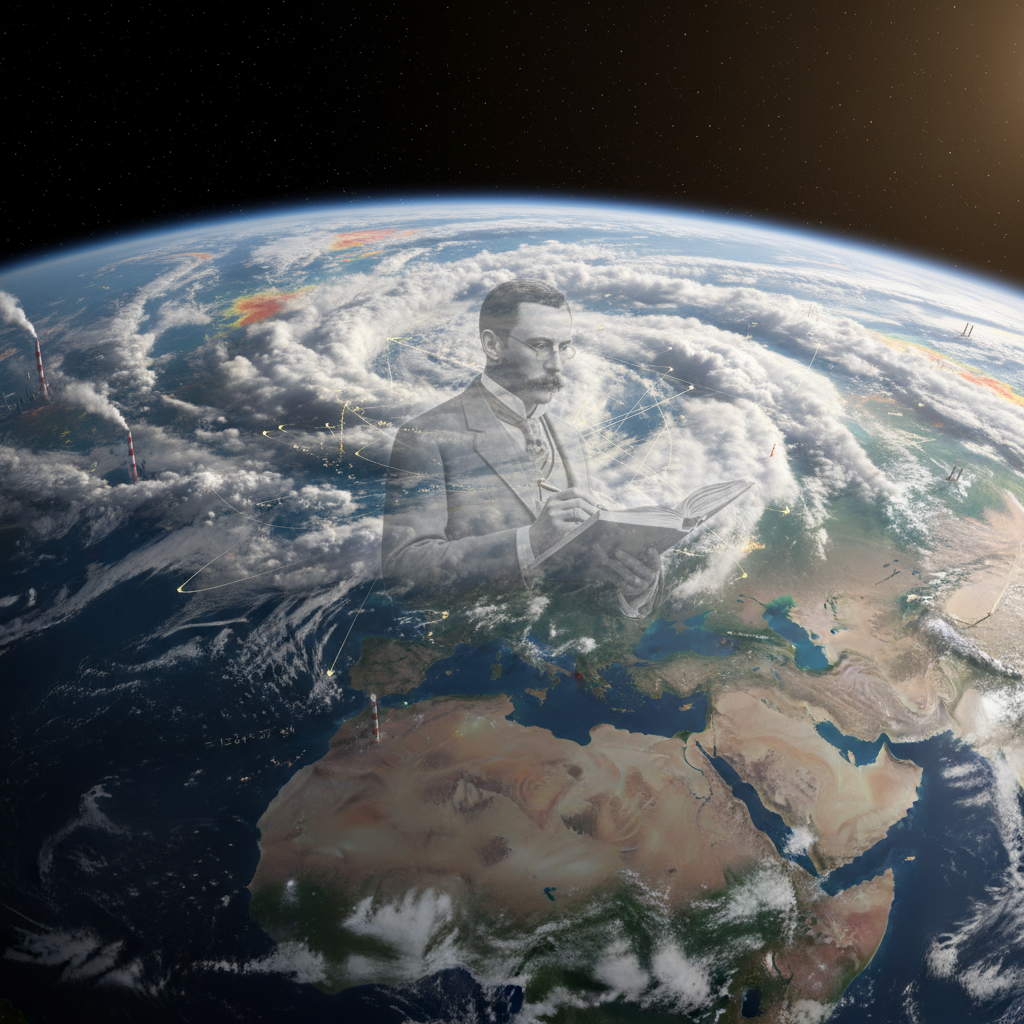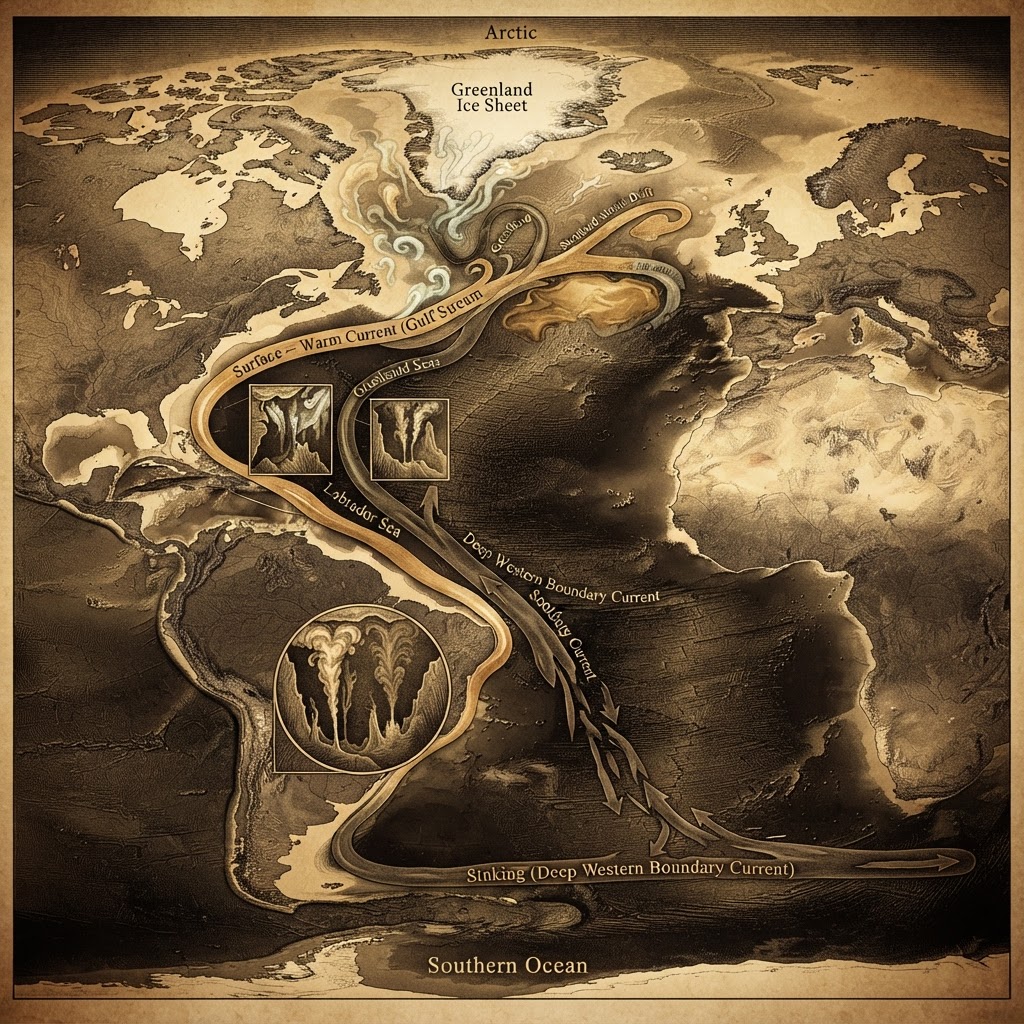
For centuries, the North Atlantic has been more than an expanse of water. It has been a machine for moving heat. Warm, salty surface waters flow northward from the tropics, releasing energy to the atmosphere before cooling, becoming denser, and sinking into the deep ocean. The returning water travels southward at depth, part of a planetary system known as the Atlantic meridional overturning circulation, or AMOC.
In ordinary language, the AMOC is the Atlantic’s great conveyor. It helps moderate the climate of Europe, redistributes tropical heat, influences rainfall across the tropics, and stores carbon and warmth in the deep sea. Its importance became clear gradually, through the work of oceanographers who learned to see the ocean not as a collection of currents but as a connected circulation system.
From Gulf Stream to global system
Benjamin Franklin was among the first to recognize that the Gulf Stream was a distinct current. In the eighteenth century, while serving as a colonial official and scientist, Franklin helped produce one of the earliest charts of its path, based partly on information from whalers and partly on observations of the time required for ships to cross the Atlantic. Franklin was interested in a practical puzzle: why did ships sail faster from Europe to North America than in the opposite direction? The answer was a moving river within the sea.
Later investigators supplied the deeper mechanism. In the nineteenth century, the oceanographer Matthew Fontaine Maury mapped winds and currents on a global scale. By the twentieth century, researchers recognized that seawater density—controlled chiefly by temperature and salt—could drive circulation far below the surface. The Norwegian polar explorer Fridtjof Nansen and the Swedish oceanographer Walfrid Ekman helped establish how wind and Earth’s rotation organize ocean motion, while modern physical oceanography connected surface flows, deep-water formation, and climate.
The AMOC is not identical to the Gulf Stream. The Gulf Stream is a powerful surface current, partly driven by winds and partly by differences in density. The AMOC is the larger overturning pattern into which that current feeds. This distinction matters: a familiar surface current can persist even as the broader circulation weakens.
A circulation under pressure
Global warming threatens the AMOC through several linked changes. Warmer water is less dense. Increased rainfall and melting ice add fresh water to the North Atlantic, making surface seawater less salty and therefore less likely to sink. Greenland’s accelerating ice loss is especially important because its meltwater is delivered close to regions where dense water forms.
Direct observations of the AMOC are short compared with the circulation’s long climate history. The modern RAPID array, deployed across the Atlantic at roughly 26.5 degrees north in 2004, provides the most important continuous monitoring, but a few decades are not enough to define a stable baseline for a system that varies naturally from year to year and decade to decade.
Scientists therefore combine instruments with indirect evidence: ocean sediments, corals, ice cores, tree rings, historical climate records, and patterns in sea-surface temperature. Several recent studies have reported fingerprints consistent with a long-term weakening, including unusual warming south of Greenland surrounded by broader patterns of altered North Atlantic temperatures. A 2021 study by Niklas Boers found that early-warning indicators in climate records suggested declining stability in the AMOC. A 2023 analysis led by Peter Ditlevsen and Susanne Ditlevsen went further, arguing that statistical signals in a sea-surface-temperature index pointed to a possible transition during this century, perhaps around mid-century under continued emissions.
Evidence is not a countdown clock
The claim attracted attention because a collapse would not resemble a gradual dimming switch. It would be a reorganization of circulation, potentially producing abrupt regional climate effects: cooling in parts of the North Atlantic region, shifts in European weather, changes in tropical rainfall belts, stress on marine ecosystems, and altered sea levels along the North American coast. The consequences would unfold unevenly and would interact with ongoing global warming.
But the statistical result is not a dated forecast. It depends on assumptions about which observations capture the AMOC, how natural variability is separated from forced change, and whether statistical relationships derived from past behavior remain valid as the climate moves into unfamiliar conditions. Other researchers have questioned the robustness of the proposed warning signal and emphasized that direct measurements do not yet establish that a tipping point is imminent.
Assessment reports from the Intergovernmental Panel on Climate Change have judged an abrupt AMOC collapse this century to be unlikely or not expected in the central range of projections, while also acknowledging substantial uncertainty and a likely weakening under continued warming. These statements are not contradictory. A system can be very likely to weaken without being known to be close to a critical threshold.
Why the question matters now
The scientific debate is therefore not between “nothing is happening” and “collapse is certain.” It concerns how much risk society should accept when the monitoring record is short, the impacts could be global, and the underlying forcing is growing. The AMOC is a classic example of a climate system whose inertia can conceal accumulating vulnerability. Ocean circulation may change slowly for decades, then respond rapidly once stabilizing feedbacks are overcome.
The practical response is both clearer and more demanding than a precise tipping date. Cutting greenhouse-gas emissions reduces the warming and freshwater forcing that weaken the circulation. Sustained ocean observations improve detection. Paleoclimate research reveals how the AMOC behaved during past abrupt climate shifts. Better models can test whether proposed warning signals survive realistic variability.
From Franklin’s shipboard puzzle to today’s arrays, satellites, and statistical reconstructions, the story of the AMOC is a story of expanding scientific vision. What began as a question about a current became a discovery about the climate system’s hidden architecture. The latest evidence does not settle exactly when that architecture might change. It makes the cost of ignoring the question harder to justify.