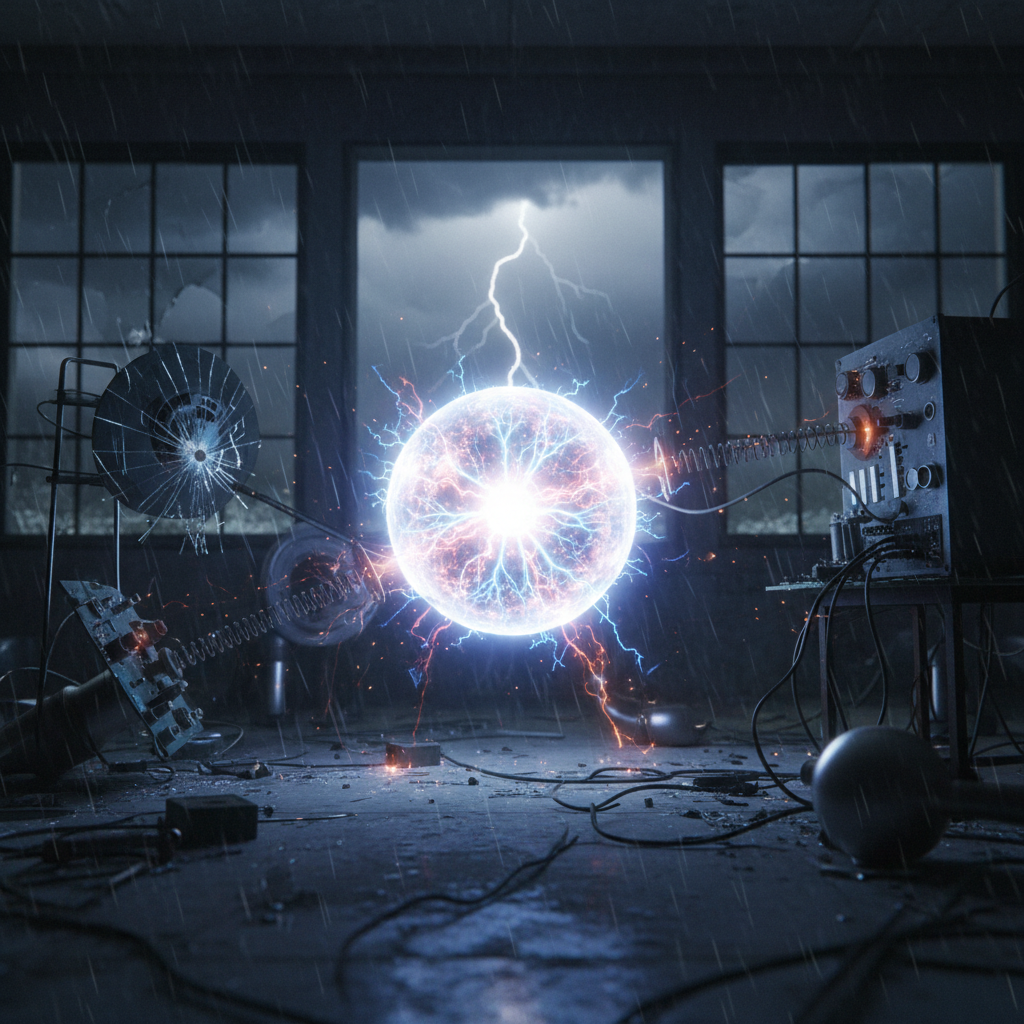
Few atmospheric phenomena sit so awkwardly between folklore and physics as ball lightning: luminous, roughly spherical objects reported during or after thunderstorms, sometimes drifting through rooms, tracking along surfaces, or vanishing with a sharp flash or a quiet fade. Witness accounts describe colors from white to orange, lifetimes from a fraction of a second to several minutes, and sizes ranging from a marble to a large beach ball.
The phenomenon is not established by anecdote alone. In 2014, Chinese researchers reported an instrumental observation made after a lightning strike on the ground. Two video spectrometers recorded a luminous sphere about five meters above the surface, lasting roughly 1.6 seconds. Its spectrum contained emission lines associated with silicon, iron, and calcium—elements plausibly produced when a lightning channel vaporizes soil. The observation did not solve ball lightning, but it moved at least one class of reports from testimony toward measurement.
A name for many possible things
The central difficulty is that “ball lightning” may not denote one phenomenon. Some observations could be afterimages, electrical discharges, burning material, or optical effects associated with ordinary lightning. Others appear to involve a self-contained luminous object with unusual motion and persistence. Without a standardized definition, researchers may be trying to explain several rare events under one label.
Even the most credible accounts resist easy classification. Ball lightning is often reported near conductors, windows, aircraft, or power lines, suggesting a role for electric fields. Yet some witnesses describe spheres moving independently of obvious conductive paths. Objects may pass through or emerge from apertures that seem too small for their apparent size, although such reports are difficult to verify and could reflect perspective, reflection, or an observer’s reconstruction of a chaotic event.
The leading ideas—and their limits
One influential family of models begins with a lightning strike vaporizing soil. The resulting plume of hot, ionized material could cool into a glowing aerosol or chemically reactive cloud, with nanoparticles sustaining light emission through oxidation. This idea fits the 2014 spectral evidence and may explain why silicon-rich emissions can appear. But it struggles with reports of long lifetimes, indoor movement, and apparent stability.
Other proposals invoke microwave energy trapped inside a plasma structure, electromagnetic vortices, or chemical combustion in a porous, electrically active aerosol. Laboratory experiments have produced luminous spheres or sphere-like discharges under particular conditions. Producing a transient glow, however, is not the same as reproducing the full reported package: persistence, mobility, brightness, interaction with objects, and formation during natural storms.
That gap matters. A successful theory must explain not merely how a ball can glow, but how it forms in an atmosphere that is turbulent, wet, electrically complex, and changing on millisecond timescales. It must also predict which observations are reliable and which belong to unrelated phenomena.
A rare event with a modern measurement problem
Ball lightning is difficult to study because it is rare, unpredictable, and dangerous. Researchers cannot easily place instruments where a lightning strike will occur, and eyewitness reports are usually collected long after the event. The result is a field rich in hypotheses but poor in controlled, repeatable data.
Better progress may come from distributed observation: synchronized high-speed cameras, electric- and magnetic-field sensors, radio receivers, and spectrometers deployed around storm-prone regions. Machine-learning systems could help identify candidate events, but only if researchers first agree on operational criteria. The goal is not to make every strange light into ball lightning; it is to separate a reproducible physical category from the atmospheric world’s many visual illusions.
For now, the most defensible conclusion is neither “ball lightning is a myth” nor “one exotic mechanism has been found.” Some reports likely describe genuine luminous plasma or chemically active matter. The enduring mystery is whether those events share a common mechanism. Ball lightning remains scientifically valuable precisely because it exposes a boundary: nature may be producing transient states that our instruments encounter only after they are gone.