For decades, NASA’s Pioneer 10 and 11 seemed to be drifting toward the Sun for no obvious reason. Their radio signals suggested a small, persistent acceleration—about 8.7 × 10⁻¹⁰ m/s2, directed approximately sunward. The effect was minuscule: far below everyday gravitational accelerations, yet large enough to challenge the precision of spacecraft navigation and provoke speculation about modified gravity, dark matter, or a breakdown of general relativity.
The anomaly was real in the data. Its interpretation was the difficult part.
A signal hidden inside the spacecraft
Pioneer’s radio system acted as an extraordinarily sensitive motion detector. Engineers transmitted a signal to the spacecraft, which returned it at a precisely shifted frequency. Any unmodeled change in velocity appeared as a Doppler drift. The observed effect was unusually steady, and its direction seemed close to the direction of the Sun.
That combination made the anomaly compelling. It also made it easy to overlook the spacecraft itself as a source.
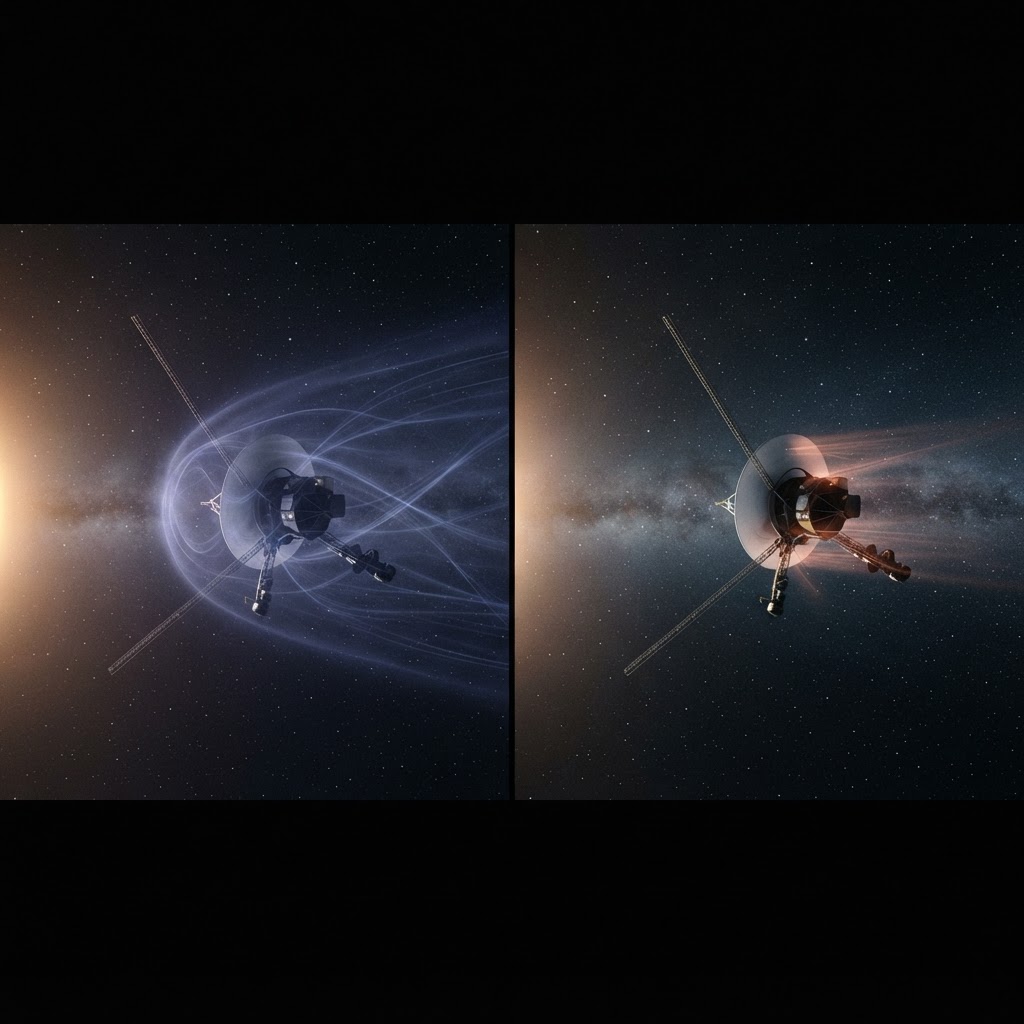
The Pioneers were not ideal test particles. They carried radioisotope thermoelectric generators, or RTGs, whose plutonium-238 fuel produced substantial heat. That heat escaped into space through radiation. Because the spacecraft was assembled asymmetrically—with large dish antennas, instrument compartments, booms, and louvered panels—the emitted infrared photons did not leave equally in every direction. Photons carry momentum. If more thermal radiation departed one way than another, the spacecraft received a recoil push in the opposite direction.
The mundane force that survived decades of scrutiny
In 2012, an independent analysis by Slava Turyshev and colleagues reconstructed Pioneer’s thermal behavior using engineering records, telemetry, electrical power histories, and models of heat flow. Their conclusion was that the spacecraft’s anisotropic thermal radiation could account for the anomalous acceleration.
The explanation was not a single hidden thruster. It was the cumulative effect of ordinary energy escaping imperfectly. Heat from the RTGs was partly reflected by the high-gain antenna; electrical equipment inside the spacecraft converted power into heat; louvers and surfaces radiated differently as the craft aged. The resulting recoil was tiny but persistent, and its gradual decline tracked the radioactive decay of the RTG fuel and changing onboard power consumption.
Later work strengthened the case by showing that the anomaly’s time dependence matched these thermal processes. The apparent “new force” was, in effect, a spacecraft heat budget written into its trajectory.
Why the resolution matters
The Pioneer anomaly is often remembered as a failed hint of new physics. That framing misses its more durable lesson: precision measurements are only as revolutionary as their force models are complete.
Modern spacecraft experience many non-gravitational forces. Solar radiation pressure pushes on exposed surfaces. Outgassing produces tiny, irregular thrusts. Antennas and thermal systems emit momentum. Micrometeoroid impacts, charged particles, attitude-control activity, and even instrument operations can perturb a trajectory. At the accuracy demanded by deep-space navigation, “unimportant” engineering details become dynamical variables.
This is why missions designed to test gravity now treat thermal design, telemetry, and calibration as part of fundamental physics. The same principle applies beyond spacecraft: an unexplained residual can indicate new phenomena, but it can also reveal a neglected pathway by which known physics acts.
What remains unresolved
The Pioneer anomaly itself is considered solved, not because every microscopic surface property is known, but because a physically grounded thermal model explains its magnitude, direction, and evolution without invoking altered gravity. The open questions are broader: how can future spacecraft be engineered and monitored so thoroughly that non-gravitational forces remain below the signal being sought?
That is the hidden legacy of Pioneer. The spacecraft did not expose a crack in gravity. They exposed how much work it takes to know what a spacecraft is doing when photons, not engines, are providing the push.