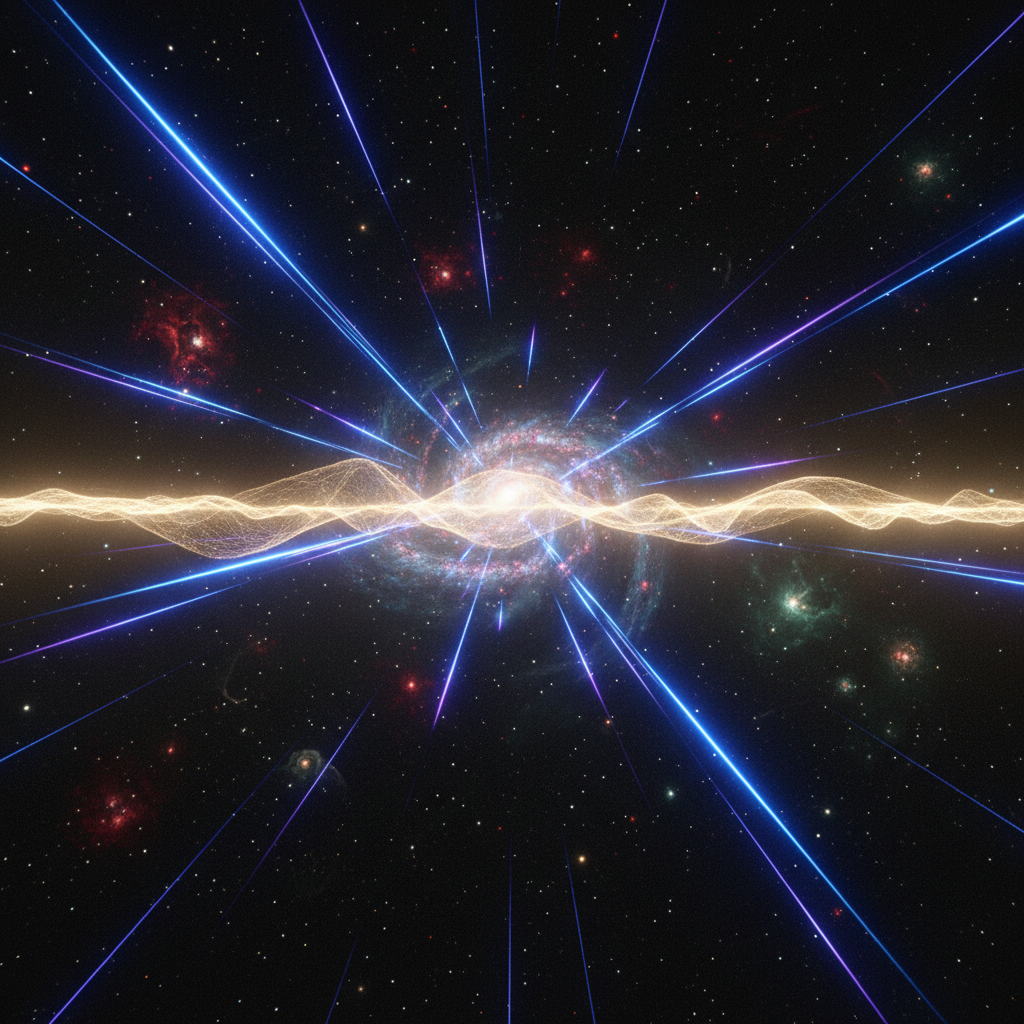
Cosmic rays are not rays in the usual sense. They are subatomic particles—mostly protons and atomic nuclei—moving through space at nearly the speed of light. The most energetic among them carry more than 1020 electron volts (eV), roughly the kinetic energy of a well-hit tennis ball compressed into a single proton.
That scale is astonishing, but the deeper mystery is geographical. In 1966, Kenneth Greisen and, independently, Georgiy Zatsepin and Vadim Kuzmin predicted that cosmic rays above about 5 × 10¹⁹ eV should be strongly attenuated while crossing intergalactic space. The culprit is the cosmic microwave background—the cold afterglow of the Big Bang. An ultrahigh-energy proton can collide with one of these microwave photons and produce pions, losing a substantial fraction of its energy. Heavy nuclei face a related hazard: background photons can knock nucleons out of their nuclei, a process called photodisintegration.
A limit, not a wall
The GZK threshold is often described as a hard speed limit, but that is misleading. Particles can be created above it; they simply cannot travel cosmological distances while retaining such energy. For protons, the effective attenuation length near the threshold is tens of megaparsecs and shrinks rapidly at higher energies. One megaparsec is about 3.26 million light-years. The observable sources should therefore lie in our cosmic neighborhood, within a few hundred million light-years at most—and often much closer.
Yet detectors have recorded events above the expected suppression. The 1991 Fly’s Eye event, later nicknamed the “Oh-My-God particle,” had an estimated energy near 3 × 10²⁰ eV. More recent observatories, including the Pierre Auger Observatory and the Telescope Array, continue to find ultrahigh-energy events, although they are extraordinarily rare: only a few arrive per square kilometer per century at the highest energies.
The puzzle is not simply “where?”
At first glance, the solution seems straightforward: identify the sources. But the particles do not make that easy. If they are protons, magnetic fields in the Milky Way and intergalactic space bend their paths by amounts that depend on energy and distance. If they are iron or another heavy nucleus, the deflection can be much larger, and their interactions with background light limit their range. The observed arrival direction may therefore point only loosely—or not at all—to the accelerator.
The composition itself remains contested. Fluorescence measurements of atmospheric air showers suggest that the average primary particle becomes heavier with increasing energy, but the inference depends on hadronic-interaction models extrapolated far beyond energies reached by terrestrial colliders. The Auger and Telescope Array experiments also report differences in their highest-energy spectra and composition trends, though calibration, exposure, and limited statistics complicate direct comparison.
Possible engines, incomplete answers
Candidate accelerators include active galactic nuclei, powerful jets from supermassive black holes, starburst galaxies, and the shocks associated with violent transients such as gamma-ray bursts. Some nearby structures appear in statistical correlations with arrival directions, but no single source class has yet emerged as the definitive answer. The energy requirement is severe: an astrophysical accelerator must both reach extraordinary energies and keep particles confined long enough to accelerate them, while allowing them to escape.
More exotic explanations—decaying superheavy relics, violations of Lorentz invariance, or new interactions—are scientifically possible but increasingly constrained. The conservative interpretation remains that ordinary astrophysical particles are responsible, and that the apparent paradox reflects a combination of sparse data, uncertain composition, magnetic deflection, and imperfect knowledge of extreme cosmic accelerators.
A frontier made of air showers
These particles are not observed directly. They strike Earth’s atmosphere and generate cascades containing billions of secondary particles. Ground arrays sample the shower footprint; fluorescence telescopes watch faint ultraviolet light from excited atmospheric nitrogen. From these indirect signals, researchers reconstruct the primary energy, mass, and direction—each with unavoidable uncertainty.
The next decisive progress may come from larger ground arrays, improved fluorescence coverage, and neutrino and gamma-ray observatories that can search for secondary messengers. The central question is unusually concrete: what objects within the GZK horizon can accelerate matter to energies beyond the reach of any human machine? The particles above the limit are not breaking known physics. They are exposing how little we yet know about the most powerful engines in the nearby Universe.