Why the question matters now
X‑class flares are the most powerful explosions in the solar system, and understanding their energy source is central to both basic plasma physics and operational space‑weather forecasting. Over the past decade, coordinated remote sensing (EUV, X‑ray, spectropolarimetry) and in situ probes have tightened constraints on where the energy resides and how fast it is released. Those constraints point squarely at coronal magnetic reconnection as the principal mechanism, but reconciling numbers — the magnetic free energy available in an active region versus the energy seen in particles, heat, radiation and coronal mass ejections (CMEs) — continues to be an active, quantitative problem.
What recent analyses show
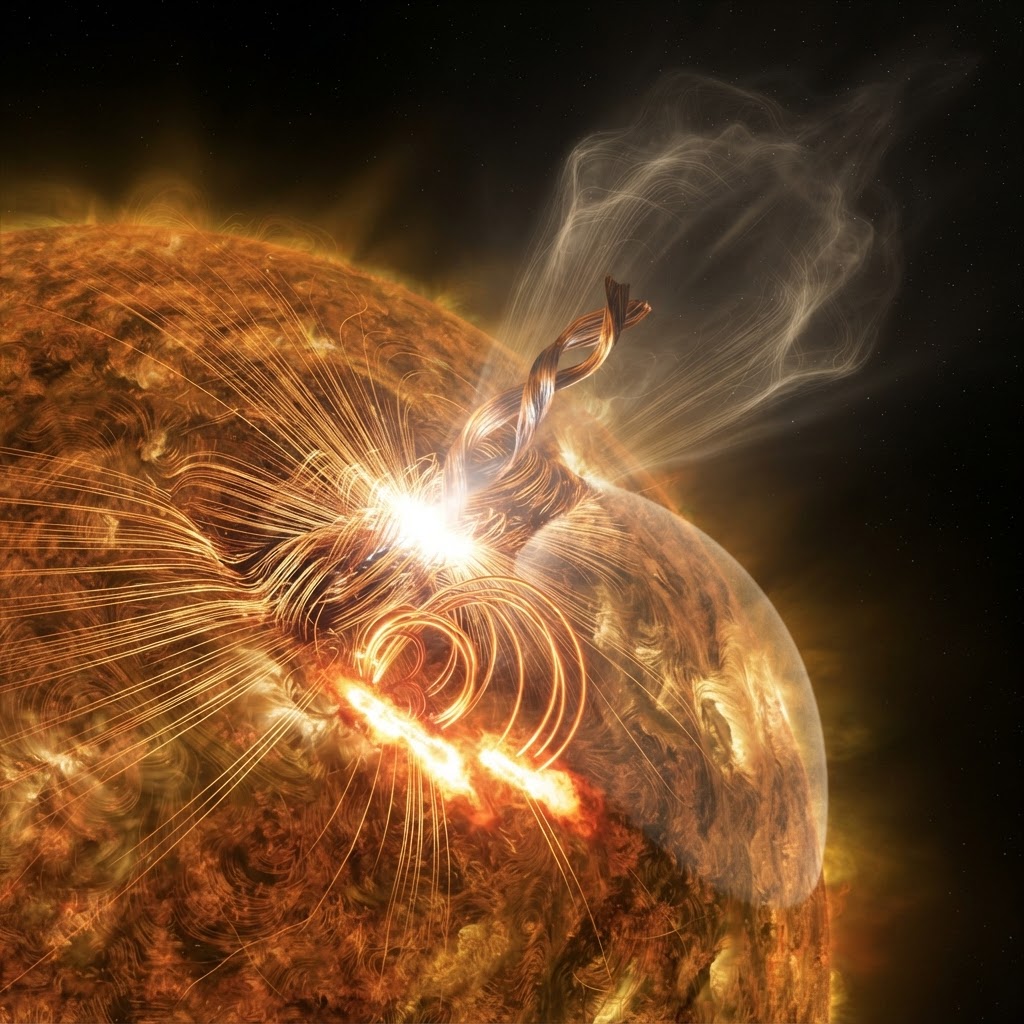
Coronal reconnection explains the timing and gross energetics. Flare ribbons, fast coronal inflows, and hard X‑ray signatures of accelerated electrons line up with magnetic flux‑transfer rates expected from reconnection. Global energetics studies that combine flare radiation, nonthermal particle energetics and CME kinetic/magnetic energy demonstrate that the magnetic free energy extracted from the corona is large enough, in principle, to power the observed outputs for typical X‑class events.
Work that aggregates multiwavelength budgets finds a recurring pattern: a substantial fraction of the released energy is carried away by the CME (kinetic and magnetic), another large fraction goes to accelerate electrons and ions, and the remainder heats plasma and powers radiation. The partition fractions vary event to event but are broadly consistent with a picture in which coronal reconnection converts stored magnetic energy into these channels on timescales of minutes to hours.
Where the uncertainties are
- Measuring the available magnetic free energy. Photospheric magnetograms are our boundary data, but the coronal field is force‑free and three‑dimensional; extrapolations (nonlinear force‑free field models) carry systematic uncertainties. Small changes in boundary conditions or preprocessing can shift estimated free energy by tens of percent — an important systematic when comparing with the combined flare + CME energy.
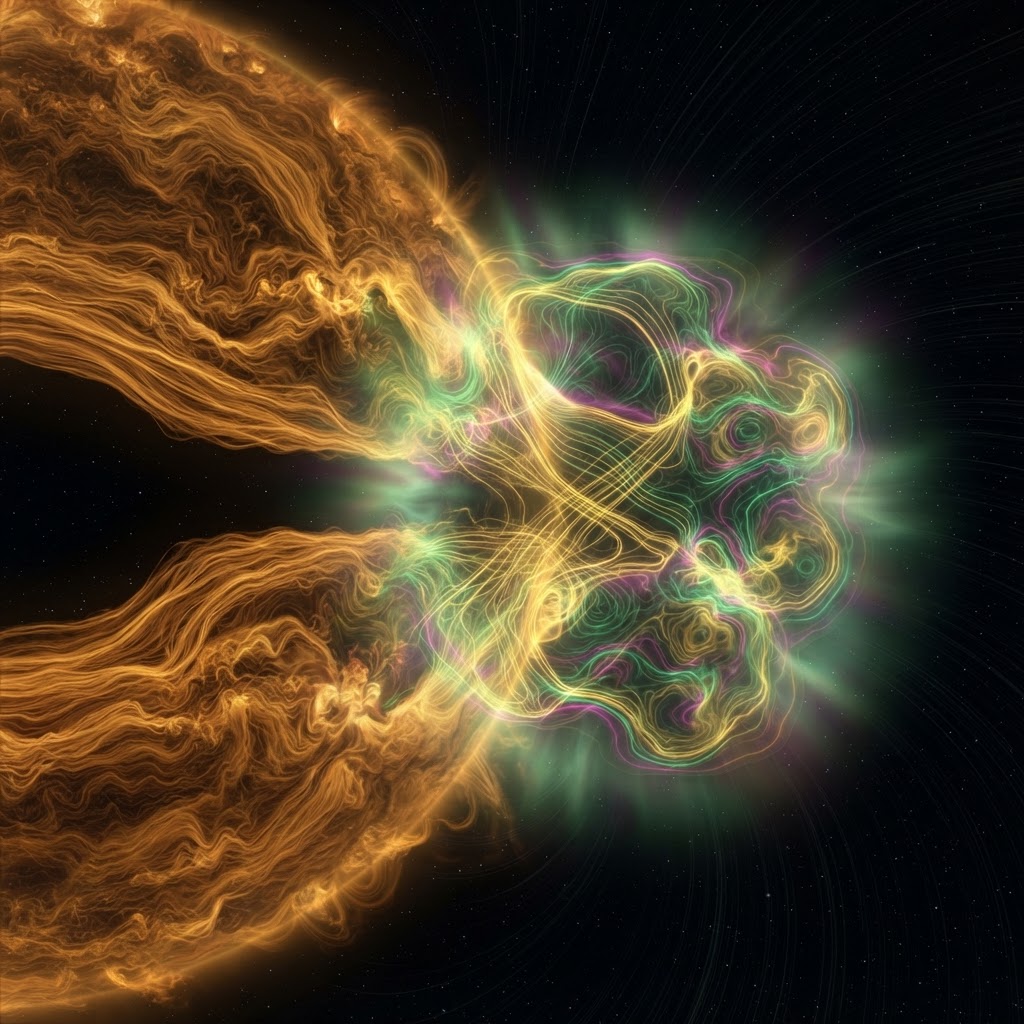
- Energy partition microphysics. How exactly reconnection channels energy into bulk CME motion versus particle acceleration versus heating is not settled. Kinetic processes — turbulence, plasmoid formation and shock compression — all appear in observations and simulations, but their relative roles in X‑class scales remain a frontier.
- Temporal resolution and transport losses. Observational budgets often sum outputs integrated over the event, but energy conversion rates vary rapidly. Transport and escape of energetic particles, and the time‑dependent development of CME magnetic structure, complicate simple accounting.
Paths forward
The next step is convergent measurement: routine, well‑calibrated coronal vector field and polarimetric observations to reduce extrapolation ambiguities; high‑cadence spectroscopy and imaging to capture the impulsive phase; and coordinated use of Solar Orbiter, Parker Solar Probe and ground‑based facilities such as DKIST to connect remote signatures to in situ diagnostics. On the modeling side, coupling global MHD to kinetic models that resolve plasmoid and turbulent scales will be necessary to predict partitioning robustly.
Implications
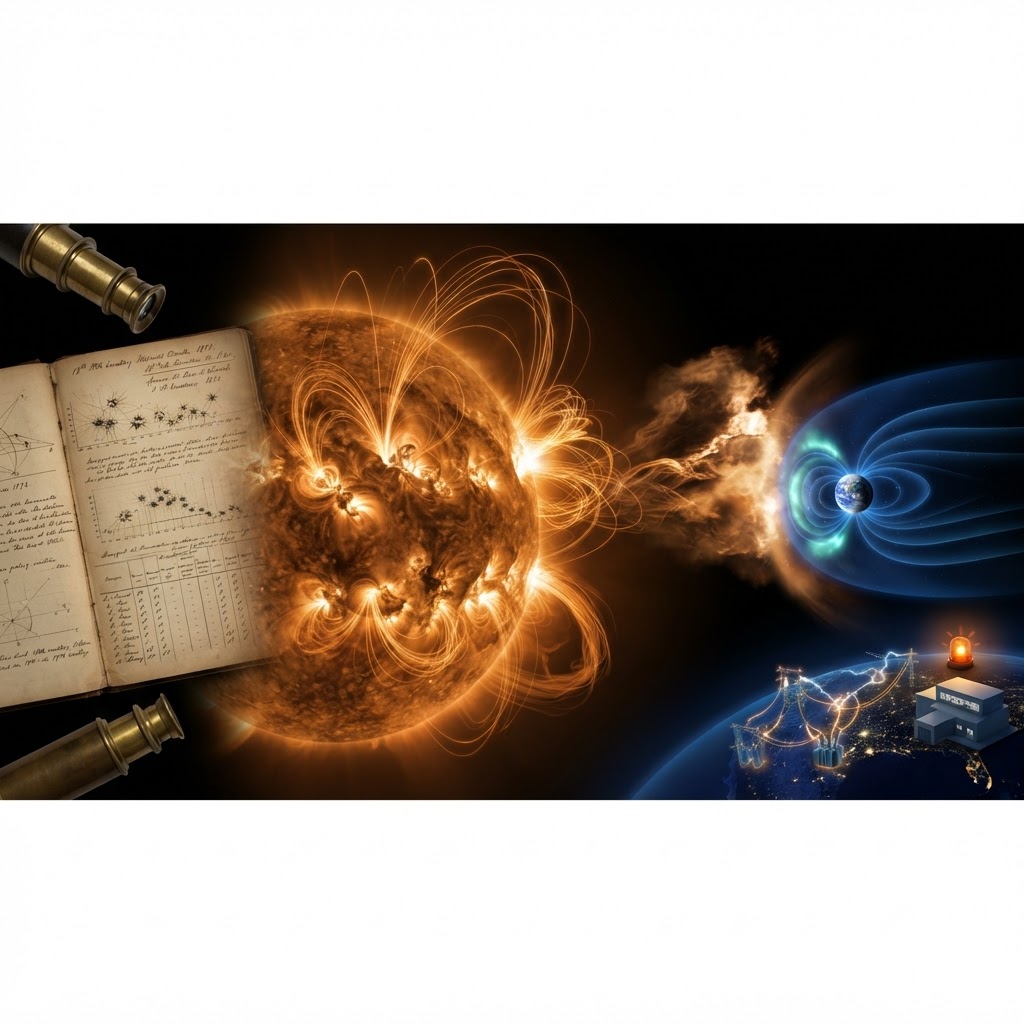
Refining the energy budget is not an academic exercise. Better constraints on how much energy is available and where it goes will improve forecasts of CME speeds and particle fluences — the quantities that determine technological impact at Earth and in cislunar space. More fundamentally, X‑class flares are a natural laboratory for fast magnetic reconnection at high Lundquist numbers; tightening the budget will sharpen tests of reconnection theory under extreme conditions.
In short: coronal magnetic reconnection is the leading, quantitatively plausible engine for X‑class flare energetics, but fully closing the books on where the energy goes requires improved coronal field measurements, higher‑fidelity models, and coordinated multi‑platform observations.