Summary
X‑class solar flares are the most energetic explosions in the solar system, driven by rapid reconfiguration of coronal magnetic fields. Recent observational advances — microwave imaging spectroscopy, high‑cadence EUV/X‑ray imaging, and refined coronal magnetic modeling — are tightening the accounting of where the energy goes, even as core uncertainties remain.
Reconnection: the engine, not the whole story
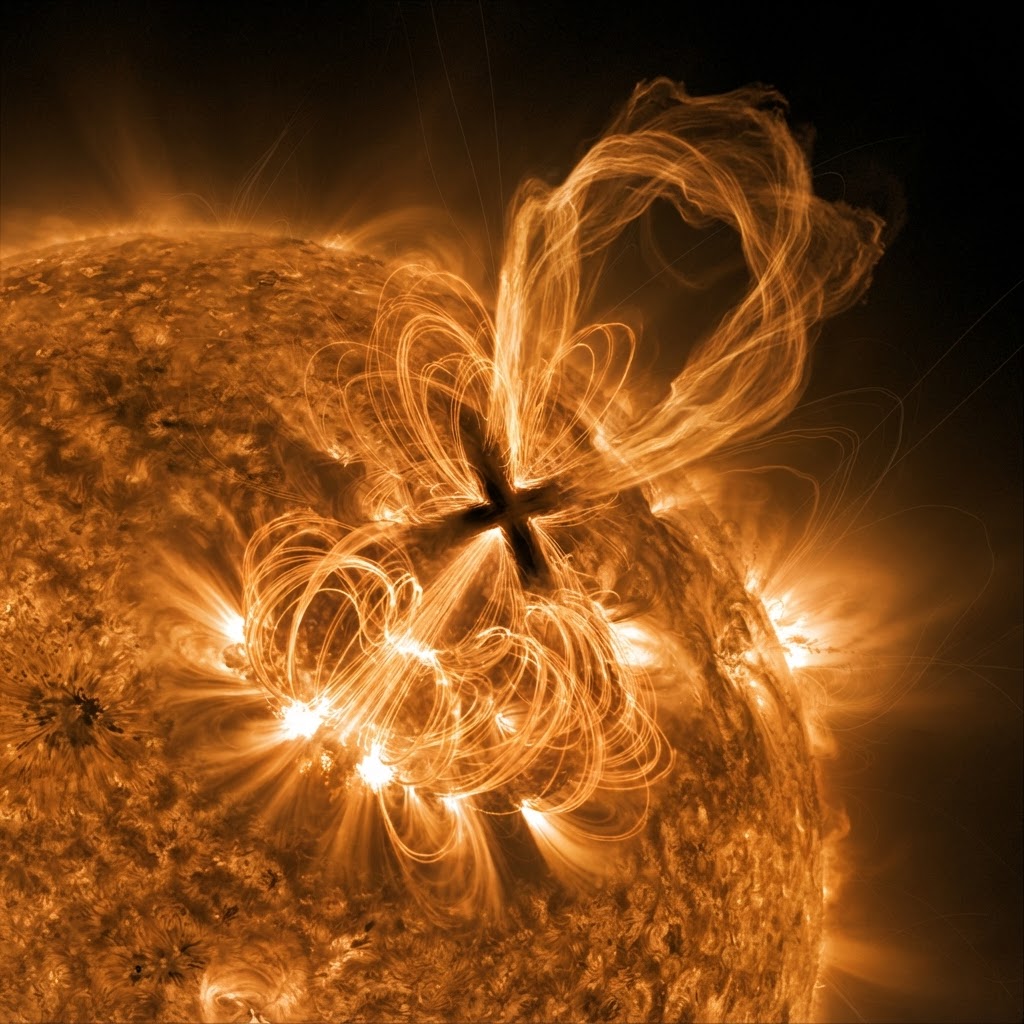
Magnetic reconnection in the corona converts stored magnetic energy into bulk motions, heat, accelerated particles and radiation. In the classical picture (CSHKP), reconnection beneath an erupting flux rope powers both the flare and the associated coronal mass ejection (CME). But that schematic leaves open two practical questions: how fast can coronal reconnection release energy, and how is that released energy divided among thermal plasma, nonthermal particles, and CME kinetic/magnetic energy?
New diagnostics, sharper budgets
- Global energetics: Analyses of large events put total released magnetic energy for X‑class flares in the 10^31–10^33 erg range. A significant fraction often appears in the CME kinetic and magnetic reservoirs (tens of percent to sometimes the majority), with the flare thermal and nonthermal outputs making up the rest.
- Particle energetics: Hard X‑ray and microwave imaging spectroscopy (e.g., EOVSA and RHESSI legacy analyses) have closed in on the electron energy content by better constraining the low‑energy cutoff — the parameter that dominates estimates of nonthermal electron energy. Those constraints show nonthermal electrons can carry a substantial fraction (comparable to the thermal energy) in many X‑class events, but precise fractions vary by event.
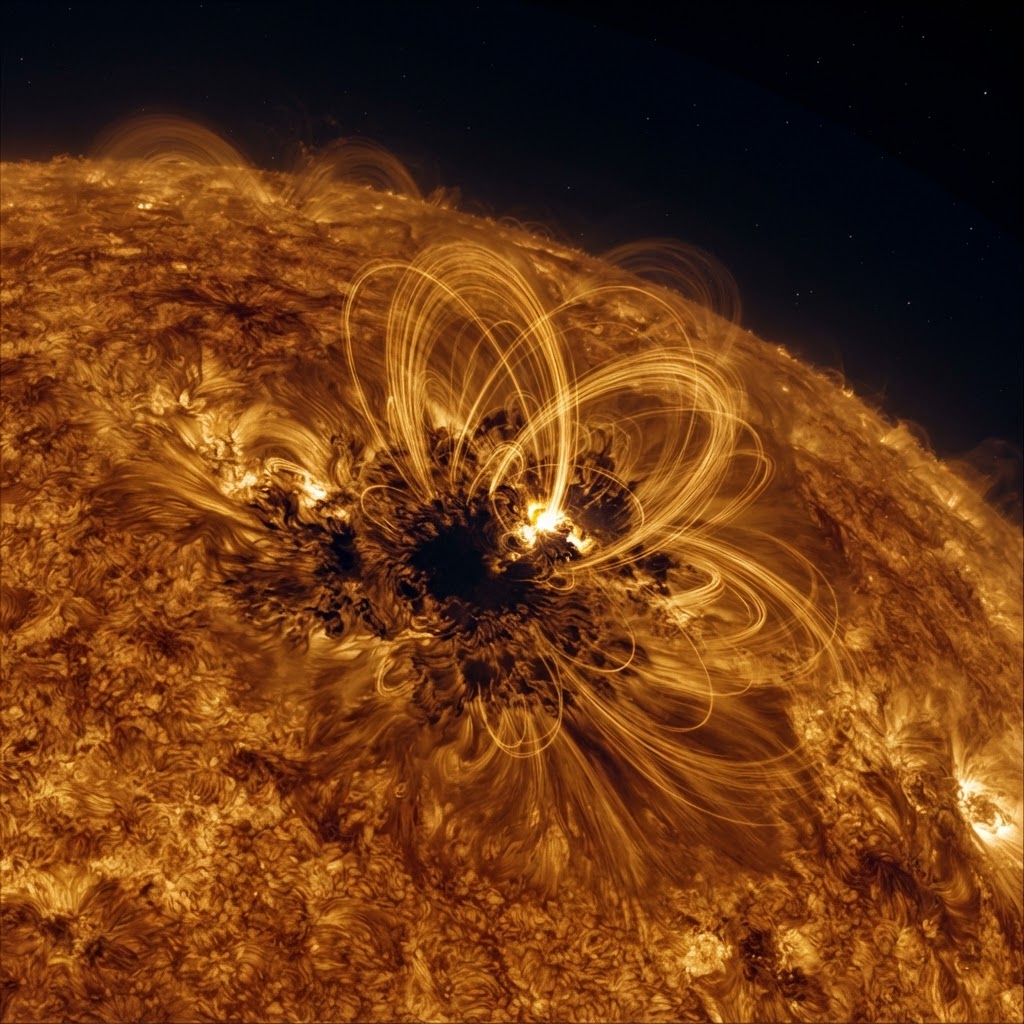
- Reconnection rate and structure: High‑cadence EUV and coronal spectroscopy reveal fast, intermittent, plasmoid‑dominated reconnection in flare current sheets. These multiscale, turbulent reconnection regimes naturally produce fast energy release and efficient particle acceleration in three dimensions, aligning better with observed rapid rises in X‑ray and radio emission.
Why the corona complicates an accounting
Estimating the magnetic energy available in the corona remains the primary uncertainty. We only directly measure the photospheric field; coronal fields are inferred through extrapolation (force‑free or magnetofrictional models) that carry systematic uncertainties. Similarly, the partition of energy between thermal plasma and nonthermal particles is sensitive to diagnostics: thermal energy depends on emission measure and filling factors, while nonthermal energy hinges on the poorly constrained low‑energy cutoff in electron spectra.
Where progress is happening
Rapid progress follows from three converging trends: advanced microwave spectropolarimetry that constrains electron distributions and magnetic field strength in flaring loops; improved 3D modeling linking MHD scales to kinetic particle acceleration; and coordinated observations from instruments such as SDO/AIA, Hinode, RHESSI legacy data, Solar Orbiter/STIX, and ground‑based facilities (IRIS, DKIST). Together they are moving the field from broad, order‑of‑magnitude budgets to event‑specific energy audits.
Open questions
How and where does reconnection deposit energy into the CME versus the flare loops, and what determines event‑to‑event variance? In particular, the fraction of magnetic energy converted into nonthermal particles remains the single largest practical unknown for predicting radiation and space‑weather impacts.
Bottom line: Coronal magnetic reconnection is confirmed as the driver of X‑class flares, and new diagnostics are making the energy bookkeeping far more precise. But until coronal magnetic fields and the low‑energy end of accelerated particle spectra are constrained routinely, the detailed partition of the flare energy budget will remain an active, decisive frontier for solar‑space weather science.