Executive hypothesis
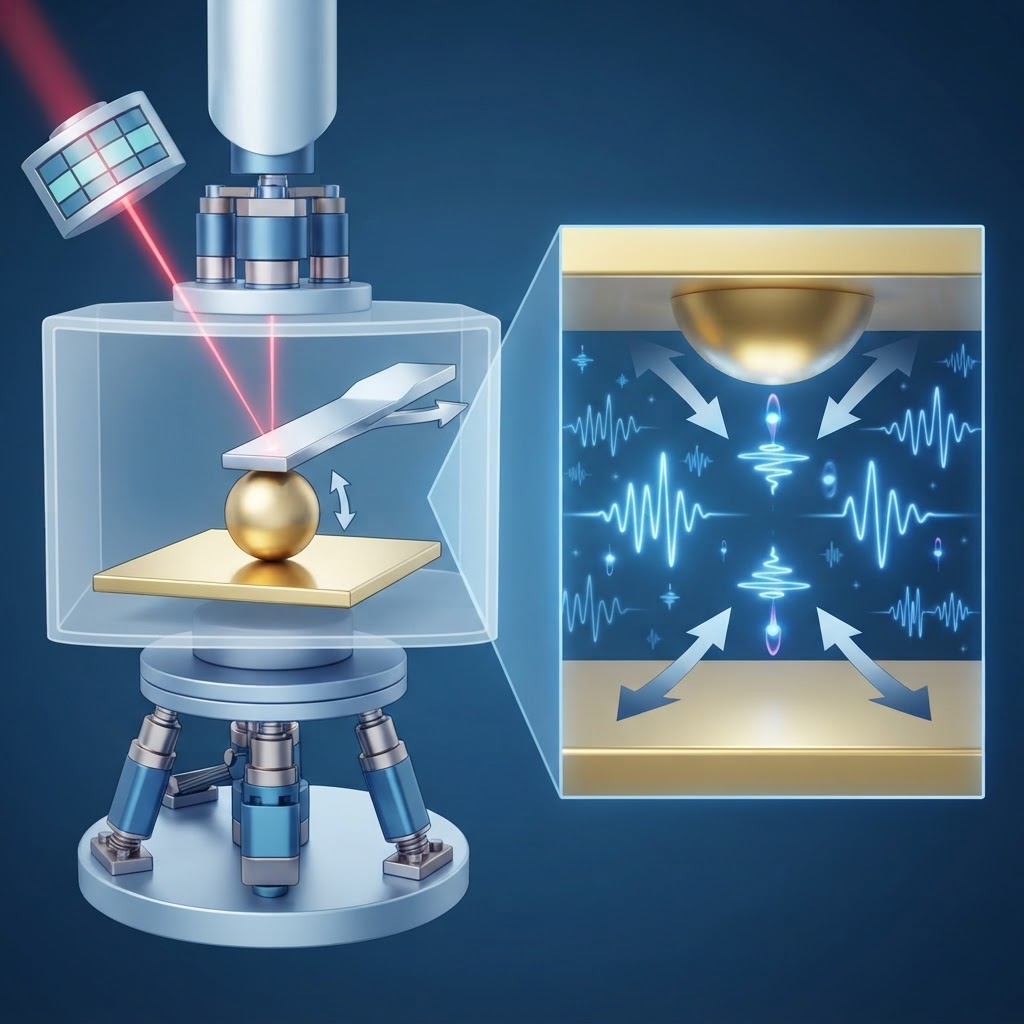
Vacuum energy fluctuations can be measured directly as a broadband, non-thermal force-noise spectrum on micro- and nano-mechanical probes by performing Casimir force spectroscopy with time-modulated boundary conditions and spectrally-resolved correlation detection. By converting zero-point field fluctuations into measurable force noise (and, when parametrically driven, into emitted photons), an experiment can recover the spectral density predicted by Lifshitz theory and the quantum fluctuation–dissipation relation, distinct from thermal and technical noise.
Why this is plausible
The Casimir effect is already a macroscopic manifestation of vacuum field modes constrained by boundaries. Precise force measurements (Lamoreaux 1997; Mohideen & Roy 1998) agree with quantum electrodynamics (QED) predictions for static configurations. The quantum fluctuation–dissipation theorem (FDT) connects dissipative response to underlying vacuum fluctuations; dynamical modulation of boundaries (the dynamical Casimir effect) converts vacuum fluctuations into real photons that have been observed in superconducting circuits. Combining these mature threads—static Casimir metrology, time-dependent boundary modulation, and FDT—creates a direct route to measure the spectral properties of vacuum fluctuations as a force noise power spectral density (PSD) on a mechanical element.
Mechanistic sketch
Consider a high-Q micro- or nano-scale mechanical resonator (cantilever or membrane) facing a planar surface at separation d where Casimir forces dominate. The ensemble of electromagnetic modes between the objects produces a mean Casimir force F_C(d) and force fluctuations S_F(ω;d). Under equilibrium QED, S_F contains a temperature-independent zero-point term plus a thermal contribution. To reveal the zero-point component we propose two complementary tactics:
- Passive spectroscopy: Measure the force noise PSD S_F(ω) of the mechanical probe at cryogenic temperatures where thermal mechanical noise is minimized. Readout via a low-noise interferometer or superconducting microwave cavity yields force sensitivity sufficient to approach predicted zero-point noise levels in the kHz–MHz band.
- Active modulation (parametric conversion): Apply a controlled, high-bandwidth modulation to the boundary conditions — either by electro-optically modulating the dielectric function (graphene gating, carrier injection) or by physically modulating separation at high frequency — to parametrically upconvert high-frequency vacuum fluctuations into the measurement band or into emitted microwave/optical photons. The rate and spectrum of converted signals are predicted by time-dependent Lifshitz/QED calculations and scale with modulation amplitude and frequency.
Falsifiable predictions
- The measured force noise PSD S_F(ω;d) will contain a component that is temperature-independent down to base temperature, with magnitude and distance scaling matching Lifshitz theory zero-point terms within experimental uncertainties.
- Under parametric modulation at frequency Ω, additional spectral features will appear at sidebands (e.g., ω±nΩ) and as emitted photon flux; their amplitudes scale predictably with modulation amplitude and material permittivities. Turning off modulation eliminates these sidebands.
- Material control: replacing a normal metal with a superconductor (gap ≫ k_BT) will change the high-frequency cutoff of contributing modes and thereby alter S_F(ω) in a predictable way; suppression inconsistent with theory would falsify standard QED descriptions of boundary-mode spectra.
Experimental roadmap
- Platform selection: Build a cryogenic AFM/MEMS force sensor with sub-attonewton/Hz^1/2 sensitivity and a dynamic range spanning kHz–MHz. Couple the mechanical element to an optical or microwave interferometric readout; for active modulation, integrate a superconducting microwave cavity for photon detection.
- Baseline characterization: Calibrate mechanical thermal noise, calibrate distance-dependent mean Casimir force, and map electrostatic patch potentials with Kelvin-probe techniques. Lower temperature to suppress thermal phonon contributions.
- Passive spectroscopy: Record S_F(ω;d) at multiple separations and temperatures; extract a separation-dependent, temperature-independent component and compare to Lifshitz-based predictions of zero-point force noise.
- Parametric experiments: Apply time-dependent modulation of dielectric or separation, scan modulation frequency and amplitude, and measure sidebands and photon emission. Use heterodyne and cross-correlation analyses to increase signal-to-noise ratio (SNR).
- Materials studies: Repeat with metals, doped semiconductors, graphene, and superconductors to test spectral cutoff and material-dependent mode densities.
Controls and pitfalls
Primary confounders are thermal mechanical noise, electrostatic patch forces, vibration, backaction from the readout, and technical electronic noise. Mitigations:
- Operate at millikelvin or cryogenic temperatures to minimize thermal force noise; verify temperature scaling.
- Nullify and map patch potentials; use conductive coatings and Kelvin probes; perform charge-neutralization steps.
- Use cross-correlated readout (two independent sensors) to separate correlated quantum-driven force noise from uncorrelated electronics noise.
- Implement calibration signals (known forces, radiation pressure pulses) to verify transfer functions and rule out calibration bias.
Finally, theoretical pitfalls include inaccuracies in modeling finite conductivity, surface roughness, and non-equilibrium effects. These must be incorporated into data-to-model fits and bounded by auxiliary metrology (AFM maps, ellipsometry).
Implications
A successful direct spectral measurement of vacuum energy fluctuations would constitute a new empirical access to quantum fields in confined geometries, closing a long-standing gap between concept and measurement. It would provide stringent tests of Lifshitz QED for realistic materials, inform discussions of vacuum energy in cosmology (by clarifying how boundary conditions and material response shape observable vacuum energy), and enable new routes in metrology and quantum technologies that exploit engineered vacuum reservoirs. Even a null result — persistent discrepancy with theoretical spectral predictions — would demand revisions in our understanding of macroscopic quantum field interactions.
In short: Casimir force spectroscopy, augmented by time-modulated boundaries and rigorous control, offers a feasible, falsifiable pathway to directly measure the spectral imprint of vacuum fluctuations.