Executive hypothesis
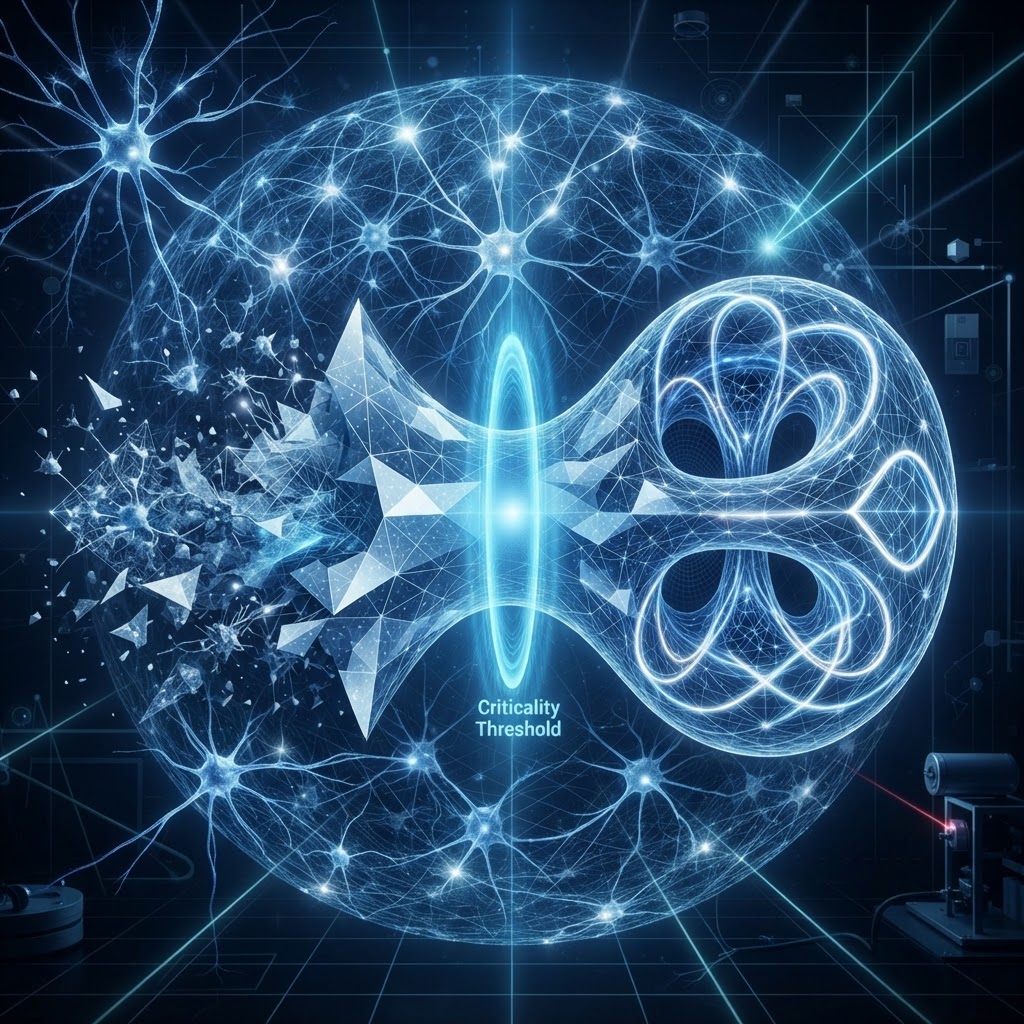
Consciousness is a macroscopic phase of neural information statistics that appears when the information geometry of brain activity undergoes a topological phase transition. This transition is visible as a discrete change in topological invariants (e.g., Betti numbers, persistent homology summaries, Euler characteristic) of the manifold formed by population activity under the Fisher–Rao information metric. Below the critical point the neural information manifold fragments into many localized information pockets (unintegrated processing); above it, high-dimensional cavities and long-range information pathways percolate to form a globally integrated topological structure corresponding to conscious access.
Why this is plausible
Three lines of empirical and theoretical evidence converge on this picture. First, neural activity shows hallmarks of criticality and large-scale reorganizations with state changes (sleep/wake, anesthesia, psychedelics). Second, topological data analysis (TDA) has revealed nontrivial higher-order structure in brain networks and spike trains that relates to function and cognition. Third, information geometry — the differential geometry of probability distributions — provides a principled metric (the Fisher–Rao metric) to quantify distances between neural states, and therefore to define continuous manifolds whose global topology can change sharply as coupling, noise, or neuromodulation vary. Combining these suggests a discontinuous, topologically characterized transition in the space of information relationships as the substrate of conscious states.
Mechanistic sketch
Model the instantaneous population activity as a point in a high-dimensional probability simplex; the time evolution traces a trajectory on an information manifold endowed with the Fisher–Rao metric. Local neuronal interactions shape the local curvature of this manifold; synaptic strengths, neuromodulators, and network motifs adjust the metric and thereby the geometry. As coupling or effective gain increases, local information pockets begin to link via higher-order correlations, generating cycles and cavities detectable by persistent homology computed across a filtration of information thresholds (e.g., mutual information or conditional transfer entropy cutoffs). At a critical parameter set the homological signature undergoes a non-analytic change: lower-dimensional components coalesce, higher-dimensional cavities appear or disappear, and the Euler characteristic or Betti spectrum jumps. That topological rearrangement corresponds to a new functional regime enabling rapid, global information integration and multiplexed routing—properties widely associated with conscious cognitive processing.
Falsifiable predictions
- Topological signature: Transitions between unconscious and conscious states (sleep→wake, anesthesia induction/recovery, general anesthesia depth) will coincide with sharp, reproducible changes in persistent homology summaries of the information manifold (e.g., abrupt shifts in Betti numbers or in the persistence landscape), beyond what is expected from smooth changes in correlation magnitude.
- State specificity: The critical point should be tunable by neuromodulators or stimulation; increasing effective coupling (pharmacologically or via electrical stimulation) should shift the transition threshold, producing conscious-like topological signatures even at reduced arousal.
- Predictive power: The topological phase measure will predict behavioral markers of conscious access (e.g., reportability, stimulus detection) more robustly than global synchrony or average mutual information.
- Intervention effects: Targeted disruption of connections across putative topological hubs (identified by homology generators) will collapse the global topology and abolish conscious signatures without necessarily eliminating local activity.
Experimental roadmap
Stage 1 — In silico validation: Build spiking and rate-network models with controllable coupling, gain, and noise. Compute information distances (Fisher–Rao approximations), build filtrations (thresholded mutual information / transfer entropy), and compute persistent homology. Demonstrate a sharp transition in homological summaries as parameters vary; correlate with measures of information integration (e.g., integrated information approximations).
Stage 2 — Mesoscopic recordings: Apply to high-density EEG/ECoG and mesoscale calcium imaging in rodents during controlled transitions (sleep/wake, graded anesthesia, electrical/optogenetic modulation). Construct trial-wise information manifolds and compute persistent homology across time; test association with behavioral responsiveness.
Stage 3 — Human translational tests: Use intracranial EEG and high-density MEG/EEG during anesthesia induction, recovery, and controlled altered states (pharmacological agents). Test predictive power for reportability and responsiveness. Use noninvasive perturbation (TMS) to probe causality by trying to switch the topological state.
Controls and pitfalls
- Control for trivial drivers: Shuffle temporal structure, neuron identities, or surrogate data (phase-randomized signals) to ensure topological signatures reflect structured information, not spectral or trivial correlation changes.
- Metric dependence: Alternative distance choices (e.g., KL divergence, Wasserstein) must be tested to verify that results are not artefacts of a particular metric; robustness across metrics strengthens the hypothesis.
- Noise and finite sampling: Persistent homology is sensitive to sample size; control analyses with bootstrap, subsampling, and null models are essential to bound false positives.
- Non-uniqueness: Similar topological changes could arise from geometric stretching without qualitative information reorganization; pair the topological analysis with directed-information measures and perturbational assays to establish functional integration.
Implications
If confirmed, this hypothesis reframes consciousness as a topologically distinct phase in the geometry of neural information, giving a measurement-tractable order parameter grounded in information theory and topology. It would unify observations of neural criticality, higher-order network structure, and integrated information. Practically, a topological biomarker could improve anesthesia monitors, aid diagnosis of disorders of consciousness, and guide neuromodulatory therapies. The framework would also inform neuromorphic designs: to engineer conscious-like processing, one must realize and control topological phase structure in information manifolds. Finally, grounding consciousness in topological transitions suggests a new way to think about qualia and access: subjective access may correspond to system-spanning homological connectivity that enables global broadcasting of information.