Executive hypothesis
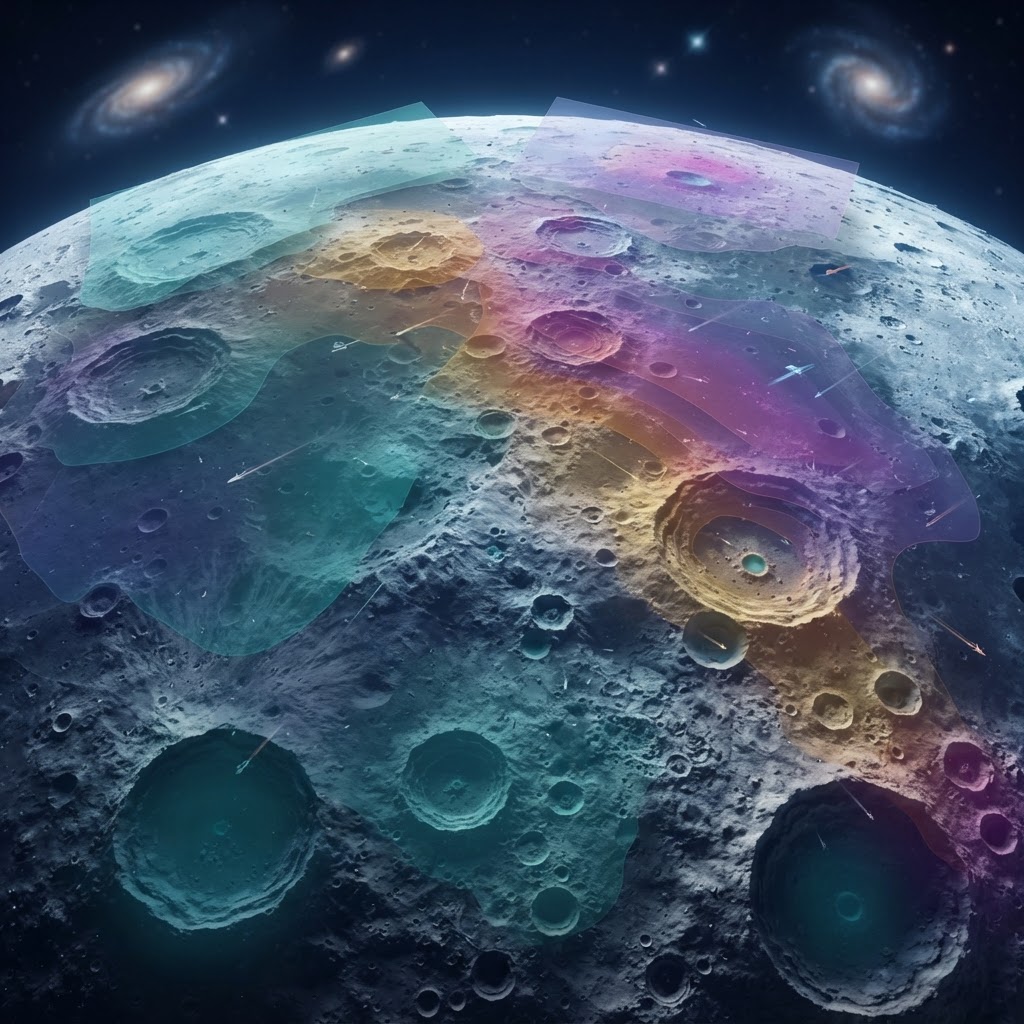
The small‑crater population preserved on the lunar surface encodes a measurable signal of hyperbolic interstellar object (ISO) impacts: by combining high‑resolution crater mapping, impact‑velocity diagnostics, compositional assays of fresh ejecta, and forward modeling of Solar System impactors, we can extract an ISO flux estimate complementary to telescope surveys.
Why this is plausible
The discovery of 'Oumuamua and 2I/Borisov showed that interstellar objects cross the inner Solar System, but transient surveys sample only the brightest tail of the population and are dependent on fortuitous geometry. The Moon, with ~4 billion years of crater retention and no atmosphere, presents a long‑duration detector: each ISO impact produces a crater whose morphology, size‑velocity scaling, spatial distribution, and surviving ejecta (including glass spherules) carry information about the impactor. On geological timescales the Moon integrates many sampling years' worth of interstellar flux, amplifying the effective exposure compared with Earth‑based surveys.
Mechanistic sketch
ISOs differ from bound Solar System small bodies in three measurable ways: (1) approach velocity distribution — typically higher heliocentric excess speed (v∞) and hence higher impact speeds, (2) isotropy of incoming directions relative to the ecliptic, and (3) potentially different bulk composition and isotopic ratios if they formed around other stars.
These differences produce observable signatures in the lunar crater record:
- Higher mean impact speeds produce a different crater size‑to‑projectile size scaling: for a given crater diameter, ISO projectiles will tend to be smaller and produce sharper melt signatures.
- An isotropic ISO flux should weaken the strong leading/trailing longitudinal asymmetry imposed by the Moon's orbital motion on bound meteoroids and near‑Earth objects (NEOs); ISO impacts should present a more isotropic azimuthal and latitudinal distribution.
- Fresh ejecta and glass spherules from ISO impacts may carry non‑Solar System isotopic or elemental anomalies (e.g., O, C, noble gases) detectable in returned samples or in‑situ mass spectrometry.
Falsifiable predictions
- If ISOs contribute at detectable levels, the small‑crater azimuthal/latitudinal distribution after correction for orbital focusing and observational bias will contain a statistically significant isotropic component beyond that expected from modeled NEO and comet populations.
- The inferred mean impact velocity for a subset of fresh small craters (estimated from morphology and annular melt) will be higher than the modeled Solar System background with >3σ significance.
- Returned samples from candidate fresh ISO‑like craters will show compositional or isotopic anomalies inconsistent with known Solar System reservoirs, or alternatively, their absence will constrain the ISO mass distribution to levels incompatible with optimistic flux estimates.
Experimental roadmap
- Data assembly: produce a global census of small (<100 m) fresh craters using LROC narrow‑angle imagery, automated detection, and supervised classification to identify retention age and freshness.
- Modeling: construct forward models of expected crater distributions from NEOs, main‑belt ejecta, and long‑period comets including gravitational focusing by Earth–Moon; inject hypothetical ISO populations with parameterized flux, velocity distribution, and isotropy to generate comparative maps.
- Statistical inference: use Bayesian model selection to quantify the need for an isotropic/high‑velocity component in observed crater statistics; marginalize over observational selection effects and secondary cratering contamination.
- Ground truth: select a prioritized list (~10) of very fresh, small craters with preserved glass and ejecta blankets for targeted sample return or in‑situ mass spectrometry (e.g., laser‑ablation MS, stepped heating for volatiles, noble gas analysis).
- Cross‑checks: conduct simultaneous optical/IR monitoring for transient impact flashes to validate modern ISO impact rates and correlate with lunar seismic monitoring if available.
Controls and pitfalls
Controls: build null catalogs from synthetic crater fields produced by well‑constrained Solar System impactor populations; use lunar far side versus near side comparisons to control for Earth gravitational focusing; leverage crater freshening age estimates (e.g., superposed regolith thickness, spectral maturity indices) to exclude ancient record biases.
Pitfalls: the ISO flux may be very low (one per many Myr at a given small‑crater size), making signal extraction marginal; secondary cratering and regolith gardening can erase or mimic isotropic patterns; compositional mixing in ejecta may obscure exogenous signatures; modeling uncertainties in NEO flux and secular resonances can confound inference. These can be mitigated by careful statistical stacking, conservative priors, and selecting the freshest craters with unambiguous primary morphology.
Implications
If successful, this program would provide an independent, time‑integrated measurement of the ISO space density and size distribution across orders of magnitude fainter than current telescopic limits. That measurement would inform models of planetesimal ejection from other systems, constrain the likelihood of material exchange between stellar systems, and refine risk assessments for rare high‑velocity impactors. A negative result—no ISO signal above modeled Solar System backgrounds—would place strong upper limits on the ISO population and narrow the allowed formation/ejection histories of planetary systems. Either outcome meaningfully advances our empirical knowledge of interstellar small bodies and leverages the Moon as a passive, enduring sensor of the Galactic environment.
This proposal calls for an interdisciplinary program linking lunar remote sensing, impact physics, cosmochemistry, and statistical inference—an approach that could transform the Moon into a long‑term observatory for interstellar visitors.