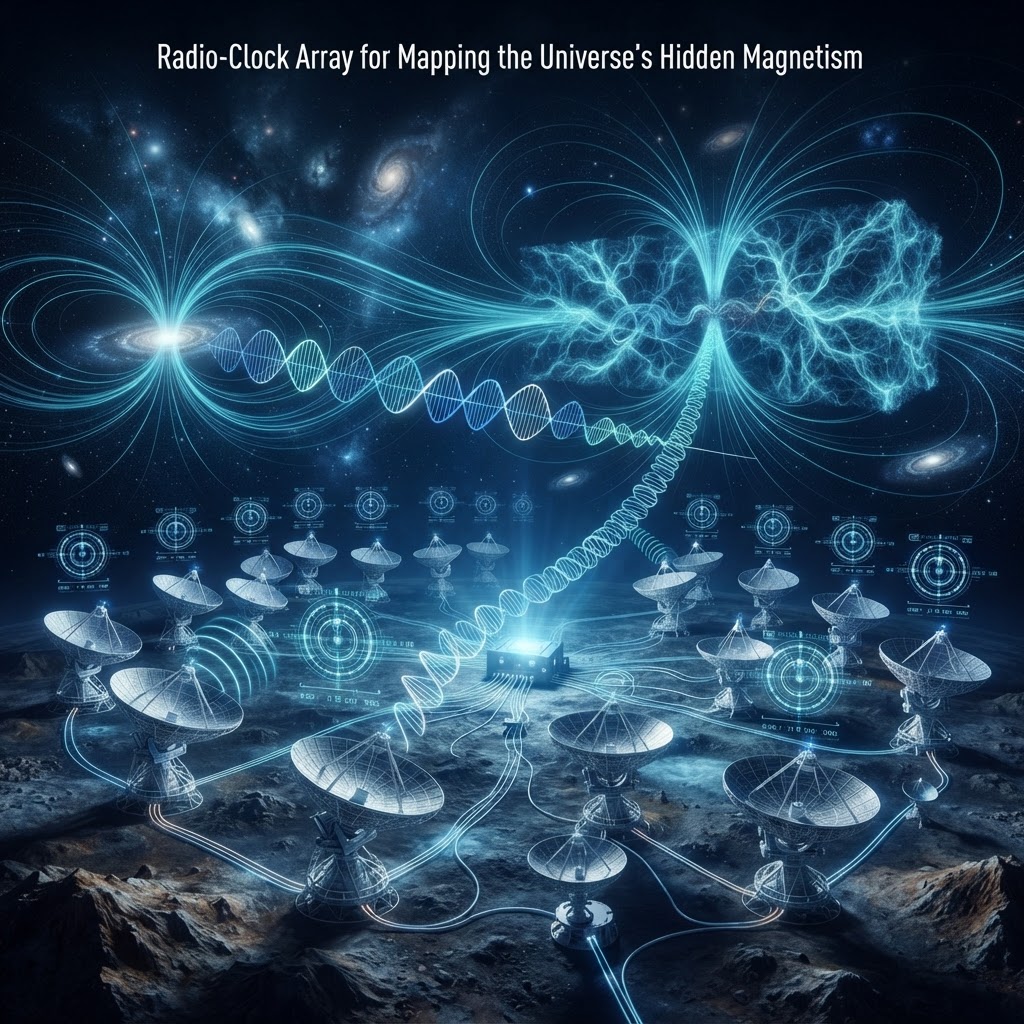
Executive hypothesis
Fast radio bursts (FRBs) can be assembled into a distributed timing array that measures the strength, coherence, and topology of magnetic fields in the intergalactic medium (IGM). The central proposal is to combine densely sampled FRB dispersion measures (DMs), Faraday rotation measures (RMs), redshifts, sky positions, and, where available, repeat-burst timing with large-scale-structure reconstructions. The resulting joint statistics should separate magnetized filaments and voids from magnetized galactic environments more effectively than any single FRB or isolated RM source.
The hypothesis is falsifiable: after modeling host-galaxy and Milky Way contributions, FRBs whose sightlines intersect comparable cosmic-web structures should exhibit correlated residual DM, RM, and polarization signatures. The amplitude and scale dependence of those correlations would constrain the otherwise poorly measured intergalactic magnetic field (IGMF).
Why the proposal is plausible
An FRB is an unusually clean propagation probe. Its radio pulse is dispersed by free electrons, with the delay scaling approximately as the inverse square of frequency. The measured DM therefore integrates electron column density along the line of sight. If the plasma is magnetized, the same electrons rotate the plane of linear polarization through Faraday rotation, quantified by RM, which weights the line-of-sight magnetic field by electron density and redshift.
FRB surveys now provide the essential ingredients: large event samples, localized host galaxies for a growing subset, broadband polarization measurements, and repeaters that permit precision comparisons among bursts. Unlike quasars or pulsars, FRBs extend to cosmological distances and sample the cosmic web from many directions. Their transient nature is a challenge for follow-up, but it also enables a high-throughput, redshift-tagged grid of probes.
Mechanistic sketch
For each localized burst, construct a propagation vector containing observed DM, RM, redshift, polarization properties, burst width, and a probabilistic decomposition into Milky Way, host, circumsource, and intergalactic terms. Use galaxy surveys and gravitational-lensing or photometric-redshift catalogs to infer the intervening filament, group, and void geometry. A forward model then predicts the joint probability of DM and RM under competing magnetic-field scenarios.
The key statistic is not merely mean RM. It is the cross-correlation between residual RM and the projected matter field, conditioned on electron column density and redshift. A complementary statistic compares pairs of FRBs whose sightlines pass through the same reconstructed filament but diverge before and after it. In a sufficiently large sample, this is a form of magnetic tomography: the common segment contributes a correlated signal, while unrelated foregrounds average down.
Repeating sources provide an internal control. Their burst-to-burst DM and RM changes can identify local plasma variability near the source, preventing a persistent host contribution from being mistaken for an IGM signal. Multi-frequency burst morphology can further distinguish propagation effects from intrinsic polarization evolution.
Falsifiable predictions
- Filament correlation: residual RM should increase statistically with the inferred number, baryon content, or overdensity of intersected filaments, after accounting for Galactic foregrounds.
- Coherence scale: nearby sightlines traversing the same large-scale structure should show correlated RM with an angular dependence set by the magnetic coherence length and filament geometry.
- Redshift evolution: the variance and mean absolute RM should evolve with redshift according to the competing histories of magnetization, ionization, and cosmic expansion.
- DM–RM covariance: magnetized overdense structures should generate a positive, though broad, covariance between excess DM and absolute RM; a null covariance would challenge simple filament-magnetization models.
- Void contrast: sightlines dominated by voids should show substantially lower IGM RM than comparable filament-crossing sightlines, unless fields are widespread and volume-filling.
Experimental roadmap
Phase one should standardize burst-level measurements. Every localized FRB should receive broadband Stokes calibration, robust RM synthesis, uncertainty propagation, and a host-environment assessment. Repeater monitoring should establish the distribution of local DM and RM variability.
Phase two should build the array. Combine wide-field discovery surveys with interferometric localization and optical or infrared host spectroscopy. The target is not simply a large catalog, but a sample with controlled sky coverage, redshift completeness, polarization sensitivity, and well-characterized selection effects.
Phase three should perform hierarchical inference. Simultaneously fit Galactic foreground maps, host contributions, circumsource plasma, electron-density structure, magnetic coherence models, and survey systematics. Simulations should inject synthetic FRBs into realistic cosmic-web light cones to measure parameter bias before applying the method to data.
Phase four should compare independent tracers: background-quasar RMs, synchrotron emission, thermal Sunyaev–Zel'dovich measurements, weak lensing, galaxy groups, and cosmological hydrodynamic simulations. Agreement across tracers would be stronger evidence than an FRB-only detection.
Controls and pitfalls
The dominant danger is contamination. The Milky Way contributes spatially structured RM; host galaxies can contribute large and variable values; source environments may contain magnetized shocks or nebulae. These terms must be marginalized rather than subtracted with unjustified precision. Repeater-derived priors, host inclination, star-formation rate, local environment, and burst frequency should enter the model explicitly.
Selection bias is equally serious. Polarized bursts and easily localized events are not necessarily representative. Telescope latitude, observing cadence, depolarization, scintillation, and redshift-dependent sensitivity can manufacture apparent correlations. Null tests should randomize FRB positions, rotate polarization angles, split the sample by instrument, and compare sky regions with different foreground complexity.
RM alone can be ambiguous: tangled fields may cancel along a sightline, while a small dense structure can dominate a diffuse IGM contribution. The proposal therefore treats RM, DM, redshift, pair statistics, and external structure information as a joint inference problem. A non-detection would still constrain the volume filling factor, coherence length, or field strength of the IGMF.
Implications
If successful, FRB timing arrays would convert transient astronomy into a survey of cosmic magnetism. They could distinguish primordial-field scenarios from astrophysical seeding by testing whether magnetization follows galaxies, groups, filaments, or voids. The measurements would also improve models of baryon distribution, feedback, cosmic-ray transport, and the thermal history of the low-density universe.
The decisive experiment is not a single spectacular burst. It is a statistically disciplined network of bursts whose timing, polarization, and environments are analyzed together. The cosmic web is already carrying the signal; the proposal is to make its magnetism legible.