Executive hypothesis
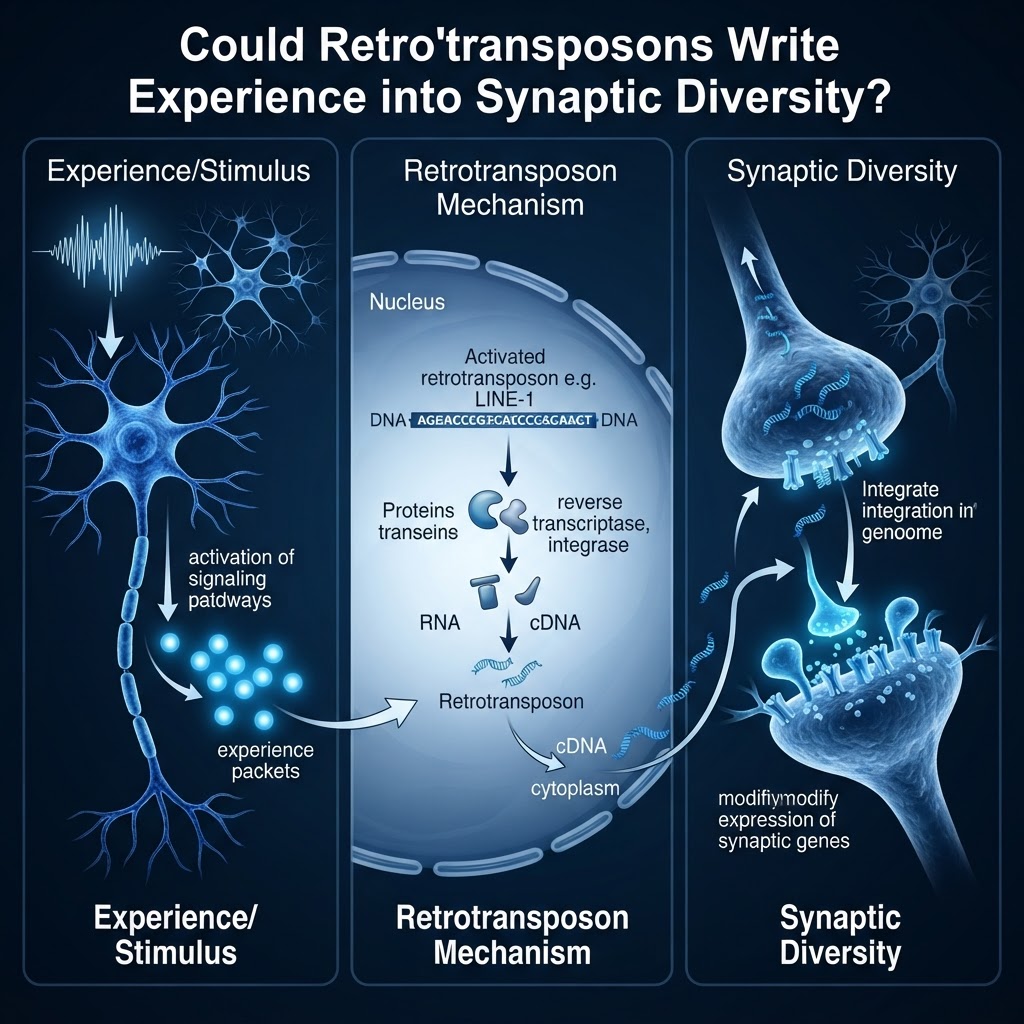
Experience-dependent synaptic plasticity is usually understood as regulation of existing genes, proteins, and circuits. This proposal advances a more radical possibility: retrotransposon activity contributes directly to the diversification of synapses by creating mosaic, neuron-specific changes in gene regulation and genome sequence.
Retrotransposons are mobile genetic elements capable of copying themselves through an RNA intermediate. In the brain, elements including LINE-1 (L1) have been detected in neuronal genomes, although their abundance, developmental timing, and functional consequences remain contested. The central hypothesis is that salient experience—learning, stress, enriched environments, or sensory deprivation—modulates retrotransposon mobilization in defined neuronal populations. In turn, new insertions or retrotransposon-derived regulatory events alter the expression of synaptic genes, producing a persistent layer of cellular individuality.
Why the hypothesis is plausible
Neurons are unusually long-lived, highly specialized, and genetically mosaic. Their function depends on precisely tuned differences in receptor composition, dendritic architecture, intrinsic excitability, and local translation. Conventional transcriptional plasticity can generate much of this diversity, but it is often transient or shared across many cells. Somatic retrotransposition could provide a mechanism for creating durable, lineage-independent differences between otherwise similar neurons.
Several observations motivate the proposal. L1-related sequences and proteins are present in neural tissue, and somatic insertions have been reported in the human brain. Retrotransposon expression can respond to cellular stress, DNA damage, inflammation, and chromatin remodeling—all processes engaged by neural activity. Retrotransposon transcripts may also influence innate immune signaling, RNA processing, and chromatin state without producing a new genomic insertion. These routes create multiple opportunities for activity to affect synaptic function.
Yet plausibility is not proof. Published estimates of neuronal L1 insertion rates vary substantially, partly because repetitive DNA is difficult to map and because technical artifacts can mimic rare somatic events. The proposal therefore treats retrotransposons as a hypothesis-generating mechanism requiring stringent, orthogonal validation.
Mechanistic sketch
Experience-induced calcium influx and neuromodulatory signaling could alter the balance between repression and activation at retrotransposon loci. Activity-dependent transcription factors, changes in DNA methylation, histone modifications, and stress-associated loss of heterochromatin may permit L1 transcription in a subset of neurons. Reverse transcription and integration could then generate somatic insertions, preferentially near genomic regions already accessible during plasticity.
Those insertions might affect synaptic phenotypes in at least three ways: by disrupting or enhancing nearby gene regulation; by supplying alternative promoters, splice sites, or polyadenylation signals; or by changing local chromatin architecture. A second, potentially more common route would involve retrotransposon RNA or proteins. These products could sequester RNA-binding proteins, activate innate immune pathways, or modify translation in dendrites. In either case, the predicted outcome is not a uniform increase in plasticity, but a broadened distribution of synaptic states across neurons.
Falsifiable predictions
- Learning or controlled sensory experience should increase validated somatic retrotransposon activity in defined neuronal ensembles relative to yoked or inactive controls.
- The effect should be cell-type- and region-specific, with the strongest signal in neurons recruited during the experience rather than in all neighboring cells.
- Neurons carrying experience-associated insertions, or exhibiting elevated retrotransposon expression, should show distinctive synaptic properties—such as altered spine turnover, miniature event frequency, receptor composition, or dendritic translation.
- Blocking retrotransposition should reduce a persistent component of experience-induced synaptic diversity without abolishing acute activity-dependent transcription.
- Artificially increasing retrotransposon activity should generate reproducible, though heterogeneous, changes in synaptic gene expression and connectivity.
- If retrotransposon products act mainly through RNA or immune signaling, synaptic effects should persist even when new genomic insertions are prevented.
Experimental roadmap
First, use a precisely controlled behavioral paradigm, such as contextual fear conditioning or environmental enrichment, together with activity tagging to identify neurons recruited by experience. In sorted tagged and untagged cells, quantify retrotransposon RNA, protein, and chromatin accessibility using single-cell and single-nucleus methods. Long-read sequencing, insertion-site capture, and duplex or single-cell genome sequencing should be combined to distinguish genuine somatic insertions from mapping errors.
Second, establish temporal order. Sample animals before experience, during consolidation, and after long-term memory. An experience-linked insertion mechanism requires retrotransposon activation to precede or accompany durable synaptic remodeling, not merely reflect late tissue damage.
Third, perturb the pathway. Use conditional suppression of L1 reverse transcriptase, targeted epigenetic repression, or validated genetic models with reduced retrotransposition. In parallel, use inducible gain-of-function systems at near-physiological levels. Assess behavior, spine morphology, electrophysiology, synaptic proteomics, and spatial transcriptomics. Ideally, perturbations should be restricted to the neuronal population engaged by the experience.
Finally, test causality at individual cells. Reconstruct insertion-bearing neurons, measure their connectivity and physiology, and compare them with genetically matched neighboring neurons. CRISPR-based transcriptional perturbation of candidate insertion sites could determine whether a specific event changes a nearby synaptic gene.
Controls and pitfalls
Critical controls include stress- and handling-matched animals, replication across sexes and ages, inactive transgene controls, and assays for DNA damage, apoptosis, inflammation, and cell-cycle re-entry. Sequencing pipelines must use unique molecular identifiers, matched germline DNA, multiple library preparations, and independent validation by targeted PCR or long-read reads spanning insertion junctions.
A major pitfall is conflating retrotransposon expression with retrotransposition. Another is interpreting global inflammatory or toxic effects as synaptic diversification. Reverse-transcriptase inhibitors may have off-target pharmacology, while strong L1 overexpression can damage cells and create nonphysiological phenotypes. Negative results would also be informative: they could indicate that retrotransposon RNAs, rather than insertions, are the relevant substrate, or that experience-dependent diversity arises through conventional regulatory mechanisms alone.
Implications
If supported, the hypothesis would expand the molecular vocabulary of memory. Experience would not merely tune a fixed neuronal genome; it could help produce a mosaic genome and regulatory landscape in which individual neurons acquire partly unique capacities. This mechanism might explain why neighboring cells with similar developmental histories can diverge in plasticity, vulnerability, and connectivity.
The proposal also carries caution. Somatic retrotransposition could link adaptive plasticity to neurological disease, particularly when genome maintenance, inflammation, or chromatin repression fails. The decisive question is therefore not whether retrotransposons exist in neurons, but whether naturally occurring experience changes their activity in a controlled, causal, and functionally meaningful way.