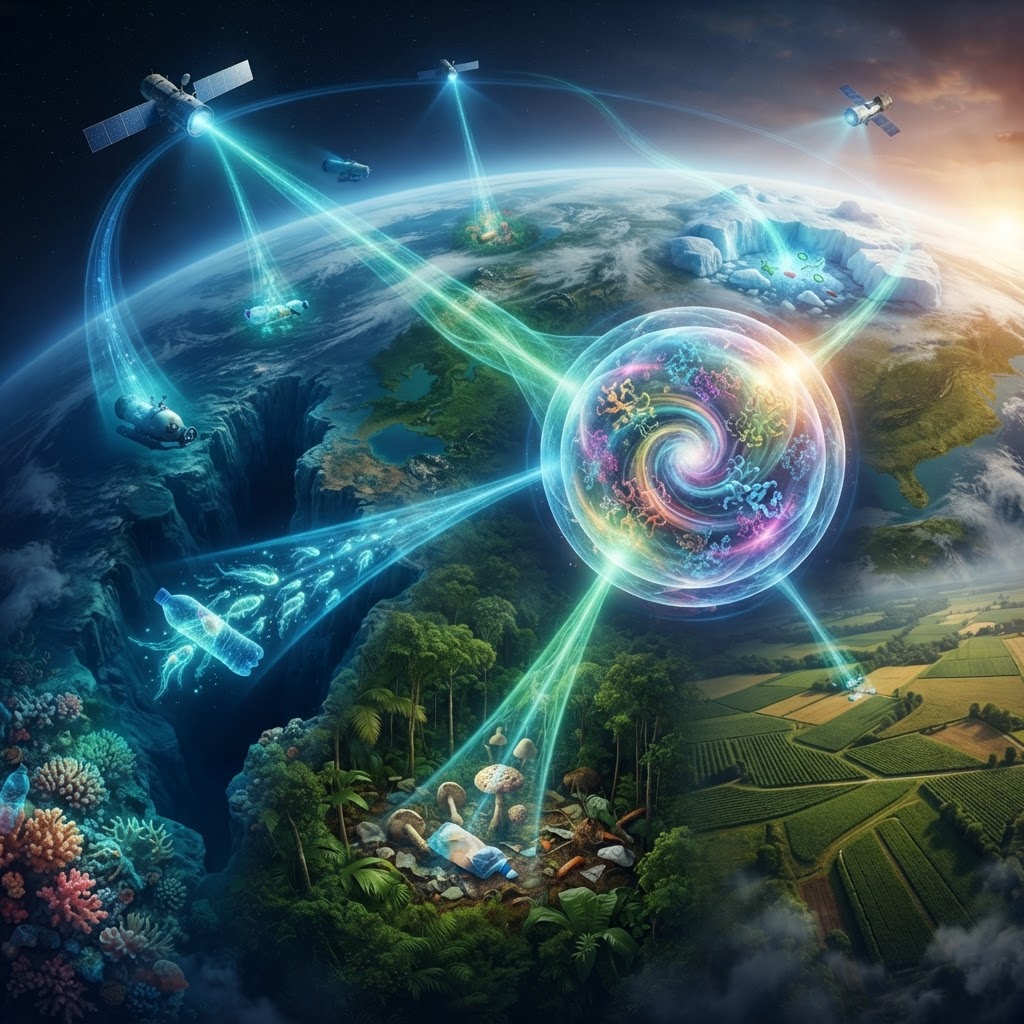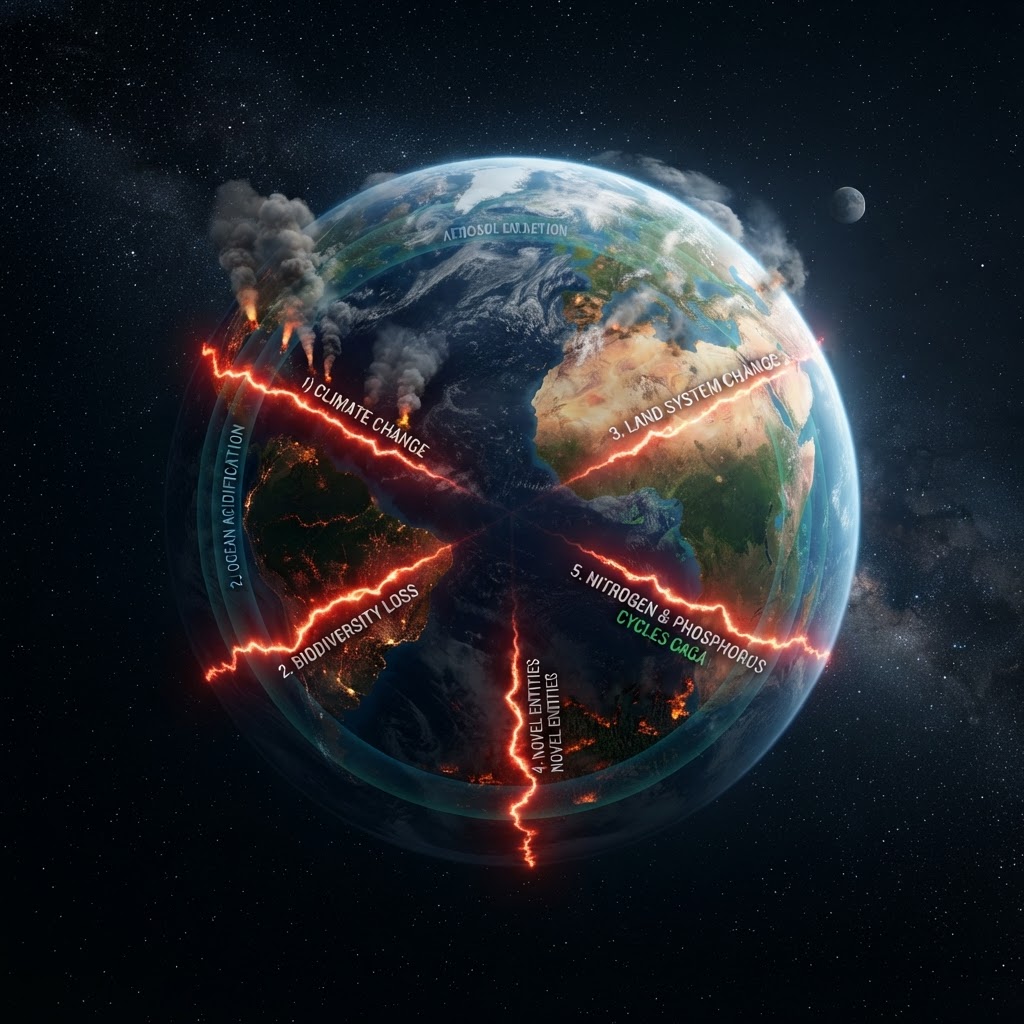
The planetary boundary framework has moved from a stark metaphor to an increasingly quantitative tool for assessing Earth-system risk. Its central claim is straightforward: humanity can alter the planet without immediately triggering collapse, but only within a limited “safe operating space.” Recent assessments indicate that six of nine global boundaries are now transgressed, while pressure on several others is rising.
From thresholds to measurable limits
First proposed in 2009 and substantially revised in 2015, the framework tracks processes that regulate the stability and resilience of the Earth system. They include climate change, biosphere integrity, land-system change, freshwater change, biogeochemical flows, ocean acidification, atmospheric aerosol loading, stratospheric ozone depletion, and the introduction of novel entities such as synthetic chemicals and plastics.
The boundaries are not simple “points of no return.” They are precautionary limits designed to reduce the probability of large-scale, potentially irreversible environmental change. Crossing one does not mean planetary catastrophe is inevitable; it means the risks associated with further pressure are no longer acceptably low, especially when multiple pressures interact.
A widening pattern of transgression
Research published in recent years has placed climate change, biosphere integrity, land-system change, freshwater change, and altered nitrogen and phosphorus cycles beyond their proposed safe limits. A global assessment published in Science Advances in 2023 added atmospheric aerosol loading to the list, finding that particulate pollution has exceeded a global boundary in several regions and contributes to dangerous disruption of monsoon systems.
The framework’s newer metrics also reveal that transgression is not distributed evenly. Global averages can conceal severe regional conditions: freshwater withdrawals, ecological damage, chemical pollution, and nutrient runoff are often concentrated in particular river basins, agricultural zones, and industrial regions. This has prompted scientists to develop “safe and just” boundaries that consider both Earth-system stability and human access to essential resources.
Why interactions matter
The most consequential insight is that boundaries do not operate independently. Deforestation can reduce carbon storage, intensify regional warming, alter rainfall, and accelerate biodiversity loss. Excess fertilizer can increase food production while driving oxygen depletion and ecological collapse downstream. Climate change can amplify water stress and ecosystem vulnerability, making a breach in one domain harder to manage in another.
Scientists therefore increasingly describe the situation as a portfolio of compounding risks rather than a checklist of isolated failures. Some boundaries, including stratospheric ozone, demonstrate that coordinated international action can reverse planetary pressure. The recovery of the ozone layer following the Montreal Protocol is an important counterexample to the idea that environmental deterioration is always irreversible.
The unresolved question: how much room remains?
Quantification remains difficult. Boundary values depend on incomplete observations, model assumptions, regional variation, and judgments about acceptable risk. The novel-entities boundary is especially challenging because thousands of chemicals and materials enter commerce faster than their environmental effects can be evaluated. Scientists also continue to debate how best to translate global limits into national or sectoral responsibilities.
Even with these uncertainties, the framework has become a useful navigation instrument. It does not predict a single date of planetary failure. Instead, it shows that human activity is moving several regulating systems away from the conditions under which modern societies developed. The policy implication is less about finding one final threshold than about rapidly reducing multiple pressures at once—before interacting changes narrow the options for recovery.