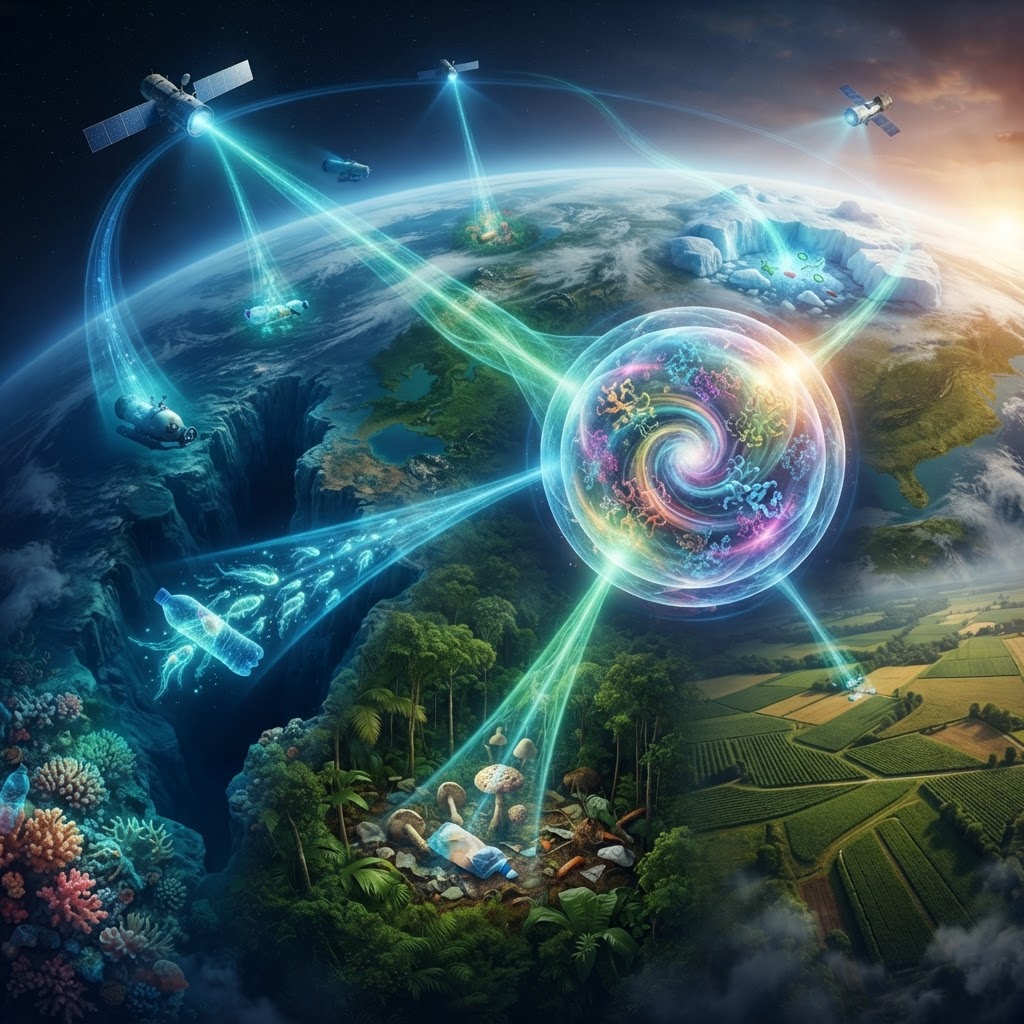
Microplastics are now found across marine, freshwater, and terrestrial food webs, from plankton and bivalves to fish, seabirds, and mammals. But a central assumption—that these particles steadily biomagnify as predators consume contaminated prey—has proved more complicated than the phrase suggests.
Studies published in recent years support a clearer picture: microplastics can be transferred across trophic levels, yet concentrations often do not increase predictably from prey to predator. In some systems, predators carry fewer particles than their food. In others, particles or their associated chemicals can accumulate, particularly when ingestion is repeated, elimination is slow, or contamination occurs through multiple routes.
Uptake begins at the base of the web
Small organisms can ingest particles while filtering water or feeding on suspended material. Zooplankton, mussels, worms, and other deposit feeders may mistake microplastics for food or consume them incidentally. Particle size, shape, density, and surface chemistry influence whether they are swallowed, retained, or expelled.
Once inside an animal, particles may remain in the gut, cross into tissues, or be transported through the circulatory system. Laboratory experiments have documented tissue exposure in several taxa, but results vary substantially with particle type and dose. The high concentrations used in some experiments can also exceed environmentally realistic exposures, complicating comparisons with conditions in the wild.
Why predators do not always contain more
Classical biomagnification describes a rise in concentration across successive trophic levels. Microplastics often behave differently because they are physical particles rather than dissolved contaminants. Many are egested within hours or days, and larger particles may pass through the digestive tract without entering tissues. A predator can therefore ingest a substantial number of particles without retaining them.
Feeding behavior matters as well. A fish that consumes contaminated mussels may receive particles, but it may also eliminate them rapidly. A seabird or marine mammal feeding on many prey species can experience a different balance of particle size, polymer type, and exposure frequency. Sediment-feeding animals may encounter far higher concentrations than pelagic predators, even when they occupy lower trophic positions.
There is, however, an important indirect pathway. Microplastics can carry additives and can concentrate hydrophobic chemicals from surrounding water, although the importance of this “vector” effect in nature remains contested. Chemicals may also leach from particles after ingestion. In some cases, the biological accumulation of plastic-associated chemicals—not the particles themselves—may be the more consequential trophic process.
The measurement problem
Comparing studies is difficult because researchers use different size cutoffs, digestion methods, polymer-identification techniques, and reporting units. A study counting particles per animal is not directly equivalent to one measuring particle mass per gram of tissue. Nanoplastics, which are smaller and harder to detect, are especially likely to be missed.
Environmental scientists increasingly argue that trophic-transfer studies should combine field observations with realistic feeding experiments and chemical analysis. They also need to distinguish trophic transfer—movement from prey to predator—from biomagnification, a systematic increase in concentration with trophic position.
What is established—and what is not
The evidence now supports three cautious conclusions. Microplastics are routinely available for uptake at multiple trophic levels. They can move through food webs, including from prey into predators. But consistent biomagnification of the particles themselves has not been demonstrated across ecosystems.
The unresolved question is less whether particles move than which particles persist, where they accumulate, and when they alter physiology or transport hazardous chemicals. Answering it will require long-term field studies that track polymers, particle dimensions, additives, and biological effects together. For now, the most defensible description is not a ladder of ever-higher concentrations, but a branching network of exposure pathways shaped by ecology and particle chemistry.