What do we mean by evolvability?
Evolvability denotes the propensity of a lineage to generate heritable, selectable variation that produces adaptive phenotypes. That is different from the fitness of an individual genotype in the short term: evolvability is a property of the genotype-to-phenotype map and of population processes that determine how variation is produced, revealed and sorted.
Why the debate matters now
For decades evolutionary biologists have argued about whether evolvability can be targeted by selection in its own right, or whether it is only an incidental byproduct of selection on other traits. Recent theoretical work and empirical experiments — especially in microbes and molecular systems — have sharpened both sides of that question and provided concrete mechanisms by which evolvability can increase under selection.
Empirical signals: where evolvability appears to increase
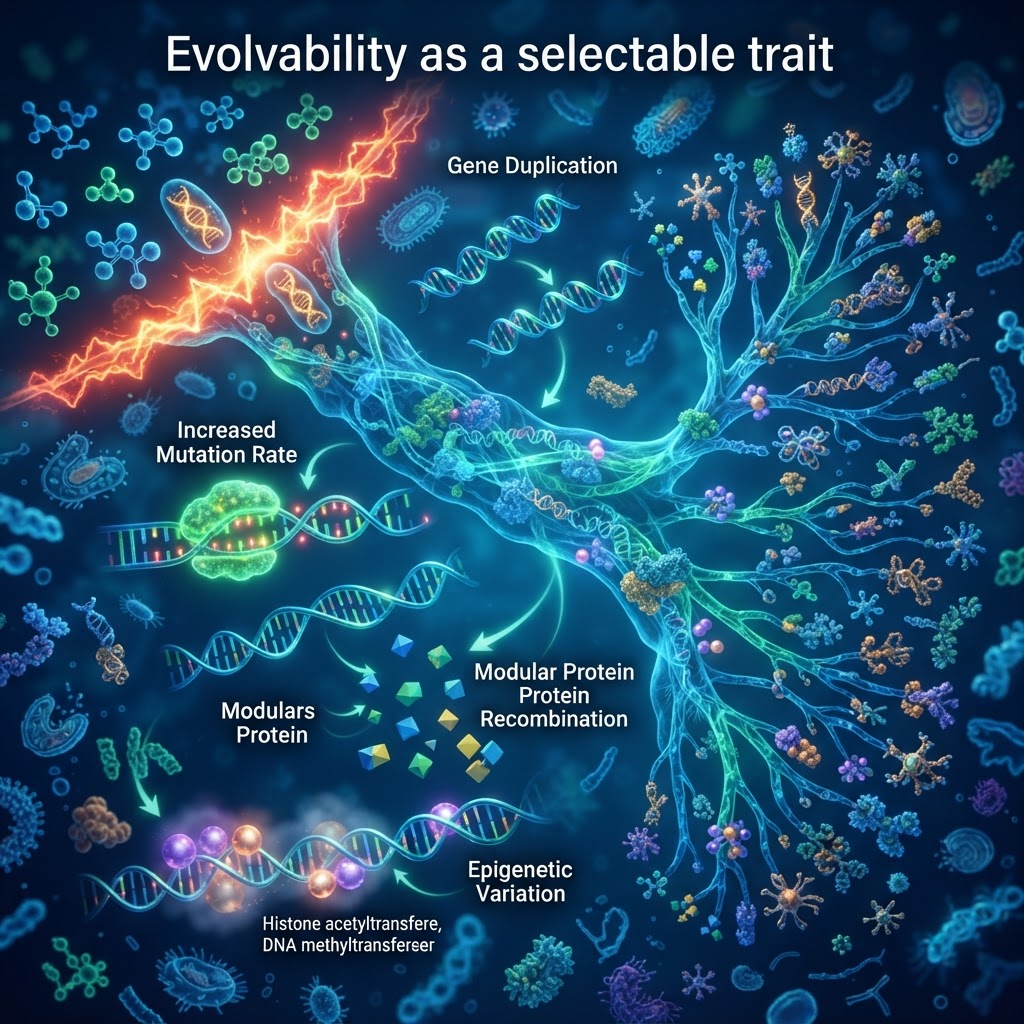
- Mutator alleles in microbes: Classic laboratory evolution shows that alleles elevating mutation rates can rise because they hitchhike with beneficial mutations they produce; long-term experiments in bacteria provide direct evidence that mutation-rate modifiers can invade under strong selection (mutator dynamics) — a literal selection for an increased capacity to generate variation.
- Capacitors and cryptic variation: Molecular chaperones such as Hsp90 can mask genetic variation; when the capacitor is relaxed, hidden variation is revealed and rapid phenotypic diversification can follow. Experiments argue that such systems can facilitate bursts of innovation, effectively modulating evolvability at the molecular level.
- Recombination and reassortment: Sexual recombination and viral genome reassortment reshape genetic combinations and can be favored in fluctuating environments because they accelerate adaptive response—again, increasing evolvability by altering how variation is assembled.
Mechanisms that allow evolvability to be selected
Across theory and data, three themes recur:
- Modifying the supply of variation. Mutator alleles, mobile elements and epigenetic modifiers change the raw input of genetic or epigenetic novelty available to selection.
- Altering how variation is revealed. Capacitors, robustness mechanisms and developmental plasticity can hide or expose standing variation when environments change, biasing the direction and speed of response.
- Biasing the distribution of effects. Network structure and modularity make some mutations more likely to produce viable, adaptive change; selection for modular architectures under modularly varying selection pressures has been shown in silico and in microbial selection experiments.
Constraints, caveats and the role of population structure
Selection for evolvability usually occurs as a second-order effect: the modifier that increases evolvability is favored because it increases the probability of producing future beneficial mutations. This requires substantial linkage between modifier and beneficiary, sufficiently large populations, and environmental regimes that reward exploratory variation (e.g., frequent or severe environmental shifts). Without these conditions, direct selection against the immediate fitness cost of increased variation will dominate. Structured populations, lineage selection and fluctuating selection regimes therefore play key roles in making evolvability selectable.
Where the evidence points
When considered together, experimental evolution, molecular systems biology and mathematical models converge on a nuanced conclusion: evolvability can be a selectable trait under realistic biological conditions, but it is not inevitable. It is more likely to evolve when organisms face recurring change, when modifiers are tightly linked to adaptive outcomes, or when mechanisms (like modularity or capacitors) bias variation toward usable novelty.
The current frontier is to quantify these dynamics in natural populations and complex multicellular organisms, and to distinguish direct selection for evolvability from correlated, indirect outcomes of other selective pressures.