For decades, heredity was taught as a clean handoff of DNA sequence from parent to offspring. That picture remains fundamentally correct—but it is no longer complete. Researchers are now investigating whether chemical marks and molecular states associated with genes can sometimes survive reproduction and influence descendants, even when those descendants were never directly exposed to the original environment.
This phenomenon, known as transgenerational epigenetic inheritance, sits at the intersection of molecular biology, development and evolution. It is also one of biology’s most easily overstated ideas.
What is being inherited?
Epigenetic regulation changes how genes are used without altering the underlying DNA sequence. Mechanisms include DNA methylation, chemical modifications to histone proteins, chromatin organization and regulatory RNAs. These systems help cells remember their identities: a liver cell and a neuron carry essentially the same genome but activate different gene programs.
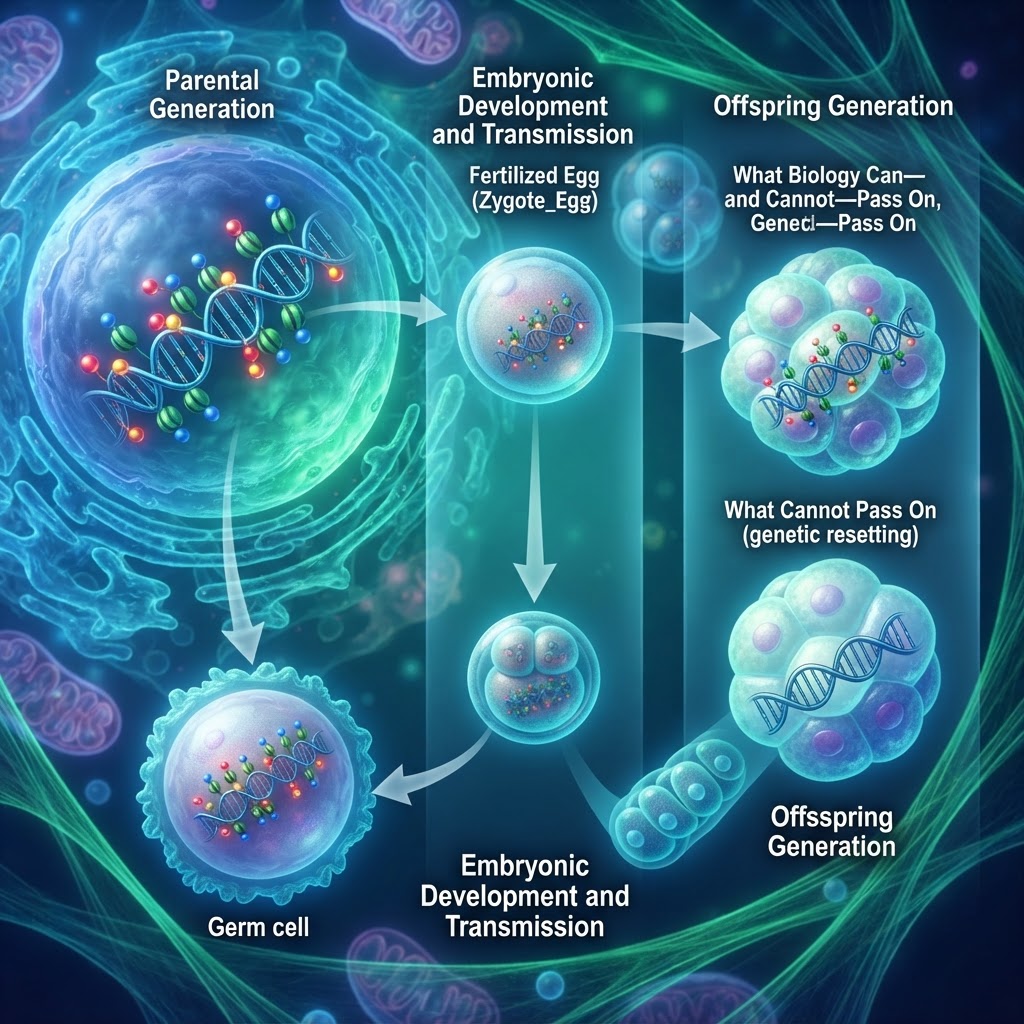
Most epigenetic information is reset during the formation of eggs and sperm and again during early embryonic development. That resetting is a major barrier to inheritance. Yet some molecular states can escape it, particularly in regions of the genome with unusual sequence or chromatin features. Small RNAs carried in sperm, for example, have been implicated in transmitting information about paternal diet, stress or toxicant exposure in laboratory animals.
The experimental evidence
Studies in worms, flies, plants and mice have reported descendants with altered metabolism, stress responses, fertility or gene expression after an ancestor experienced an environmental challenge. In Caenorhabditis elegans, certain chromatin states and small-RNA pathways can persist across multiple generations. Plants often show especially robust inheritance because their germline develops differently and epigenetic resetting is less complete.
In mammals, the evidence is more contested. If a pregnant female is exposed to a chemical, the mother, her developing fetus and the fetus’s future germ cells may all be directly exposed. Effects seen in the offspring therefore do not demonstrate transgenerational inheritance. For a maternal exposure, convincing evidence generally requires an effect in the fourth generation; for a paternal exposure, the third generation is the critical test.
Recent work has strengthened the case that sperm RNAs, altered DNA methylation and changes in chromatin packaging can carry environmentally responsive signals. But many findings are sensitive to genetic background, diet, housing conditions and statistical design. Replication across laboratories remains uneven, and the molecular chain from exposure to inherited trait is often incomplete.
An evolutionary possibility, not a new Lamarckism
If epigenetic states are heritable, reversible and responsive to conditions, they could provide organisms with a rapid way to adjust across changing environments. In theory, such inheritance might be favored when conditions persist long enough for descendants to benefit but not long enough for ordinary genetic evolution to respond.
That does not mean acquired traits routinely rewrite evolution. Epigenetic marks are often unstable, context-dependent and tightly constrained by development. Natural selection can act on the machinery that produces or preserves an epigenetic state, but the state itself may disappear after a few generations. In this sense, epigenetic inheritance is better viewed as a possible layer of evolutionary memory than as an alternative to DNA-based heredity.
The next test
The field’s central challenge is now methodological: separating inherited molecular information from persistent parental effects, shared environments and ordinary genetic differences. That requires controlled multigenerational experiments, precise exposure histories, direct molecular measurements and independent replication.
The emerging consensus is consequently measured. Transgenerational epigenetic inheritance is biologically plausible and well established in some organisms, especially plants and invertebrates. In mammals, it remains a real but limited phenomenon whose frequency, durability and importance in natural populations are still being determined.