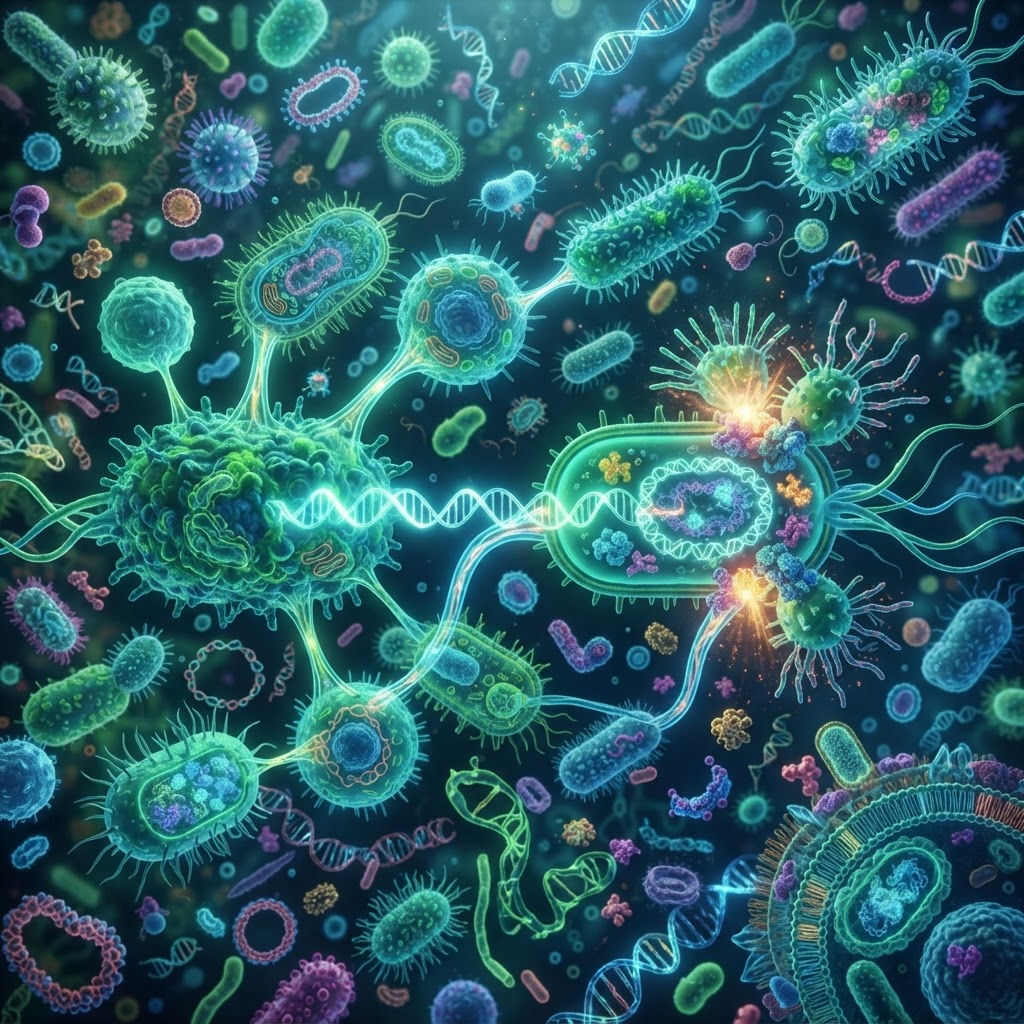
Evolution is often pictured as a branching family tree: genes pass from parent to offspring, accumulating changes over generations. That picture remains foundational, but for microbes it is incomplete. Bacteria and archaea can also acquire genes directly from unrelated organisms—a process known as horizontal gene transfer (HGT). The result is an evolutionary shortcut: traits that might otherwise require many mutations and generations can arrive as a ready-made genetic package.
Recent genomic studies have made clear that HGT is not an occasional curiosity. It is a major force shaping microbial adaptation, especially in environments where conditions change rapidly or survival depends on specialized chemistry. Genes move through several routes, including DNA released from dead cells, viruses that ferry genetic material between hosts, and plasmids—mobile DNA molecules capable of copying themselves across cellular boundaries.
Evolution by acquisition
The clearest examples involve antibiotic resistance. A bacterium does not need to independently evolve a complete resistance mechanism if it can acquire a resistance gene from another cell. Plasmids may carry several such genes at once, allowing a single transfer event to produce resistance to multiple drugs. Comparable exchanges can spread genes for toxin production, unusual metabolic pathways, host invasion, and tolerance of heavy metals or extreme environmental conditions.
This does not make natural selection irrelevant. Acquired genes are costly or useless unless they function in their new host, and most transferred DNA is eventually lost. Selection determines which transfers persist. But HGT changes the raw material available to selection. Instead of searching only through small mutations in existing genes, a population can sample biological innovations that evolved elsewhere.
A network, not just a tree
Modern genome sequencing has exposed the scale of this process. Closely related strains can differ sharply in their accessory genomes—the genes present in some members of a species but absent in others. These variable regions often contain the traits most important for ecological success. Genome comparisons also reveal genes whose evolutionary histories conflict with the species history, a signature that they arrived through transfer rather than ordinary inheritance.
The pattern is especially pronounced in microbes living in dense communities, including soil, oceans, animal microbiomes, and wastewater systems. Physical proximity increases opportunities for exchange, while intense competition creates strong selection for useful acquisitions. Phages and plasmids can therefore act as rapid-response systems, linking distant lineages through a web of genetic exchange.
Why the mechanism matters now
HGT has become central to efforts to predict antimicrobial resistance and manage engineered ecosystems. Public-health surveillance increasingly tracks mobile genetic elements, not only bacterial species, because the same resistance gene can move among multiple pathogens. In agriculture and environmental biotechnology, researchers are also investigating how community composition, antibiotic exposure, and pollution alter transfer rates.
Yet important uncertainties remain. Transfer is difficult to measure directly in nature, and detecting a gene in two organisms does not always reveal when, where, or by what mechanism it moved. Researchers are still working to determine how often transfers produce durable evolutionary change, how cellular defenses restrict foreign DNA, and whether interventions can block harmful exchanges without disrupting beneficial microbial communities.
Horizontal gene transfer does not replace gradual evolution. It complements it—and sometimes accelerates it dramatically. The emerging view of microbial evolution is therefore neither a simple tree nor a free-for-all, but a branching history threaded with bridges. Those bridges can turn genetic innovation into an ecological advantage almost immediately.