A quiet cavity between Earth's surface and the ionosphere resonates at 7.83 Hz with a magnetic amplitude of roughly 1 picotesla *(measured)* — the Schumann fundamental, recorded continuously by magnetometers worldwide. Geomagnetic storms deliver fields many orders larger, into the tens of microtesla range during substorms. Both are real, both are measured, and neither fact tells you whether a human nervous system can read either one as information. That gap — between a field existing and a field being legible to biology — is where this series lives.
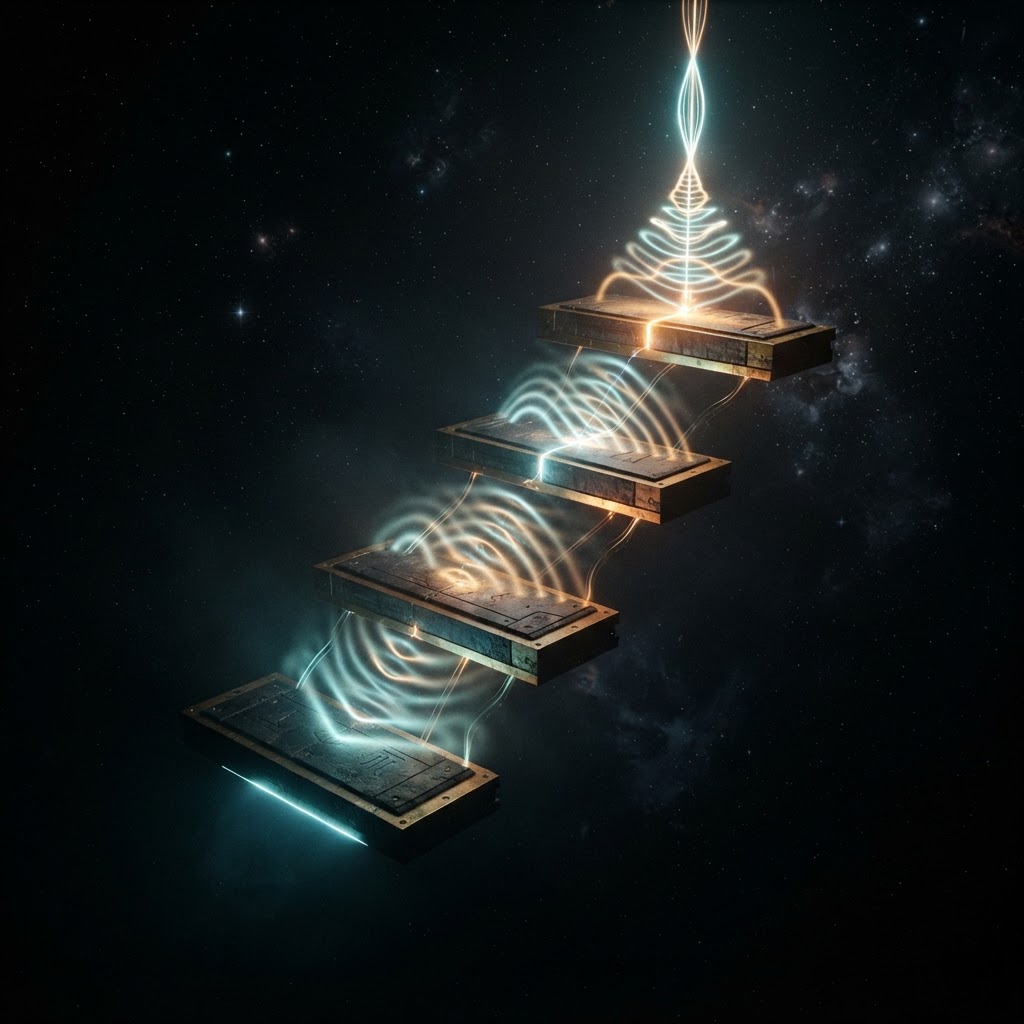
The public conversation about Earth's electromagnetic environment collapses four distinct evidentiary questions into one yes-or-no vote: does it affect us? That framing is the error. What follows is a four-rung ladder. Each rung has to be climbed in order, with its own instrumentation, its own arithmetic, its own statistics. Almost every viral claim about Schumann resonances, geomagnetic storms, or cellular 'bioelectromagnetics' quietly skips a rung — usually rung two, the one requiring arithmetic rather than correlation. A rigorous ladder does not require you to be a skeptic or a believer. It requires you to say, for any claim, which rung it has actually reached.
Rung 1: the field exists
This rung is the easiest and the most abused, because it is the one almost every popular claim actually satisfies — and then stops there. The Schumann resonance fundamental sits at 7.83 Hz with harmonics near 14.0–14.3, 20.4–20.8, 27.3, and 33.8 Hz, driven by global lightning activity exciting the Earth-ionosphere waveguide; its magnetic amplitude at the surface is of order 1 pT *(measured)* Beggan 2018. Geomagnetic storms produce transient field fluctuations of tens to hundreds of nanotesla at the surface, occasionally more during extreme events *(established)*. None of this is in dispute. The instrumentation is mature, the geometry is well modeled, the amplitudes are published with error bars. The question the first rung cannot answer is biological: not whether the field is there, but whether anything inside an organism is built to extract information from it at that amplitude, in that bandwidth, against that noise floor.
Rung 2: does a transducer exist with adequate sensitivity
This is where dose arithmetic replaces plausibility. A transducer is not a metaphor; it is a specific piece of biophysics that converts field energy into a cellular signal at a rate large enough to be distinguished from everything else moving charge around in that tissue, within the time the organism actually has to decide anything.
Dose arithmetic: a 1 pT field at 7.8 Hz across a cell membrane
Take a Schumann-band field of 1 pT oscillating at 7.8 Hz, and a cell with a membrane of typical geometry, roughly 10 µm across. Faraday induction gives an induced electric field proportional to the rate of change of flux through a loop of that radius; at 7.8 Hz and 1 pT, the induced EMF around a 10 µm-diameter loop works out to roughly 4 × 10⁻²¹ volts (ωBA, with a loop area near 8 × 10⁻¹¹ m²). The widely quoted 10⁻¹¹ volt figure belongs to a loop about one square metre in area, which is why geometry has to travel with the number. Compare this to the membrane's own thermal (Johnson) noise voltage, which for a patch of membrane with realistic resistance and bandwidth sits in the microvolt range, and to the voltage swings of endogenous signalling currents — action potentials — which are tens of millivolts. The induced signal is roughly fifteen orders of magnitude below the thermal noise floor of the membrane it would have to perturb, and eighteen to nineteen orders below the endogenous signal it would have to compete with. There is no known channel protein, ion pump, or membrane process in a generic cell with the gain required to recover a signal that far under its own noise in any biologically plausible integration time.
The general rule that arithmetic reveals: a transducer has to beat its own noise by a margin set by how long the organism can afford to average. That is exactly why the known, accepted biological magnetic transducers are specialized rather than generic. Avian magnetoreception via radical-pair chemistry operates at geomagnetic intensities around 50 microtesla — eight orders of magnitude above Schumann-band amplitudes — and even there the chemistry requires a singlet-triplet state lifetime tuned to the Zeeman splitting at that specific field strength *(established, with mechanistic detail still contested)*. Elasmobranch electroreception detects voltage gradients of nanovolts per centimetre, but through the ampullae of Lorenzini, an organ with specialized low-resistance jelly-filled canals built over evolutionary time specifically to shrink the noise floor for that one signal. A liver cell, a cardiac myocyte, a cortical neuron has no analogous architecture for a picotesla ELF magnetic field. This is not an assumption; it is where the second rung's arithmetic, done honestly, has to land for the fields actually measured in rung 1.
Rung 3: replication, blinding, and the power problem
Suppose a transducer story survives rung 2 for some larger field — a geomagnetic storm rather than the Schumann background. The next rung is not a single clever study; it is dose-response that holds up across independent labs, blinded to exposure condition, with the analysis plan registered before the data are seen. Almost nothing in this literature clears that bar, and the reason is usually underpowered sampling rather than a wrong hypothesis.
A plausible storm-magnitude effect on something like heart-rate variability, at the effect sizes reported in this field (typically small, standardized mean differences well under 0.3), requires sample sizes in the many hundreds to reliably distinguish signal from the noise of ordinary physiological variability, especially once autocorrelation in time-series health data is accounted for. This is the heart-rate-variability case, and it is instructive precisely because the disagreement inside it is about analysis, not belief. An early literature reported numerous HRV-geomagnetic correlations; when autocorrelation was properly corrected, most of those correlations dissolved *(measured; interpretation contested)* Mattoni et al. 2020. Set against that, a large cohort of 809 older men still reports reduced heart-rate variability associated with intense geomagnetic disturbance *(measured; interpretation contested)* Zilli Vieira et al. 2022. A review of the broader storm and ELF literature finds the evidence base real but mixed in quality, with effect sizes that shrink under more rigorous handling *(measured; interpretation contested)* Taha et al. 2023. A separate randomised trial on microcirculation reports evidence of individual sensitivity to storm conditions *(measured; interpretation contested)* Gurfinkel et al. 2018, and EEG power has been reported to shift transiently with 20–70 nanotesla field fluctuations in a small human sample *(measured; interpretation contested)* Mulligan & Persinger 2012. None of these results is fraudulent or absurd. All of them sit on a rung below mechanism, and most are built on samples smaller than the power calculation for their claimed effect size would demand.
Rung 4: mechanism isolated
The top rung asks for something specific: block the proposed transducer and watch the effect disappear, or reproduce the effect in a minimal system stripped of everything except the mechanism in question. Avian magnetoreception has partially reached this rung — disrupting cryptochrome-dependent radical-pair chemistry, or applying specific radiofrequency fields tuned to perturb that chemistry, degrades orientation behaviour in several bird species *(measured; interpretation contested, mechanistic detail still debated)*. Almost nothing in the Schumann-resonance-and-human-physiology literature has reached rung 4. No study has blocked a proposed human transducer for a 1 pT, 7.8 Hz field and shown the claimed physiological effect vanish, because rung 2's arithmetic has not yet identified a transducer plausible enough to block.
The difference between a coincidence and a coupling is a mechanism with a number attached.
The Frequency Ledger
| Claim as popularly stated | Measured or computed reality | Rung reached |
|---|---|---|
| Schumann 7.83 Hz equals the brain's alpha rhythm | 7.83 Hz sits at the theta/alpha border; alpha is conventionally 8–12 Hz *(measured)* | Rung 1 only — the numbers are adjacent, not identical |
| Schumann harmonics match gamma brainwaves | Harmonics measured at 14.0–14.3, 20.4–20.8, 27.3, 33.8 Hz *(measured)*; only the fifth harmonic and above graze low gamma (~30 Hz+) | Rung 1 — correspondence is partial and arrives late in the harmonic series |
| Microtubule resonances match gamma brainwaves | Predicted resonance frequencies depend entirely on the quantum/classical model assumed for tubulin lattices *(model-dependent)* | Rung 1 at best — no measured transducer, no dose arithmetic published |
| Geomagnetic storms affect the heart | Induced current densities at storm amplitudes are computable and, by rung-2 arithmetic, land far closer to endogenous noise than Schumann-band fields, though still contested *(measured; interpretation contested) | Rung 2–3, unresolved — see HRV case above |
| Biophotons communicate between cells | Ultraweak photon emission from cells is real *(measured)*, but published flux rates imply photon counts per target cell per second low enough that information-bearing signalling requires an unverified detection gain *(speculative — flagged) | Rung 1–2, transducer arithmetic undone |
The coherence argument, taken seriously
Biology evolved entirely inside Earth's electromagnetic cavity, so the fields have always been there for selection to use — this is true and it is not nothing. A weak, persistent, globally available periodic signal is exactly the kind of regularity evolution is good at exploiting, as the existence of circadian photoperiod sensing demonstrates for light. But a demonstrated selective opportunity is not a demonstrated channel, and natural selection can be entirely indifferent to a signal that carries no exploitable information, however omnipresent it is *(speculative — flagged, as a general claim about Schumann-band coupling specifically)*.
The concrete measurement that distinguishes a clock from a signal is information content, not mere presence. If an organism uses the 7.8 Hz field as a clock, it needs only the period to stay stable — it does not need the field's amplitude or phase to carry variable, task-relevant information. If it uses the field as a signal, there must be demonstrable mutual information between fluctuations in the field and a measurable behavioural or physiological output, above and beyond what circadian or seasonal cues already predict. No published study has computed that mutual-information quantity for Schumann-band exposure; until one does, 'biology evolved with this field' remains a statement about opportunity, not about a working channel.
What is settled, and what is not
Parts of this domain are not in dispute. Radiofrequency exposure at thermal thresholds produces measurable tissue heating with well-characterized dose-response *(established)*. Animal magnetoreception, at least in its behavioural existence, is established across multiple taxa even as its full mechanism remains under study *(established, mechanism partially open)*. Electromagnetic induction in tissue by sufficiently strong time-varying fields — the basis of transcranial magnetic stimulation — is textbook physics *(established)*. The open question is narrow and specific: non-thermal, low-amplitude, information-bearing coupling between ambient ELF/geomagnetic fields and ordinary human physiology. Narrowing the question this way is not a concession to skeptics; it is what the evidence actually supports isolating.
The next installment in this series takes up microtubule coherence claims directly: whether any quantum coherence effect proposed inside a warm, wet, thermally noisy cytoskeleton can survive decoherence timescales long enough to matter, and what a honest rung-2 calculation for that system looks like. The piece after it audits the biophoton literature on its own terms — photon counts, detector gains, and the specific arithmetic of whether ultraweak emission could ever carry a cell-to-cell signal distinguishable from chemical diffusion.
Later pieces turn to two framing problems that recur across the whole field: why 1/f scaling in biological time series is cheap to produce and does not by itself imply coupling to any external field, and the difference — often blurred in popular writing — between treating the electromagnetic vacuum as a physical medium with measurable structure versus invoking it as a metaphor for connection. Keeping those categories separate is, in miniature, the entire argument of this series.
What would change our mind
- A pre-registered, blinded, multi-site replication of a geomagnetic-storm/HRV effect with autocorrelation-corrected analysis and a sample size calculated from the claimed effect size in advance, not after the fact.
- A published rung-2 calculation, for any claimed Schumann-band human bioeffect, showing an induced current density or voltage that clears the membrane's thermal and endogenous noise floor by a stated, defensible margin — the current absence of such a calculation is itself informative.
- A mutual-information analysis between Schumann-band field fluctuations and any human physiological output, controlling for circadian and seasonal confounds, to test the clock-versus-signal distinction directly.
- A transducer-block experiment: identify a specific candidate mechanism, disable it pharmacologically or genetically, and show the claimed field-sensitivity effect disappears — the rung-4 test that, to date, essentially no human ELF bioeffect claim has passed.