Why Hardy–Weinberg still matters
The Hardy–Weinberg equilibrium (HWE) is more than a classroom equation; it is the standard null hypothesis against which population-genetic processes are tested. In its simplest form, HWE predicts genotype frequencies from allele frequencies in a randomly mating, infinitely large population without selection, mutation, migration, or genetic drift. When those genotype proportions deviate, something interesting is usually happening.
From paper thought-experiment to everyday genomic filter
Established independently in 1908 by G. H. Hardy and Wilhelm Weinberg, the equilibrium provided the first clear expectation for how genes should segregate in idealized populations. Over the past two decades HWE has moved from theory into routine practice. Genome-wide association studies and biobank-scale genotyping projects use HWE tests as an early quality-control filter: substantial departures at common variants often flag genotyping errors, batch effects, or sample contamination.
But deviation does not uniquely indicate selection
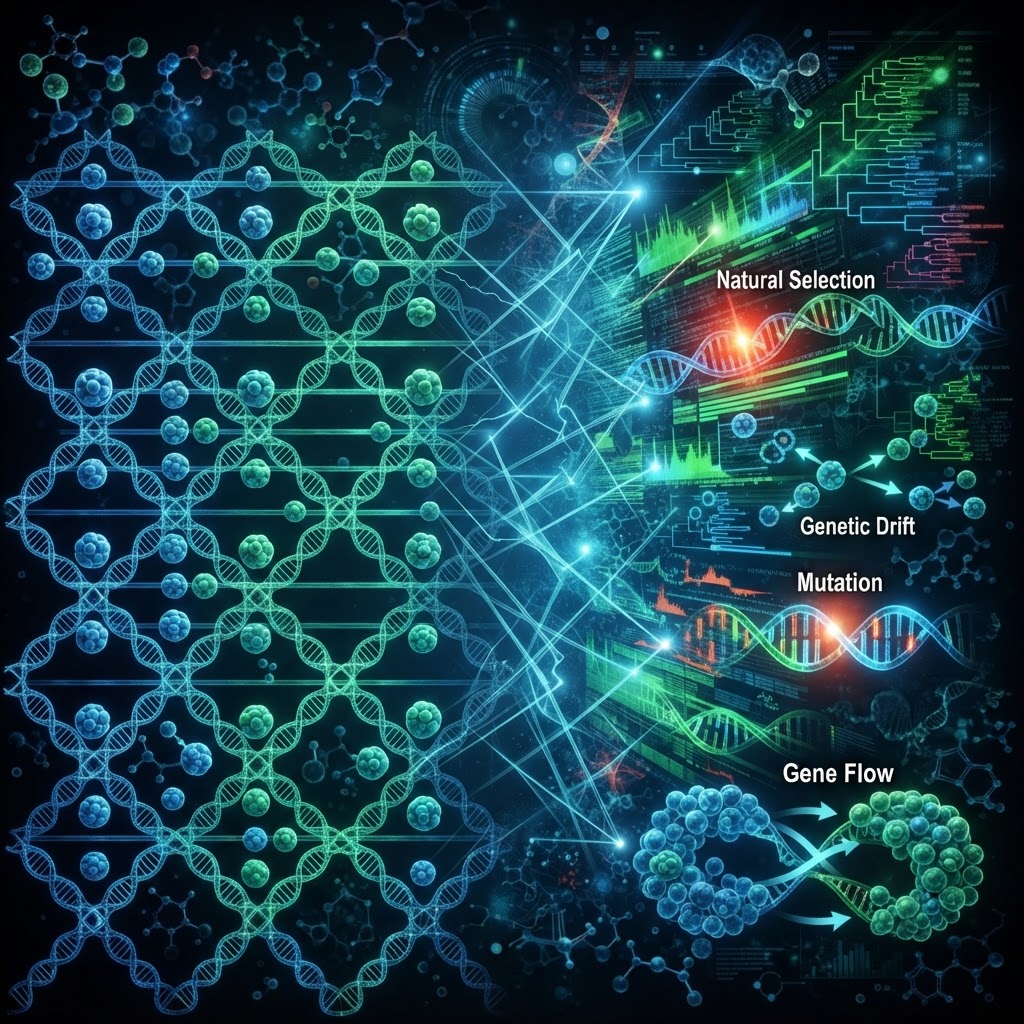
A major lesson of recent large-scale genomic work is that departures from HWE have many causes. The classic causes are familiar to students—nonrandom mating, population subdivision (the Wahlund effect), inbreeding, selection, mutation, migration, and finite population size. Modern datasets expose subtle, pervasive processes that also distort genotype expectations.
- Population structure: Large cohorts amalgamate ancestry groups. Even modest structure depresses heterozygosity and mimics inbreeding, producing apparent deviations.
- Assortative mating: People preferentially mate on traits with genetic components (height, education-associated alleles) and this creates correlations across loci that alter genotype frequencies in predictable ways.
- Relatedness: Cryptic relatives in a sample inflate homozygosity and can bias HWE-based filters.
Importantly, many of these processes are demographic or social rather than adaptive. Thus, interpreting a departure from HWE as evidence of natural selection without controlling for demography or technical artifacts is risky.
New data demand updated practice
As sample sizes swell into the hundreds of thousands and millions, subtle deviations that were previously invisible become detectable. That sensitivity is powerful: it can uncover recent assortative mating patterns, fine-scale structure across cities and regions, and admixture pulses revealed by ancient DNA. But it also increases false-positive signals if researchers apply blanket HWE filters without accounting for ancestry, relatedness, or platform-specific effects.
Best practices and analytical advances
Contemporary workflows recognize HWE as a diagnostic rather than a final verdict. Recommended steps include:
- Stratifying HWE tests by well-defined ancestry groups.
- Using mixed-models or approaches that incorporate kinship matrices to account for relatedness.
- Interpreting departures in the context of read-level QC, local ancestry, and population history rather than assuming selection.
Methodological work continues to refine tests that are robust to structure or explicitly model social behaviors like assortative mating. Simulation-based null distributions and joint demographic-selection inference are becoming more common as computational power grows.
The frontier: what HWE can reveal about human history and behavior
Where HWE once served mainly as a mathematical baseline, it now functions as a sensitive lens. Deviations in massive datasets can map recent migration, mating systems, and technical artifacts—and, when carefully controlled, can still point to loci under selection. The current debate is how best to partition signal from noise: how to quantify the relative contributions of demography, mating patterns, and selection in producing observed genotype frequencies.
The equilibrium remains foundational, but the way researchers deploy and interpret it has matured. In the era of biobanks and ancient genomes, Hardy–Weinberg is both null hypothesis and a probe that, when used thoughtfully, reveals the layered history written in our DNA.