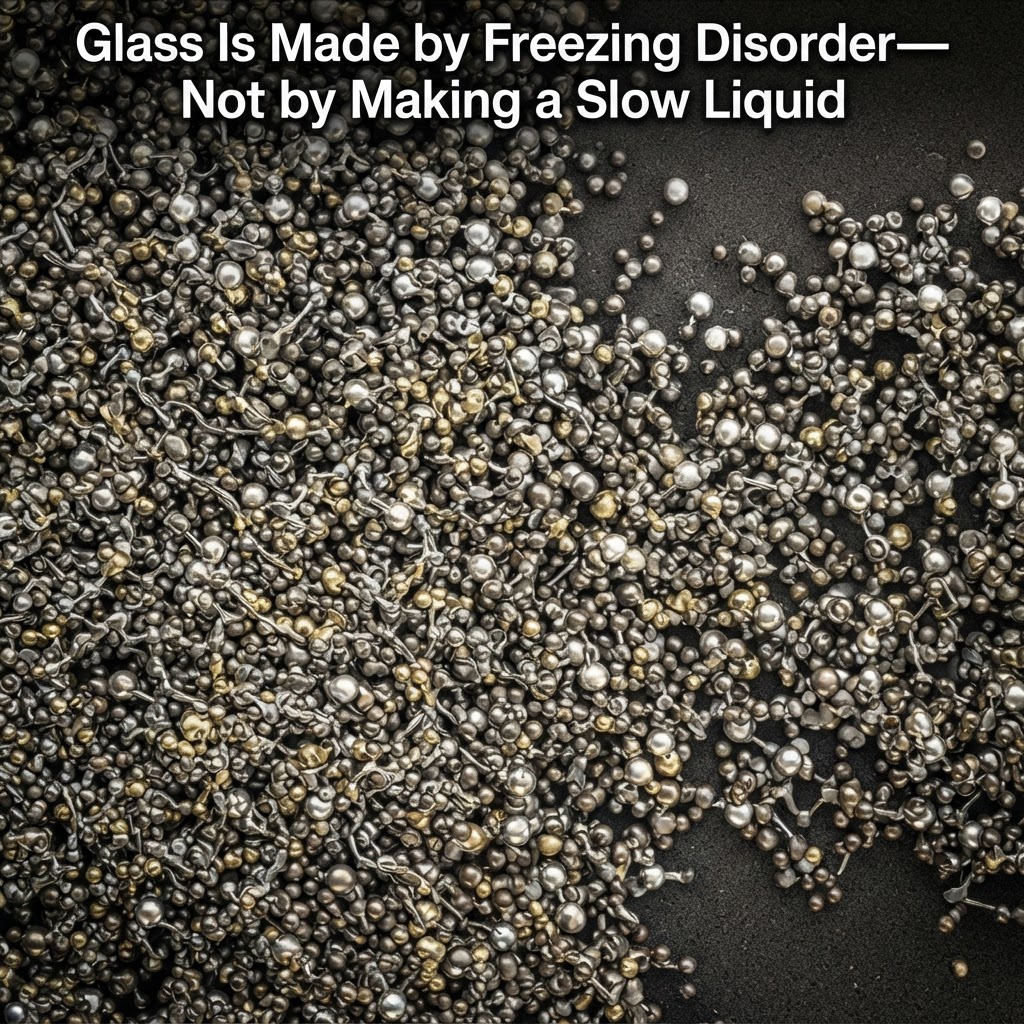
Glass begins as a liquid and ends as a rigid material, but that familiar story hides an important distinction: glass is not a conventional crystal, and it is not a liquid that has merely become extremely viscous. It is a nonequilibrium solid—a frozen structural arrangement whose atoms lack the long-range order found in crystals.
From sand to a molten network
The most common industrial glass is soda-lime glass, made primarily from silica sand, sodium carbonate, and limestone. Manufacturers melt these ingredients at roughly 1,400–1,600 °C. Sodium compounds lower silica’s melting temperature, while calcium oxide helps stabilize the final network. Recycled glass, or cullet, is added because it melts more readily and reduces energy use.
At high temperature, silica’s silicon and oxygen atoms form a continually rearranging three-dimensional network. The melt is cooled without allowing crystals to nucleate and grow. In a window, bottle, or fiber, the resulting atoms remain connected in a disordered configuration, but their motion becomes too slow to rearrange on practical timescales.
Why cooling rate matters
The transition from melt to glass is not a single freezing point. As temperature falls, viscosity rises dramatically. Eventually the structure cannot equilibrate during the time available to it. The material then falls out of equilibrium at a temperature range called the glass transition, commonly designated Tg.
A faster cooling rate generally produces a higher apparent glass-transition temperature and traps the structure sooner. A slower rate permits more relaxation before rigidity develops. This is why industrial processes carefully control cooling: residual stresses can cause a product to crack or shatter, while controlled heat treatment—annealing—allows those stresses to dissipate.
Neither crystal nor ordinary liquid
Crystals possess long-range periodic order. Liquids lack rigidity and continuously rearrange. Glass occupies an awkward middle ground. It has the mechanical rigidity of a solid, yet its atomic structure is disordered and its properties depend on thermal and processing history.
The popular claim that glass is a “supercooled liquid” is therefore misleading. Glass can slowly relax, but that does not mean ordinary windows flow visibly downward over centuries. Measurements of historical panes do not support the old explanation that they are thicker at the bottom because glass flowed in place; uneven thickness reflects earlier manufacturing methods. At room temperature, the relaxation time of common glass is vastly longer than the age of human civilization.
An active materials-science problem
Researchers now describe the glass transition using ideas from nonequilibrium thermodynamics, energy landscapes, and dynamic heterogeneity. Different regions of a cooling liquid can become mobile or immobile at different times, producing complex relaxation rather than a simple switch. New experiments and simulations continue to probe whether a deeper thermodynamic transition lies beneath the kinetic glass transition observed in the laboratory.
This unresolved physics has practical consequences. Glasses are engineered for phone displays, optical fibers, laboratory instruments, and durable containers. Their strength, transparency, chemical resistance, and thermal behavior all depend on how the disordered network is assembled and frozen. The central lesson is not that glass violates the categories of matter, but that those categories are too crude: glass is a solid defined by arrested disorder.