Executive hypothesis
The spatial, temporal, and morphological distribution of lunar impact craters may contain a measurable—but indirect—signal of the flux of interstellar objects (ISOs). The proposal is not that most lunar craters were made by extrasolar bodies. They were almost certainly produced by asteroids and comets bound to, or perturbed within, the Solar System. Rather, a sufficiently large, compositionally informed, and chronologically calibrated crater database could test whether a small isotropic excess of impacts is consistent with the observed ISO population.
The central claim is conditional: if interstellar objects arrive at rates inferred from detections such as 1I/‘Oumuamua and 2I/Borisov, and if some survive passage through the inner Solar System or are injected into lunar-crossing trajectories, their impacts should contribute a statistically structured tail to the lunar impact record. The signal is likely weak, but the Moon offers an unusually stable surface on which to search for it.
Why the proposal is plausible
The Moon has no atmosphere, active plate tectonics, or global erosion. Its surface therefore records impacts over billions of years, while its impact chronology can be anchored by radiometric ages of returned samples and by crater-count models. Modern orbital instruments also provide high-resolution topography, multispectral data, and, in selected cases, mineralogical evidence capable of distinguishing impactor-related residues from target material.
Interstellar objects are expected to approach the Solar System on unbound, hyperbolic trajectories. Their incoming directions should be broadly distributed in the heliocentric frame, although solar-system observability, gravitational focusing, and the Sun’s motion through the local interstellar medium introduce predictable anisotropies. By contrast, native impactors reflect the architecture and dynamical history of asteroid families, comet reservoirs, planetary migration, and resonant transport. Those populations should leave different correlations in impact direction, velocity, composition, and time.
The feasibility depends on scale. The inferred ISO number density is highly uncertain, and the impact probability on the Moon is tiny. A direct census may therefore be impossible using crater counts alone. The scientifically useful target is a joint constraint: lunar observations could set an upper limit on ISO flux or test whether unusual craters are compatible with a common interstellar component.
Mechanistic sketch
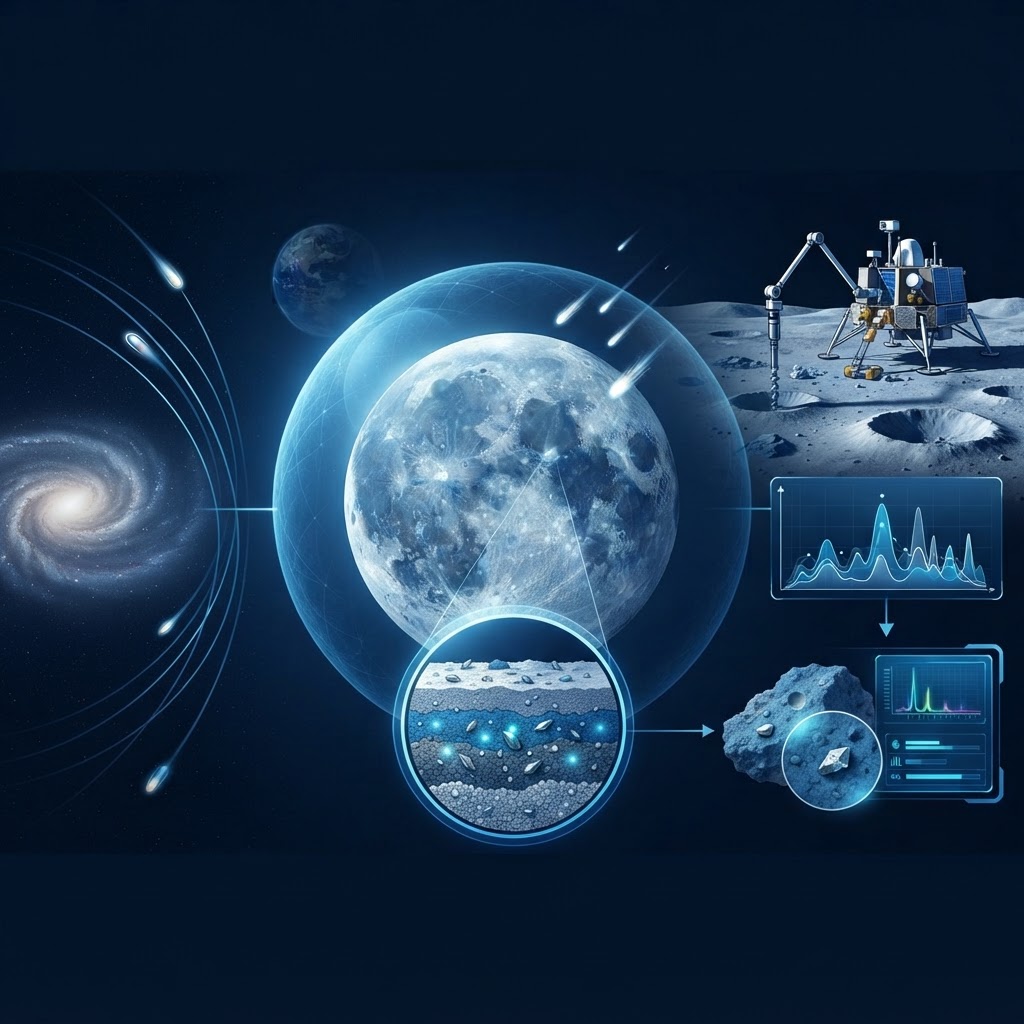
Construct a forward model that begins with a distribution of ISO sizes, velocities, compositions, and arrival directions. Propagate synthetic objects through the Solar System, including solar and planetary gravitational focusing, disruption, sublimation, and collisions. For each surviving object, calculate the probability of lunar impact and the resulting crater diameter, morphology, ejecta distribution, and spectral signature.
Next, build an equivalent model for native impactors. It should include near-Earth asteroids, Jupiter-family comets, long-period comets, and secondary or sesquinary projectiles launched by earlier impacts. The models must predict not only the total crater production rate but also its dependence on latitude, longitude, incidence angle, crater age, size, and target terrain.
The observable signal would be a residual population that cannot be adequately explained by known Solar System sources. Candidate indicators include unusually high impact speeds, atypical impact angles, volatile-rich or chemically anomalous residues, and a direction distribution inconsistent with established source populations. No single crater should be labeled “interstellar” from morphology alone. The inference must be population-based and probabilistic.
Falsifiable predictions
- Null prediction: After correcting for illumination, imaging completeness, resurfacing, and secondary cratering, the lunar crater record is fully explained by native populations; the ISO contribution is constrained below a specified flux.
- Directional prediction: If an ISO component exists, the oldest and largest statistically informative craters should show a weak excess aligned with the modeled heliocentric arrival distribution, not with lunar geography or known asteroid-family directions.
- Velocity-composition prediction: Candidate ISO-associated impacts should be overrepresented among high-velocity events and among craters with volatile or elemental signatures difficult to reproduce with ordinary asteroidal projectiles.
- Temporal prediction: The inferred excess should not track episodes of known terrestrial or lunar geological resurfacing, observational bias, or a single recent asteroid family.
- Cross-body prediction: A compatible residual should appear, within uncertainties, in crater populations on Mercury or Mars after accounting for their different gravity, atmospheres, and surface histories.
Experimental roadmap
Phase one would assemble a globally registered lunar crater catalog with uncertainty-aware diameters, ages, degradation states, terrain classes, and candidate impactor residues. Machine-learning detection may expand the sample, but every classifier must be validated against manually mapped regions and synthetic craters.
Phase two would create a dynamical library of native and interstellar projectiles. N-body integrations should be coupled to impact-scaling codes and laboratory measurements of hypervelocity compositional signatures. Bayesian hierarchical inference could then estimate the ISO fraction while marginalizing over crater chronology, incompleteness, and uncertain source populations.
Phase three would target the most diagnostic sites with landed instruments or returned samples. Measurements should include noble gases, volatile elements, isotopic ratios, and projectile-derived siderophile abundances. These data would not prove an interstellar origin by themselves, but they could sharply discriminate among asteroid, cometary, and exotic source models.
Controls and pitfalls
The dominant danger is confounding. Secondary craters can mimic directional or temporal structure; lunar mascons and basin ejecta alter local crater preservation; impact gardening erases small events; and crater-age estimates are often model-dependent. Native long-period comets may also arrive on high-speed, nearly isotropic trajectories, making them the most serious astrophysical control.
Accordingly, the analysis should pre-register exclusion criteria, compare multiple crater-size thresholds, mask poorly understood terrains, and test synthetic recovery of injected signals. Independent dynamical models should be required to reproduce the result. Chemical anomalies must be interpreted against lunar indigenous materials, spacecraft contamination, and terrestrial-meteorite analogues. A claimed detection should survive analyses that remove any one morphological, directional, or compositional feature.
Implications
A positive result would transform the Moon into a long-baseline detector for galactic material, extending ISO studies beyond the short observational windows provided by telescopic surveys. It could constrain the size distribution, volatile content, and residence history of objects formed around other stars. A null result would still be valuable: it would place an empirical ceiling on lunar-crossing ISO flux and test whether current extrapolations from a handful of detections are physically plausible.
The proposal is therefore best understood as a feasibility program, not a prediction that interstellar craters are already identifiable. The Moon may not preserve a clean archive of extrasolar impacts. But by combining crater chronology, orbital dynamics, geochemistry, and statistical inference, researchers can ask a precise question: does the ancient lunar surface contain more high-speed, compositionally unusual impacts than Solar System sources can explain?