Introduction: Rethinking Intelligence Beyond Neurons
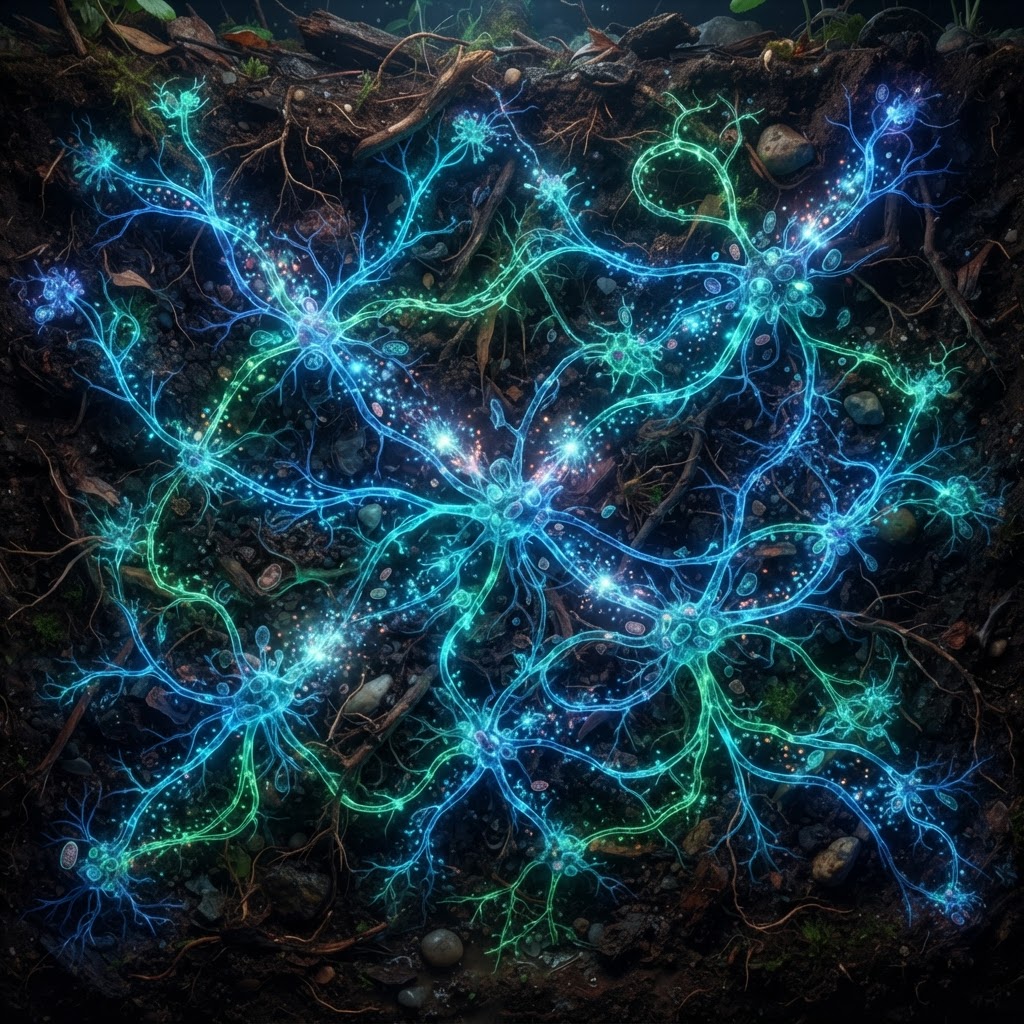
For decades, intelligence has been synonymous with centralized nervous systems. Recent work in mycology and systems biology invites a different interpretation: intelligence as collaborative, decentralized computation enacted by biological networks. Fungal mycelia — sprawling filamentous networks that connect soil, roots and litter across meters — provide an operative example. Accumulating evidence shows that mycelial systems coordinate resource flows, transmit signals, and exhibit memory-like behaviours without neurons. Taken together, these phenomena challenge neuron-centric definitions of cognition and suggest a broader biological architecture for information processing.
Evidence of Networked Communication and Coordination
Field and laboratory studies document consistent patterns of interaction mediated by mycelium. Ectomycorrhizal networks redistribute carbon and nitrogen between plants, often preferentially directing resources to shaded or stressed partners, hinting at targeted allocation rather than random diffusion. Experimental lesions and tracer studies reveal directional transfer along hyphal pathways, and regrowth after damage implies repair protocols that maintain network integrity.
Electrical and chemical signaling within fungal cords and hyphae have been measured across multiple taxa. Fungi generate propagating voltage spikes and calcium waves that respond to stimuli such as wounding, nutrient patches and environmental shifts. These signals do not map onto neurons structurally, but they share functional properties: rapid information transfer, modulation of downstream behaviour, and integration across spatially distributed nodes.
Mechanisms: Hyphae, Feedback, and Emergence
The architecture of a mycelium is conducive to distributed computation. Thousands to millions of hyphal tips sample microenvironments in parallel. Local growth decisions — branching, anastomosis (fusion), thickening — depend on nutrient gradients, chemical cues and internal metabolic status. When aggregated, these micro-decisions yield macroscopic behaviours such as foraging patterns, canalized flow toward nutrient-rich zones and selective pruning in response to stress.
Feedback loops are crucial. Resource allocation alters local conditions, which in turn modifies hyphal growth and signaling. This closed-loop interaction creates memory-like persistence: past exposures change network topology and resource routing, biasing future responses. In computational terms, mycelia implement distributed algorithms: local sensing + local rule sets + adaptive topology = emergent problem solving.
Why Call It Intelligence?
Calling mycelial behaviour "intelligent" is not poetic license but a strategic reframing. Traditional cognitive criteria — sensing, information integration, decision-making and memory — map onto fungal capacities, albeit realized through different substrates and time scales. Emphasizing the mode of computation (distributed, redundant, adaptive) highlights convergent solutions to ecological problems across life forms.
This reframing matters because it decouples cognitive function from specific hardware. Evolution has repeatedly solved environmental uncertainty with networked, scalable architectures. Recognizing mycelia as a living class of distributed processors opens new conceptual bridges between ecology, neuroscience and computer science.
Implications: Ecology, Evolution, and Bioinspired Design
Ecologically, networked fungal intelligence reframes plant communities as collective organisms mediated by fungal collaborators. Resource redistribution, pathogen signaling and stress propagation are all network phenomena: perturbations can cascade or be contained depending on mycelial topology and dynamics. From an evolutionary perspective, such networks create extended phenotypes where selection acts on distributed interaction patterns as much as on individual genomes.
Technologically, mycelial principles inspire robust distributed computing and resilient infrastructure. Hyphal-level redundancy, local rule-based adaptation, and self-repair offer design blueprints for fault-tolerant sensor networks, decentralised AI, and sustainable material systems that self-organize at scale.
Open Questions and Experimental Roadmap
Important uncertainties remain. How precisely are information content and signal fidelity maintained across long hyphal conduits? To what degree are resource transfers the result of active, regulated allocation versus passive gradients? Can we quantify a mycelial "memory" in operational terms and manipulate it predictably? Resolving these questions requires cross-scale experiments combining electrophysiology, isotope tracing, network analysis and computational modelling.
Forward-looking experiments should integrate perturbation paradigms familiar to neuroscience — controlled lesions, pattern stimulation, and behavioral readouts — with ecological realism. Comparative work across fungal lineages will clarify which features of distributed computation are ancestral and which are specialized adaptations.
Conclusion
Fungal mycelia are not mystical agents but tangible testbeds for a distributed conception of intelligence. By documenting coordinated signaling, adaptive topology and persistent modulation of behaviour, mycology supplies empirical substance to the idea that cognition can be collective, decentralized and embodied in networks without neurons. Embracing this perspective will reshape ecological theory and seed new technologies that mimic life's most persistent, scalable strategies for coping with uncertainty.