Introduction: a problem that could have ended the field
In the early 1990s the promise of quantum computers—astonishing algorithms, unbreakable cryptography, and new chemistry—collided with a brutal fact: quantum states are fragile. A stray photon, an overheated wire, a fluctuating magnetic field would corrupt a qubit and erase a computation. For a while this fragility threatened to make quantum computers an intellectual curiosity, not an engineering revolution.
The rescue came not from better shielding alone but from a conceptual breakthrough: errors could be detected and corrected without measuring (and destroying) the quantum information. That insight launched a chain of ideas—quantum error–correcting codes, stabilizer formalism, topological codes—and a single quantitative prize: the fault-tolerance threshold.
How the threshold entered the canon
Key figures appear like milestones in this story. Peter Shor in 1995 introduced the first practical quantum error-correcting code and a method to protect quantum memory. Andrew Steane refined the idea, connecting classical coding theory to quantum codes. Daniel Gottesman developed the stabilizer formalism that turned messy error-correction bookkeeping into a clean algebraic language. Alexei Kitaev proposed topological codes—most famously the toric code—that encode information nonlocally and are naturally robust against local noise.
But the decisive conceptual step was to ask a quantitative question: is there a nonzero error rate per physical operation below which arbitrarily long quantum computation becomes possible, provided we pay a polynomial overhead? The answer—yes—was given independently in careful proofs by researchers such as Dorit Aharonov and Michael Ben-Or, and by others who formalized the threshold theorem. The theorem showed there exists a threshold error probability: if each gate, preparation, and measurement fails less often than that threshold, concatenated error-correction schemes can reduce logical errors exponentially with modest resource scaling.
What the threshold means in practice
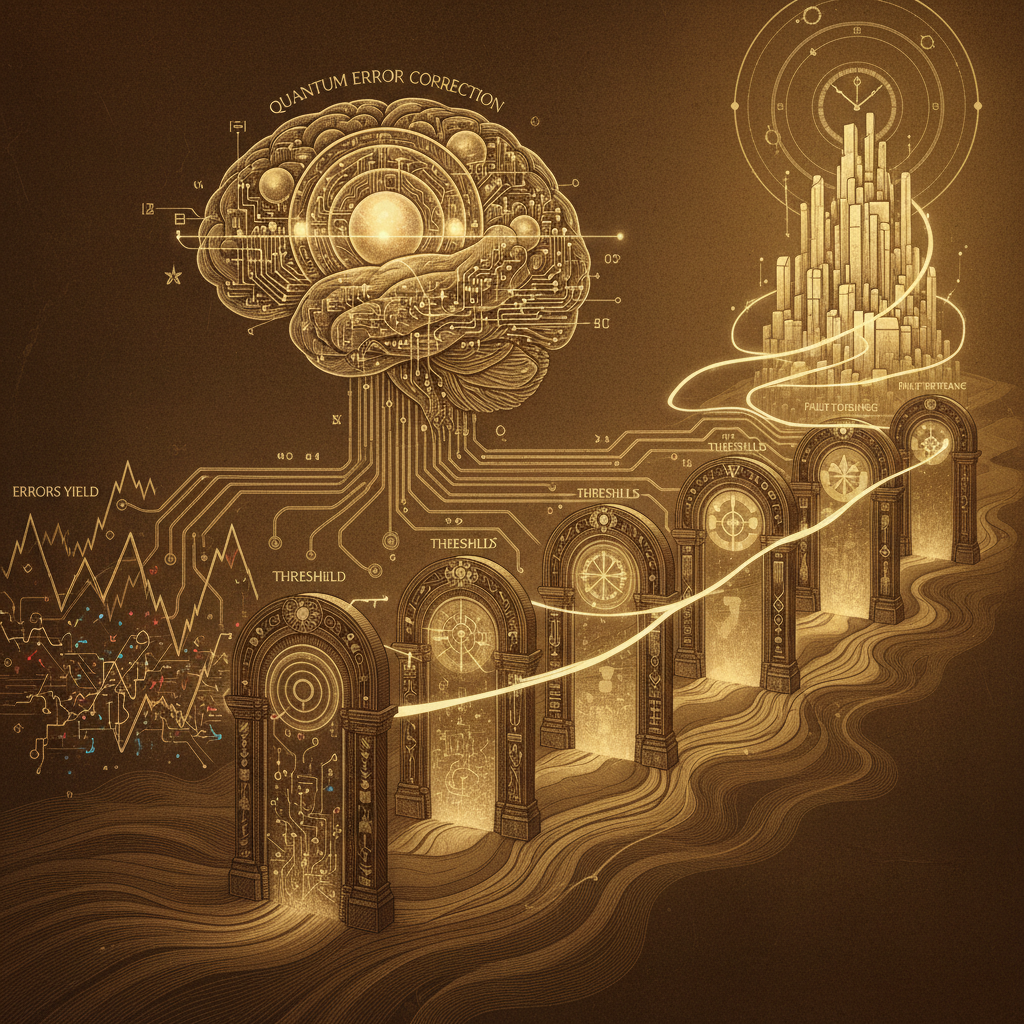
In plain terms, the threshold is a cliff edge between decay and control. Above it, errors accumulate faster than we can correct; below it, encoding and periodic correction suppress logical errors and allow arbitrarily long computations. The actual numerical value is not universal. It depends on assumptions—whether gates are local or long-range, whether measurements are fast and reliable, which code you use, and how cleverly you schedule operations.
Early, pessimistic threshold estimates were tiny—10^(-6) to 10^(-4)—but as theory matured and new codes were discovered the numbers rose. Surface codes and topological approaches shifted the landscape, offering thresholds in the 10^(-3) to 10^(-2) range under realistic models. Innovations like more efficient decoding algorithms and magic-state distillation for non-Clifford gates moved the practical target even further into experimental reach.
From theory to the lab: timelines and trade-offs
Translating a threshold into a timeline for useful quantum computers is a systems problem. It requires combining gate fidelities, qubit connectivity, error correlations, classical control speed, and fabrication yield. Experimental platforms—trapped ions, superconducting qubits, silicon spins, photonics—have made spectacular progress: single-qubit fidelities commonly exceed 99.9% in many platforms, and two-qubit gates routinely breach the 99% mark in leading demonstrations. Those numbers suggest that for certain error models and codes, parts of the hardware have crossed the threshold.
Yet crossing a threshold on a single primitive is not the same as building a fault-tolerant machine. To run meaningful algorithms one must create logical qubits with very low error rates; for many applications this still implies thousands to millions of physical qubits, depending on code overhead and target runtime. Optimistic roadmaps suggest small-scale fault-tolerant demonstrations within a few years and progressively larger logical devices over a decade or two. More conservative estimates push the arrival of universal, error-corrected quantum advantage into the longer term. The discrepancy reflects engineering uncertainty rather than theoretical mystery.
Why it matters today
Understanding thresholds changed how researchers design experiments and allocate resources. Instead of chasing raw qubit counts, teams optimize fidelity, connectivity, and classical decoders—because a thousand noisy qubits below threshold are less useful than a few hundred reliable ones that can be concatenated. The threshold theorem gives a concrete engineering target. It also structures public expectations: quantum advantage demonstrated on fragile, noisy machines is exciting, but scalable, fault-tolerant quantum computing requires sustained progress across the whole stack.
Conclusion. The threshold is at once a mathematical assurance and an engineering challenge. It transformed quantum computing from a tantalizing theoretical idea into a problem with quantifiable goals. The arc from Shor and Steane to Kitaev and modern surface-code architectures is a story of how error—once the death knell of the field—became the organizing principle for its maturation. Today the community navigates the narrow pass the threshold creates: if we keep improving fidelity, decoding, and system design, the path to reliable quantum machines becomes, at last, a matter of engineering rather than hope.