The Prediction Machine and Its Discontents
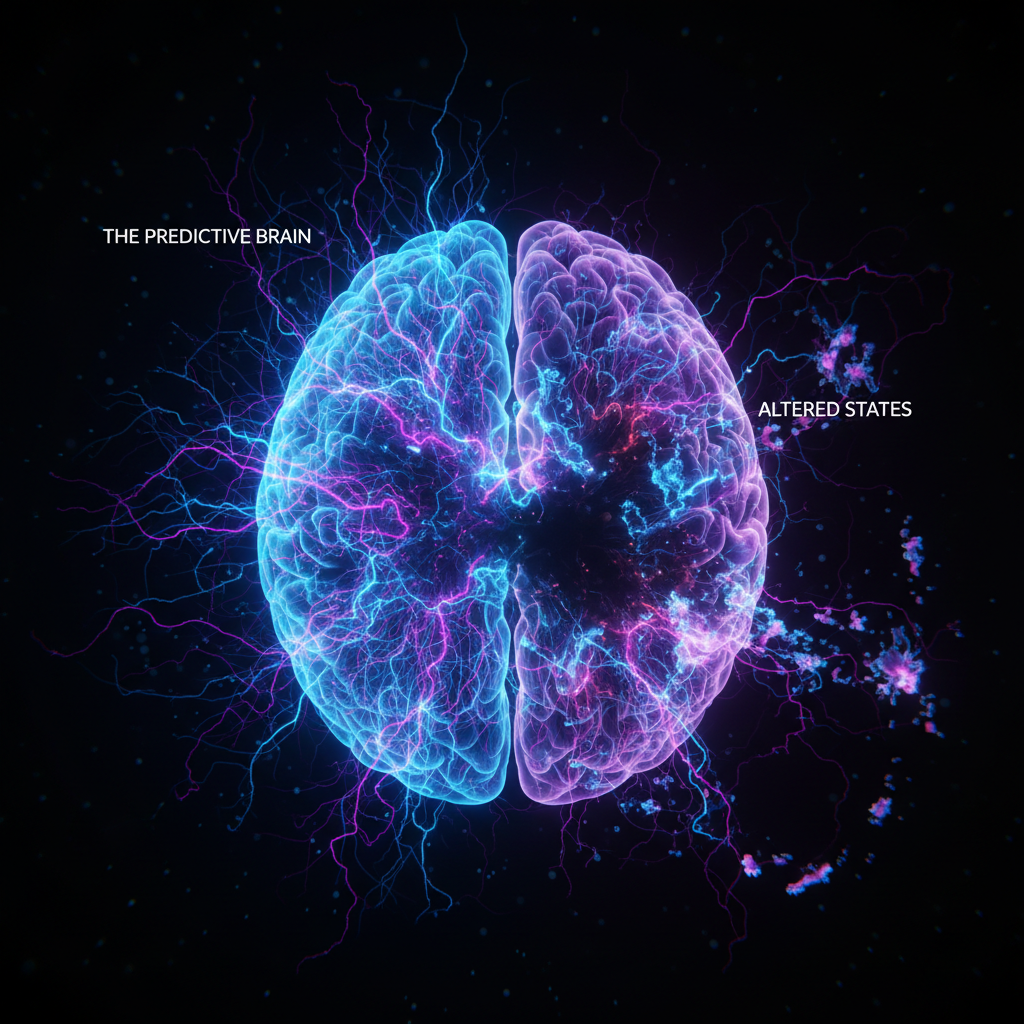
The brain, according to the predictive processing (PP) framework, is not a passive receiver of sensory data. It is a hierarchical generative model — a system that perpetually forecasts its own inputs and updates those forecasts only when they are wrong. Developed and formalized through the work of Karl Friston, Andy Clark, Jakob Hohwy, and others building on earlier Helmholtzian ideas, PP proposes that every level of the cortical hierarchy sends top-down predictions downward while receiving bottom-up prediction errors upward. Perception, in this view, is controlled hallucination: the best guess the brain can make, continuously revised against incoming evidence.
This framework has proven extraordinarily productive for understanding ordinary cognition — attention, learning, motor control, interoception. But its most radical implications emerge when the machinery breaks down, is chemically disrupted, or is deliberately perturbed. Altered states of consciousness — induced by psychedelics, anesthesia, meditation, sleep deprivation, or pathological processes — become, under PP, natural experiments in generative-model dynamics. They expose, in sharp relief, which parameters of the prediction machine are doing the heavy lifting in constructing the felt sense of a stable, unified self embedded in a coherent world.
Precision Weighting: The Master Dial
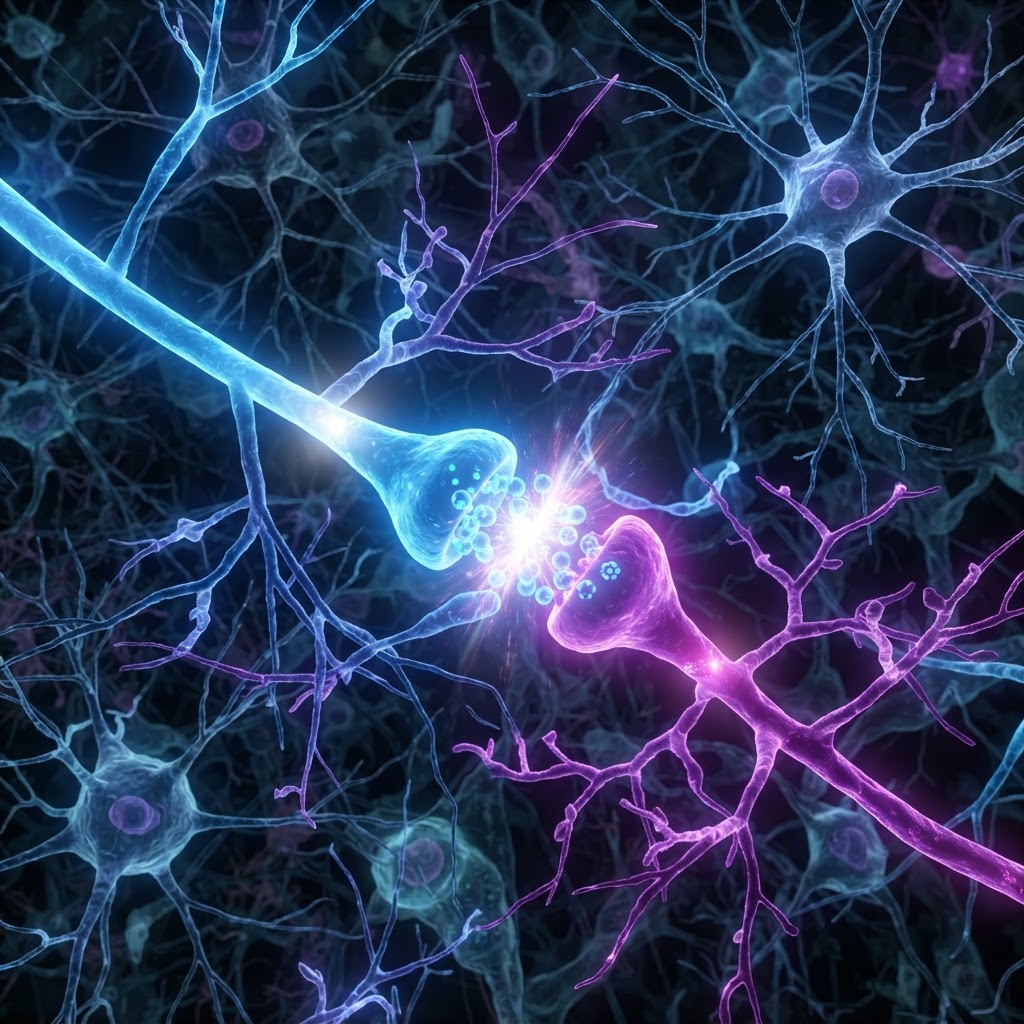
At the heart of PP lies a concept that is frequently underappreciated in popular treatments: precision weighting. Prediction errors are not treated equally. The brain assigns each error signal a precision — an estimate of its reliability or inverse variance — that determines how much it updates the generative model. High-precision errors trigger strong updates; low-precision errors are effectively suppressed. This weighting is implemented, at a neurobiological level, largely through neuromodulatory systems: dopamine, acetylcholine, norepinephrine, and serotonin all modulate the gain on prediction error signals in distinct ways and at distinct levels of the cortical hierarchy.
This is not a minor implementation detail. It is the mechanism through which altered states operate. When precision weighting is systematically shifted — either globally or at specific hierarchical levels — the generative model's behavior changes dramatically. The predictions that normally dominate perception become either too rigid (as in psychosis) or too malleable (as in certain psychedelic states). The balance between prior beliefs and incoming sensory evidence is recalibrated, sometimes catastrophically, sometimes therapeutically.
Psychedelics: Turning Up the Noise
Classical serotonergic psychedelics — psilocybin, LSD, DMT, mescaline — act primarily as agonists at 5-HT₂A receptors, which are densely expressed on layer V pyramidal neurons in the prefrontal and association cortices. These are precisely the neurons that generate top-down predictions in the PP hierarchy. Robin Carhart-Harris and colleagues have formalized this in the REBUS model (Relaxed Beliefs Under Psychedelics, 2019), proposing that 5-HT₂A agonism flattens the energy landscape of the generative model — it reduces the precision assigned to high-level priors, effectively making the top-down predictions less authoritative.
The empirical signature is striking. Neuroimaging studies using fMRI show that psychedelics increase entropy in neural signals — measured as Lempel-Ziv complexity, permutation entropy, and related metrics — by 15–30% in some datasets. Default Mode Network (DMN) functional connectivity, normally the substrate of self-referential narrative processing, is dramatically disrupted. MEG studies reveal a flattening of the power spectral exponent, consistent with reduced top-down suppression of high-frequency sensory signals. Subjectively, this maps onto the loosening of conceptual boundaries, ego dissolution, and the overwhelming vividness of raw percepts — sensation that feels unmediated by expectation because, in a precise computational sense, it is.
Critically, the therapeutic window for psychedelics in depression and PTSD may be mechanistically explained here. Pathologically rigid priors — the stuck, ruminative self-models of depression, the hyperactive threat-prediction of PTSD — are transiently relaxed, creating a window of heightened plasticity during which new predictive models can be formed. Early fMRI evidence from the Johns Hopkins and Imperial College groups shows that the magnitude of acute DMN disruption correlates with both the depth of mystical experience and long-term antidepressant effect, a dose-response relationship that is mechanistically coherent under REBUS.
Anesthesia and the Collapsing Hierarchy
If psychedelics represent a targeted loosening of high-level priors, general anesthesia represents something more total: the collapse of hierarchical message-passing itself. Anesthetic agents — propofol, ketamine, sevoflurane — act through diverse molecular targets (GABA-A potentiation, NMDA antagonism, HCN channel modulation), yet converge on a common systems-level effect: the disruption of long-range corticothalamic and corticocortical communication.
Giulio Tononi's Integrated Information Theory (IIT) and the PP framework make overlapping, though not identical, predictions here. Under PP, loss of consciousness occurs when the thalamocortical loop — the physiological substrate of the prediction-error cycle — can no longer sustain coherent hierarchical inference. EEG studies consistently show that propofol anesthesia produces a breakdown in cortical effective connectivity, specifically abolishing the feedback (top-down) component of evoked responses while leaving feedforward (bottom-up) components partially intact. This feedforward-without-feedback signature, quantified using Transcranial Magnetic Stimulation combined with EEG (TMS-EEG) by Massimini and colleagues, has emerged as one of the most reliable neural correlates of unconsciousness across agents and patient populations.
Ketamine presents a fascinating dissociation. At sub-anesthetic doses, it produces dissociative altered states — depersonalization, derealization, out-of-body experiences — while preserving wakefulness. As an NMDA antagonist, ketamine disrupts the synaptic machinery through which precision-weighted prediction errors are computed and transmitted. The result is a partial decoupling of self-model from sensory input — the generative model continues running, but without adequate grounding in real-time sensory evidence, producing a felt sense of unreality that is phenomenologically distinct from both normal waking and deep anesthesia.
Meditation, Flow, and the Voluntary Modulation of Priors
Not all altered states are pharmacological. Advanced contemplative practices — particularly open monitoring meditation and certain absorption states (jhānas) — appear to produce systematic shifts in PP dynamics through top-down, voluntary means. Neurophenomenological research, including EEG and fMRI studies of experienced meditators, consistently shows reduced DMN activity during practice, increased frontal gamma oscillations, and altered thalamocortical coherence patterns. Under PP, these findings suggest a trained capacity to voluntarily de-weight high-level self-referential priors without pharmacological intervention.
The jhāna states, in particular, are associated with reports of radical perceptual simplification — reduced sensory richness but heightened clarity — that may correspond to a different PP regime than psychedelics: rather than flattening priors globally, meditation may progressively narrow the generative model's scope, reducing the complexity of what is being predicted and thereby reducing prediction error more efficiently. This is speculative but theoretically tractable, and represents an important frontier for empirical investigation.
Flow states — the phenomenology of effortless, absorbed performance — may represent yet another regime: one in which the precision of task-relevant predictions is maximally tuned and the metabolic overhead of self-monitoring is suppressed, producing the characteristic sense of self-effacement and temporal distortion. Computational modeling of flow using active inference frameworks is in early stages but shows promise.
Open Questions and the Limits of the Framework
The predictive processing account of altered states is compelling but not without significant unresolved tensions. Several deserve explicit acknowledgment:
- The hard problem persists. PP explains the functional architecture of consciousness and its perturbations with impressive coherence. It does not explain why any of this should be accompanied by subjective experience. Friston's active inference framework gestures toward a resolution through the concept of self-evidencing systems, but this remains philosophically contested.
- Directionality of 5-HT₂A effects is complex. REBUS predicts that psychedelics should uniformly reduce the influence of high-level priors. But some phenomenological reports — and some neural data — suggest that psychedelics can also amplify certain prior-driven processes (set and setting effects, paranoid ideation, mystical archetypes). The precision-weighting account needs refinement to handle the heterogeneity of psychedelic phenomenology.
- Individual differences are poorly modeled. Identical doses of identical compounds produce radically different experiences across individuals. PP-based models have not yet provided a rigorous account of how baseline generative model parameters — shaped by personality, trauma history, prior beliefs — determine the trajectory of an altered state.
- Measurement gaps. Precision weighting is a theoretical construct. Its direct neurobiological operationalization remains contested. The field lacks validated biomarkers that cleanly index the relative influence of top-down versus bottom-up signals in vivo in humans.
The predictive processing framework has given neuroscience of consciousness a lingua franca — a common computational vocabulary that spans pharmacology, phenomenology, and systems neuroscience. Altered states are its most rigorous testing ground. The coming decade, combining high-density EEG, computational psychiatry methods, and the expanding clinical landscape of psychedelic medicine, will determine whether the framework's predictions hold under systematic empirical pressure — or whether the brain, as ever, has stranger things in store than any model can anticipate.