In a clearing near Rhinelander, Wisconsin, a forest spent eleven years breathing air that did not belong to this century.
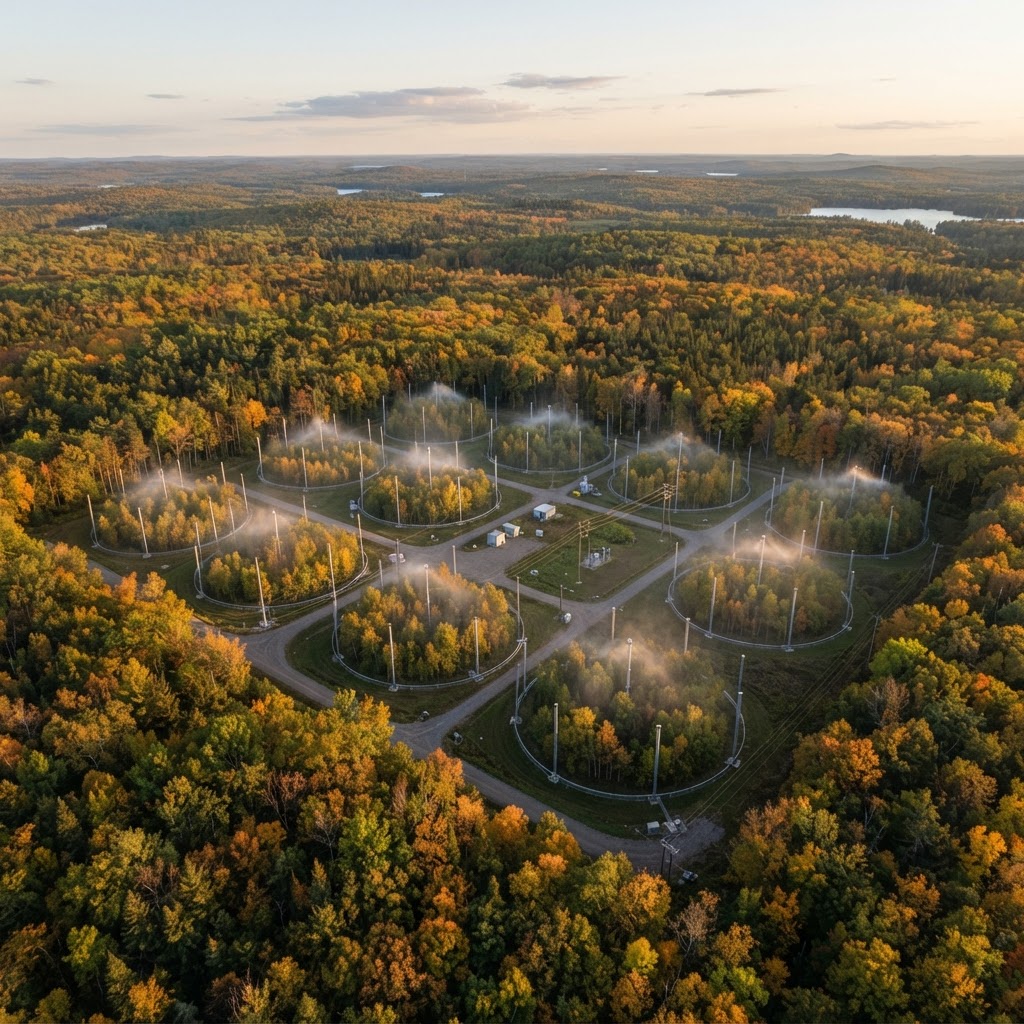
Around it stood twelve rings of vertical pipes, thirty meters across, quietly releasing carbon dioxide and ozone into the canopy at concentrations the planet will not reach globally for decades. A computer adjusted the flow every second, holding the gases steady while wind, rain, and seasons moved through the trees as they always had. There were no walls, no greenhouse glass — just open sky and a forest growing up inside an atmosphere of the future.
By the time the experiment ended, the trees had gone from knee-high seedlings to a young forest, and scientists had one of the longest, most detailed records ever gathered of how a living ecosystem responds when you change the very air it breathes.
The Experiment That Rebuilt the Atmosphere
The project was called Aspen-FACE — Free-Air Carbon dioxide Enrichment — and it ran from 1998 to 2009 on the Harshaw Experimental Forest, a USDA Forest Service site in northern Wisconsin. Funded by the U.S. Department of Energy, it brought together Michigan Technological University, the USDA Forest Service, Brookhaven National Laboratory, the University of Michigan, and a dozen other institutions into one of the most ambitious open-air climate experiments ever built.
The design was deceptively simple. Twelve circular plots, each thirty meters in diameter, were surrounded by vertical ventpipes. A feedback system sampled the air and adjusted gas release every second to hold elevated CO₂, elevated ozone (O₃), both together, or neither — all under open sky, with no enclosure to distort temperature, light, wind, or rainfall. The goal was to expose a real forest to the atmosphere it is forecast to inherit, without the artifacts of a laboratory.
Because there was no confinement, there was no significant change in the natural, ambient environment other than elevating these trace gas concentrations.
Inside those rings grew three communities meant to represent the northern temperate forest: pure trembling aspen (Populus tremuloides), aspen mixed with paper birch (Betula papyrifera), and aspen mixed with sugar maple (Acer saccharum). Aspen was chosen because it is one of the most widespread and commercially important trees in North America — and one of the most sensitive to air quality. The rings held different genetic clones of aspen, letting researchers separate the effects of atmosphere from the effects of lineage.
For eleven growing seasons, the forest did what forests do: it photosynthesized, respired, shed leaves, grew wood, built roots, and cycled nitrogen through soil and canopy. The only thing that was different was the air.
What Eleven Years of Extra CO₂ Did
When Alan Talhelm and colleagues finally harvested and sampled the forest at the end of the experiment — measuring every tree, root, and soil horizon they could reach — the carbon dioxide story was unambiguous.
Over the full eleven years, elevated CO₂ increased cumulative net primary productivity by 39%. Net primary productivity, or NPP, is the amount of biomass an ecosystem produces after subtracting the carbon the plants burn just to stay alive. It is, in effect, the forest's net income — the surplus that becomes wood, roots, leaves, and stored carbon.
The gain was not spread evenly across the ecosystem. Trees accounted for roughly 95% of the cumulative productivity measured, and the boost showed up most clearly in the woody parts — stems, branches, and coarse roots — the carbon that persists longest after a growing season ends. Total ecosystem carbon content rose by 11% under elevated CO₂, with the increase concentrated in tree biomass and the near-surface mineral soil.
Crucially, the response did not fade over time. Many short-term CO₂ studies show an initial growth spurt that diminishes as the ecosystem adjusts — nutrients get locked up, acclimation sets in, and the "fertilization" effect decays. At Aspen-FACE, the productivity response held across more than a decade, from seedlings to a closed canopy. The forest did not simply spike and settle; it sustained.
The nitrogen engine
Why did the boost persist? The answer lay partly in nitrogen. Elevated CO₂ increased canopy nitrogen content by 28% and nitrogen productivity — the amount of growth per unit of nitrogen — by 28% as well. In other words, the trees were not just photosynthesizing more; they were using their most limiting nutrient more efficiently, drawing more nitrogen into the canopy and turning it into more wood per gram.
This matters because nitrogen is the brake on most terrestrial carbon uptake. If rising CO₂ only stimulated photosynthesis while nitrogen stayed fixed, the gain would be short-lived. Aspen-FACE showed that, at least in this young northern forest, the nitrogen system flexed with the carbon system — the trees built a larger, more productive canopy and sustained it for over a decade.
What Ozone Did — Quietly, and Differently
Ground-level ozone is not a greenhouse gas in the popular sense, but it is a pollutant that warms the climate and damages living tissue. It forms when sunlight reacts with nitrogen oxides and volatile organic compounds — the exhaust of cars, power plants, and industry — and it is toxic to plants. Where CO₂ feeds photosynthesis, ozone disrupts it.
Over the same eleven years, elevated ozone reduced cumulative net primary productivity by 10%. It cut canopy nitrogen by 21% and lowered total ecosystem carbon by 9%. The damage was real, but it was not uniform.
The researchers found that ozone's negative effect on productivity became smaller as the forest developed. A young, exposed canopy is vulnerable; a mature, closed canopy appears to buffer some of the damage, perhaps by shading the most sensitive tissues or by diluting ozone's impact across more biomass. This is a rare piece of good news inside an otherwise grim result: forests may grow into a degree of resilience that saplings do not have.
When the Two Gases Met
The central question of the experiment was not just what CO₂ does, or what ozone does, but what happens when both rise together — which is, after all, the actual trajectory of the real atmosphere.
The headline finding was counterintuitive. Although CO₂ added 39% and ozone subtracted 10%, the study found no statistically significant interaction between the two treatments for cumulative productivity. The gases did not cancel each other in some neat arithmetic; they pulled in opposite directions, and the combined result was closer to a tug-of-war than a simple sum.
But for carbon storage, the combined picture was stark. Under elevated CO₂ and ozone together, total ecosystem carbon was not significantly different from the ambient control. The storage gain from CO₂ — the 11% increase — effectively vanished when ozone was present. The forest still grew faster, but it did not bank the extra carbon into long-term storage the way it did when the air was clean.
CO₂ encouraged productivity, while ozone limited growth and complicated the forest's carbon response. The forest was not a passive sink — its response depended on the full atmospheric cocktail.
This is the result that should make climate modelers pause. Models that treat rising CO₂ as a straightforward fertilizer, and that ignore the pollutants riding alongside it, may overstate how much carbon forests will actually pull out of the atmosphere in the coming decades.
From Twelve Rings to a Whole Landscape
A twelve-ring experiment in Wisconsin is a powerful instrument, but it is still twelve rings in Wisconsin. The harder question is whether those findings scale — whether what happened in a 30-meter circle holds across millions of hectares of mixed forest, with fire, drought, succession, and competition all running at once.
In 2020, Eric Gustafson and colleagues at the USDA Forest Service took up exactly that question. Using the forest landscape model LANDIS-II with a physiology-based extension called PnET-Succession, they scaled the Aspen-FACE results to whole landscapes, letting CO₂, ozone, temperature, precipitation, and disturbance interact across simulated forests over long time horizons.
Their findings sharpened the story. CO₂ was the dominant driver of landscape response — the single factor that mattered most to how much biomass the landscape carried. Disturbance — fire, wind, harvest — ran a close second. Ozone was not the dominant force, but its negative effect on mean landscape biomass was still statistically significant. You could not simply ignore it.
Two subtler results emerged. Species diversity decreased slightly under elevated CO₂ — the faster-growing species pulled ahead and crowded others out — but increased slightly under ozone, which knocked back the dominants and let less competitive species persist. And the hope that rising CO₂ would substantially relieve water stress, helping forests through drought, found only weak support. CO₂ mitigation of water stress, at least in this landscape, did not translate into major changes in composition or biomass.
Why This Matters Beyond Wisconsin
The temptation is to read Aspen-FACE as a local study about a patch of Wisconsin woodland. It is not. It is one of the cleanest tests we have of a question that sits underneath nearly every climate projection: how much carbon will the world's forests absorb as the atmosphere changes?
Earth system models that feed into policy assume a substantial land carbon sink — forests and soils soaking up roughly a quarter of human emissions each year. That assumption depends on forests continuing to respond to rising CO₂ the way they have in short experiments. Aspen-FACE is the evidence that, at least for one well-studied forest type, the response can hold for more than a decade. It is also the evidence that the response is conditional — on nitrogen, on ozone, on species mix, on forest age.
The study also closes a loop on the "missing carbon" question that motivated the experiment in the first place. Global carbon models have long struggled to account for where a portion of human emissions end up — the residual that is not in the atmosphere or the ocean. Aspen-FACE helped show that young, productive temperate forests, fertilized by the very CO₂ we emit, are one of the places that missing carbon is going. But it showed just as clearly that the sink is fragile, and that the pollutants we emit alongside the CO₂ can quietly claw back the gain.
The Open Questions
Aspen-FACE ended in 2009, and the original trees were harvested. A successor study, the Northern Forest Ecosystem Experiment, let a new forest sprout under the same treatments before they were discontinued. But the deepest questions the experiment raised remain open.
Will the 39% productivity boost hold in older forests, where the nitrogen cycle is tighter and the canopy is already closed? Will tropical and boreal forests — which face very different soils, temperatures, and ozone profiles — respond the same way? And as background ozone rises in the fast-industrializing tropics even as it declines in parts of North America and Europe, which forests will win the tug-of-war, and which will lose it?
There is also the matter of time. Eleven years is a long experiment, but a forest's carbon budget plays out over centuries. The carbon stored in wood at Aspen-FACE is still there, in the soil and the stems, but whether it stays there — through decay, fire, harvest, or the next disturbance — is a question no single experiment can answer.
What Aspen-FACE did was something more modest and more durable: it took the atmosphere apart, gave a forest the version of it that is coming, and watched, for longer than anyone had before, what happened. The forest grew faster in the CO₂-rich air. It grew slower in the ozone-rich air. And when both rose together, the carbon it managed to store was, in the end, almost the same as if the air had never changed at all.
The lesson is not that forests will not help. It is that they will help on their own terms — and that those terms include every gas we put into the sky, not just the one we talk about most.
Companion Coverage — Two Sides of the Carbon Coin
This piece is the natural counterpart to our earlier analysis, The Hidden Power Bill of Air-Capture. Read together, they bracket the single question underneath every climate projection: how much carbon will the world pull out of the sky, and at what cost?
Aspen-FACE measures the cost of the sink nature already runs. The forest is a carbon-removal machine powered by sunlight and nutrients — but its throughput is capped not by the CO₂ itself, which feeds it, but by the ozone we emit alongside the CO₂, which starves it. The bottleneck is atmospheric chemistry.
Direct air capture measures the cost of the sink we would have to build. The machine is a carbon-removal system powered by electricity and heat — but its throughput is capped not by the chemistry, which works, but by the energy required to run it. The bottleneck is thermodynamics.
Both pieces arrive at the same uncomfortable conclusion from opposite directions. The forest's gain can be erased by a pollutant we barely discuss; the machine's scale can be capped by an energy bill we have not agreed to pay. Any honest carbon budget has to price in both hidden costs — the ozone that caps the forest, and the power that caps the machine — before assuming the atmosphere will take care of itself.